
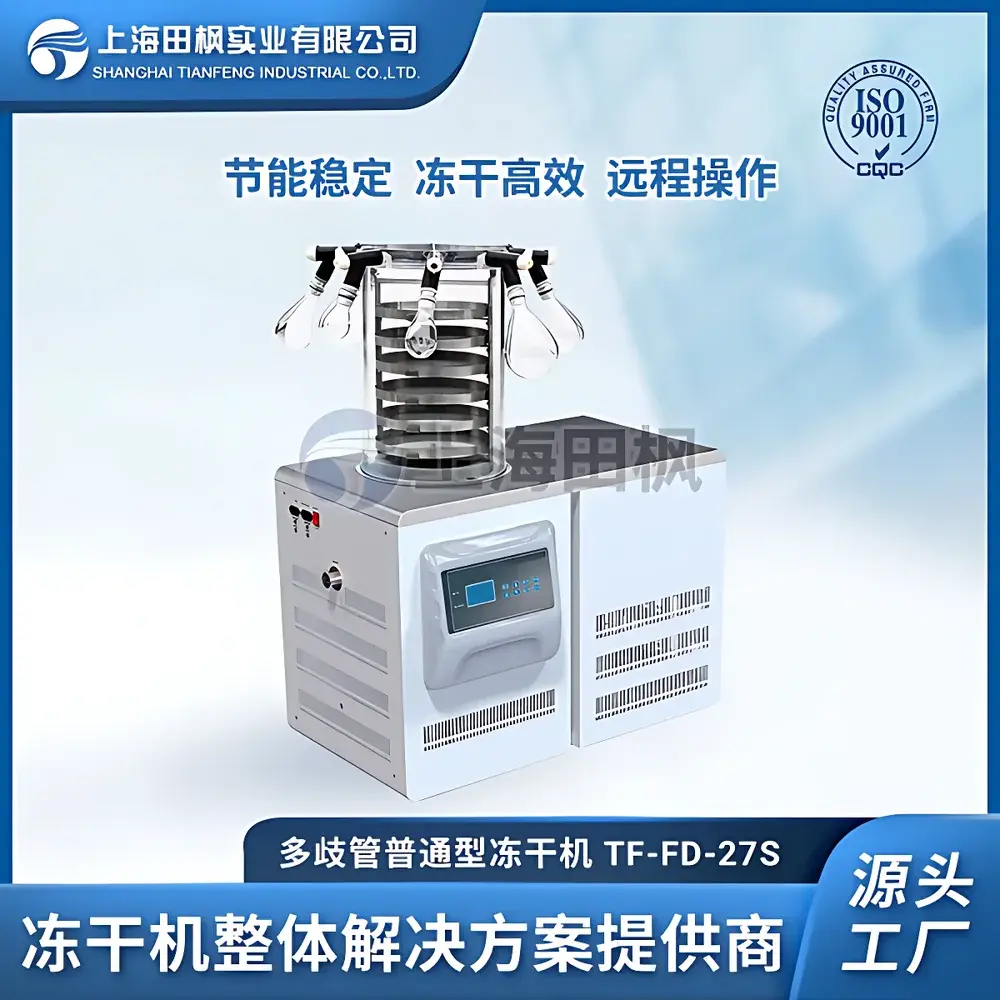
Tianfeng TF-FD-27S Multi-Manifold Freeze Dryer
| Brand | Tianfeng |
|---|---|
| Origin | Shanghai, China |
| Manufacturer Type | Direct Manufacturer |
| Instrument Type | Multi-Manifold Freeze Dryer |
| Application | Laboratory-Scale Lyophilization |
| Shelf Area | 0.27 m² |
| Ultimate Vacuum | <15 Pa (at idle) |
| Condenser Temperature | <-80 °C |
| Ice Capacity | 6 kg/24 h |
| Power Supply | 220 V, 50 Hz |
| Rated Power | 2200 W |
| Dimensions (H×W×D, excl. drying chamber) | 1200 × 550 × 870 mm |
| Sample Tray | Φ240 mm × 6 shelves |
| Manifold Ports | 8 × standard ports (compatible with 50 mL, 100 mL, 250 mL, 500 mL, and 1000 mL flasks) |
Overview
The Tianfeng TF-FD-27S Multi-Manifold Freeze Dryer is a laboratory-grade lyophilization system engineered for high-fidelity preservation of thermolabile biological and pharmaceutical materials. It operates on the fundamental principle of sublimation—removing water from frozen samples under deep vacuum without passing through the liquid phase. This process preserves structural integrity, enzymatic activity, immunogenicity, and molecular conformation far more effectively than conventional dehydration methods. The unit employs a dual-stage cascade refrigeration system to achieve condenser temperatures below –80 °C, enabling efficient capture of volatile solvents—including low-boiling-point organics such as acetone, ethanol, or ethyl acetate—commonly used in formulation development. Its multi-manifold configuration supports parallel processing of up to eight independently sealed flasks, making it ideal for comparative stability studies, excipient screening, and small-batch lyophilization where sample isolation and cross-contamination prevention are critical.
Key Features
- Stainless steel 304 construction throughout the condenser chamber, manifold, and internal components—ensuring corrosion resistance, cleanability, and compliance with GLP/GMP hygiene requirements.
- High-transparency acrylic drying chamber with integrated observation window—enabling real-time visual monitoring of ice formation, sublimation front progression, and cake morphology evolution.
- Programmable touch-screen HMI with PID-controlled shelf temperature regulation—supporting customizable freeze-drying cycles, including controlled pre-freezing, primary drying ramping, and secondary drying hold steps.
- Integrated data logging capability—recording condenser temperature, chamber pressure, shelf temperature, and time-stamped process events; exportable in CSV format for audit-ready documentation.
- Optional inert gas backfill valve (N₂ or argon)—allowing controlled reconstitution atmosphere management to prevent oxidation of sensitive biologics during chamber venting.
- Modular manifold design with standardized O-ring-sealed ports—compatible with common laboratory glassware (50–1000 mL round-bottom flasks), eliminating the need for specialized vials during exploratory lyophilization.
- Low-noise, high-efficiency compressors with refrigerant charge optimization—designed for continuous 24-hour operation while maintaining thermal stability and minimizing mechanical drift.
Sample Compatibility & Compliance
The TF-FD-27S accommodates a broad spectrum of sample formats and compositions. Its –80 °C condenser and 6 kg/24 h ice capacity support not only aqueous buffers but also formulations containing ≤15% (v/v) organic co-solvents—critical for lyophilizing monoclonal antibodies, plasmid DNA, lipid nanoparticles, and small-molecule APIs with poor aqueous solubility. The system meets key international standards relevant to laboratory-scale lyophilization: it operates within the vacuum range specified in ISO 29241 (freeze-drying equipment performance testing), supports validation protocols aligned with USP (Lyophilization Process Validation), and provides traceable process data compatible with FDA 21 CFR Part 11 requirements when paired with optional electronic signature-enabled software. All wetted surfaces conform to ASTM A240 standards for 304 stainless steel, ensuring extractables and leachables profiles suitable for preclinical and early-phase manufacturing environments.
Software & Data Management
The embedded control system records time-synchronized parameters at user-defined intervals (1–60 seconds), generating comprehensive freeze-drying curves for shelf temperature, condenser temperature, and chamber pressure. Real-time humidity trend visualization—derived from pressure rise tests (PRT)—assists operators in determining endpoint detection for primary drying. Data files include metadata headers (operator ID, batch number, cycle version) and are stored locally on internal flash memory with USB export functionality. Optional upgrade paths include Ethernet connectivity for integration into centralized LIMS or MES platforms, and configurable alarm thresholds with email/SMS notification via Modbus TCP or SNMP protocols. Audit trails retain all parameter modifications, user logins, and cycle start/stop events—fully compliant with ALCOA+ principles for data integrity.
Applications
- Stabilization of heat-labile biologics: vaccines (e.g., mRNA-LNP formulations), recombinant proteins, enzymes, and diagnostic antibodies.
- Pre-formulation studies: screening of cryoprotectants (trehalose, sucrose), bulking agents (mannitol, dextran), and pH modifiers under varied freezing rates and annealing conditions.
- Microbial culture preservation: long-term storage of bacterial, fungal, and yeast strains without loss of viability or phenotypic fidelity.
- Phytochemical and natural product research: lyophilization of plant extracts, essential oils, and polyphenol-rich fractions while minimizing thermal degradation.
- Academic and contract research: method development for GMP-aligned processes, including cycle optimization, scale-down modeling, and container-closure integrity assessment.
FAQ
What is the maximum flask size supported by the manifold?
The system accommodates standard ground-glass joint flasks up to 1000 mL per port, with eight ports available for simultaneous operation.
Can the condenser be used for pre-freezing samples?
Yes—the condenser serves as an auxiliary pre-freezing surface; samples in flasks may be cooled directly on the condenser plate prior to manifold connection, eliminating the need for external ultra-low temperature freezers.
Is the system suitable for lyophilizing samples containing acetonitrile or methanol?
With its –80 °C condenser and optimized refrigerant circuit, the TF-FD-27S achieves >95% solvent capture efficiency for acetonitrile, methanol, and other low-boiling organics when used within recommended concentration limits (≤10% v/v).
Does the unit support validation documentation packages?
Yes—factory-installed IQ/OQ documentation templates are provided, including calibration certificates for all critical sensors (PT100 shelf and condenser probes, capacitance manometer), leak test reports, and performance qualification protocols aligned with ISO 13485 and EU Annex 15 guidelines.
What maintenance intervals are recommended?
Compressor oil and refrigerant levels should be verified annually; vacuum pump oil must be changed every 500 operating hours or quarterly—whichever occurs first—using ISO VG 100 synthetic oil compliant with DIN 51506 VB.



