
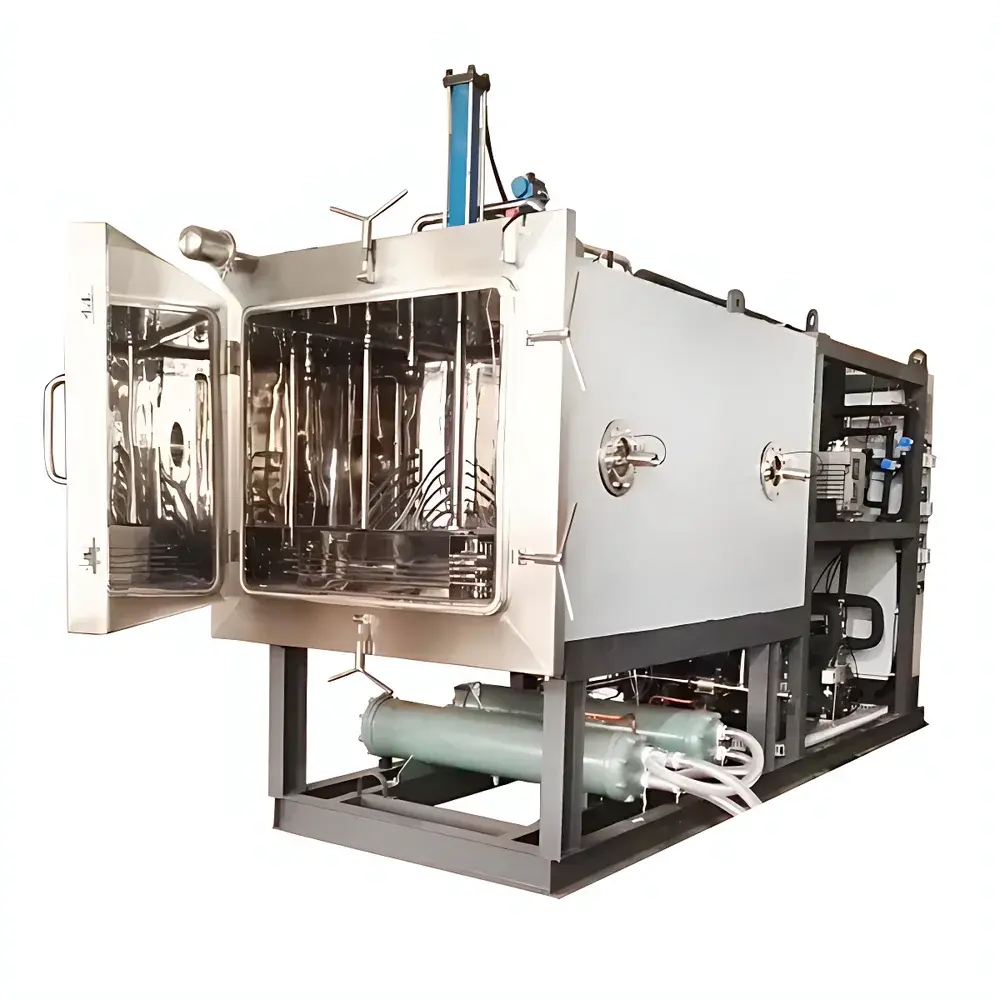
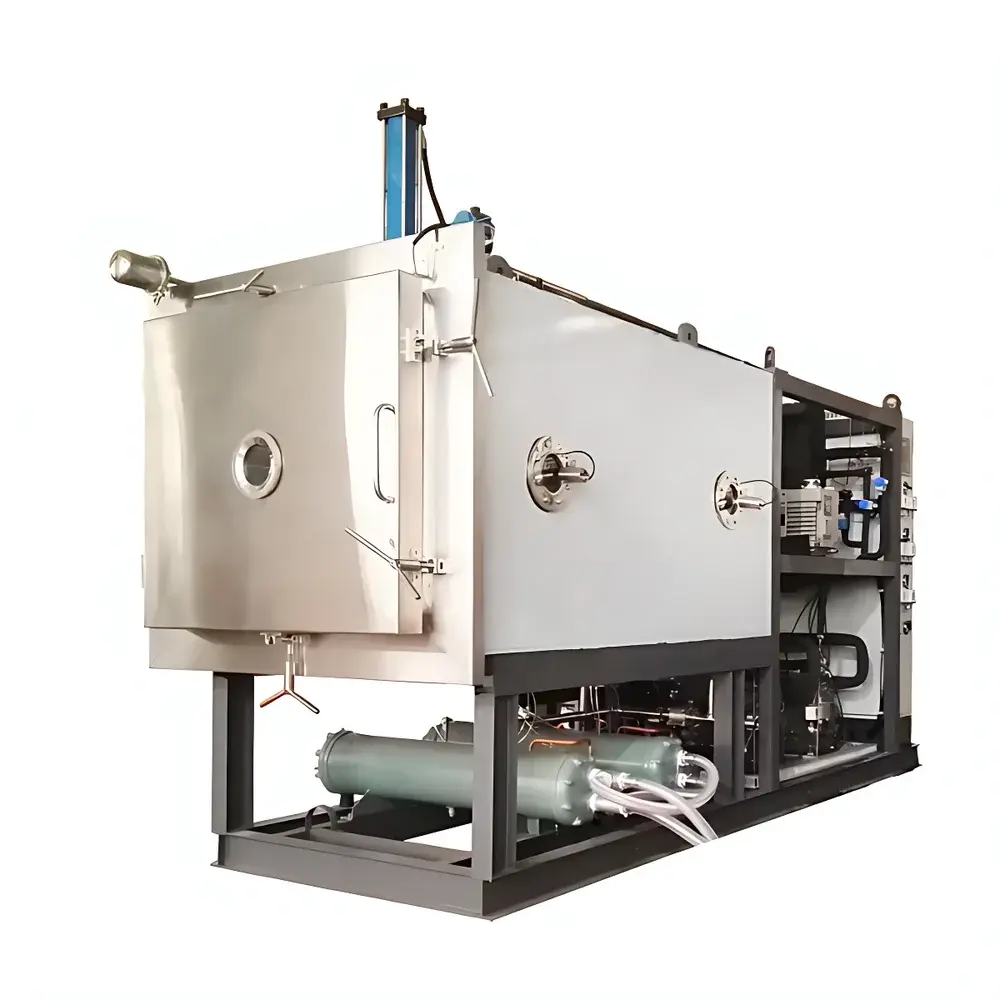
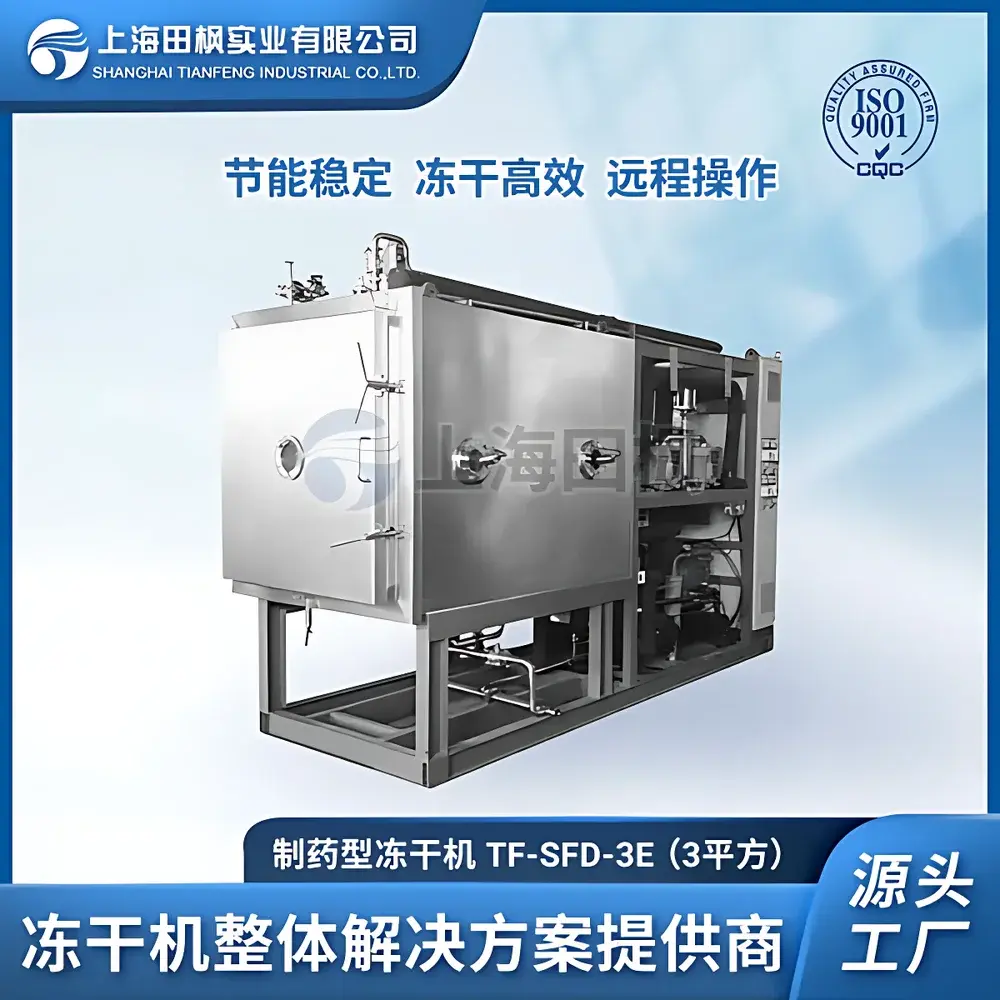
Tianfeng TF-SFD-3E Benchtop Production-Scale Freeze Dryer with Stoppering Function
| Brand | Tianfeng |
|---|---|
| Origin | Shanghai, China |
| Manufacturer Type | Direct Manufacturer |
| Equipment Type | In-situ Freeze Dryer with Hydraulic Stoppering |
| Application Scope | Pilot & Small-Batch Production |
| Shelf Area | 3 m² |
| Ultimate Vacuum | 2.7 Pa |
| Condenser Capacity (24 h) | 65 kg |
| Condenser Temperature | −75 °C |
| Overall Dimensions (L×W×H) | 3700 × 1800 × 3000 mm |
Overview
The Tianfeng TF-SFD-3E is an in-situ, production-scale freeze dryer engineered for reproducible lyophilization of heat-sensitive biopharmaceuticals, diagnostic reagents, and functional food matrices—including yogurt-based snack blocks—under controlled, GMP-aligned conditions. It operates on the fundamental principle of sublimation: aqueous samples are first uniformly frozen at −75 °C on temperature-controlled stainless-steel shelves; under high vacuum (≤2.7 Pa), ice transitions directly from solid to vapor without passing through the liquid phase, preserving structural integrity, biological activity, and chemical stability. Unlike tray-dryers requiring manual transfer, the TF-SFD-3E integrates primary freezing, primary drying, secondary drying, and hydraulic stoppering within a single chamber—eliminating contamination risk, minimizing operator intervention, and ensuring batch-to-batch consistency. Its design complies with core engineering requirements for pharmaceutical process validation: uniform shelf temperature distribution (±1 °C via silicone oil heating/cooling), low system leak rate (≤0.1 Pa·m³/s), and full traceability-ready architecture.
Key Features
- In-situ pre-freezing and drying: Eliminates sample handling between freezing and drying stages, reducing microbial and particulate contamination risks.
- Hydraulic stoppering mechanism: Enables sterile, automated vial sealing under vacuum or inert gas (N₂/Ar) atmosphere—critical for parenteral dosage forms and aseptic R&D workflows.
- 5+1 stainless-steel 304 shelves (615 × 915 mm each, 100 mm spacing): Provide 3 m² total lyophilization area; flat, rigid geometry ensures mechanical stability and ease of cleaning.
- Double-stage cascade refrigeration system: Achieves condenser temperature of −75 °C with high cooling capacity and low acoustic emission—optimized for rapid ice nucleation and efficient vapor capture.
- 7-inch industrial-grade touch HMI: Displays real-time shelf temperature, chamber pressure, condenser temperature, and time–temperature–pressure profiles; supports PID-controlled ramp/soak programming and data export (CSV/USB).
- Silicone oil thermal medium: Ensures ±1 °C shelf temperature uniformity across all positions—essential for validating drying kinetics and residual moisture distribution.
- Reinforced viewing door: High-transparency, colorless acrylic viewport allows continuous visual monitoring of cake formation, collapse events, and desiccation progress without breaking vacuum.
- Optional accessories: Co-located eutectic point measurement probe, 21 CFR Part 11-compliant data logger (with audit trail and user access control), and inert gas purge valve for oxygen-sensitive formulations.
Sample Compatibility & Compliance
The TF-SFD-3E accommodates diverse sample formats: bulk solutions (up to 60 L), serum vials (Φ16 mm: 13,300 units; Φ22 mm: 6,800 units), and irregular-shaped food matrices such as yogurt slabs or fruit puree sheets. Its 304 stainless-steel interior meets FDA-recommended surface finish standards (Ra ≤ 0.8 µm) and supports CIP/SIP protocols. While not certified to ISO 13485 out-of-the-box, its architecture supports qualification per IQ/OQ/PQ frameworks aligned with ICH Q5C, USP , and EU Annex 1 requirements for aseptic processing. The system’s vacuum integrity (leak rate ≤0.1 Pa·m³/s) satisfies ASTM F2096 for container closure integrity testing (CCIT) readiness.
Software & Data Management
Embedded firmware records all critical process parameters at configurable intervals (1–60 s). Data logs include timestamped shelf temperature setpoints and actuals, chamber pressure (capacitance manometer), condenser temperature, and elapsed cycle time. Exported CSV files are compatible with JMP, MATLAB, and PAT (Process Analytical Technology) platforms for multivariate analysis of drying endpoints. Optional compliant software adds electronic signatures, role-based user permissions, and 21 CFR Part 11 audit trails—including immutable record of parameter changes, operator ID, and session timestamps—facilitating GLP/GMP audits and regulatory submissions.
Applications
- Biopharmaceutical development: Lyophilization of monoclonal antibodies, recombinant proteins, and mRNA-LNP formulations where conformational stability dictates efficacy.
- Vaccine manufacturing: Stabilization of live-attenuated and subunit vaccines without excipient-induced aggregation.
- Diagnostic reagents: Preservation of enzyme conjugates, antigen-coated microspheres, and lateral flow assay components.
- Functional food R&D: Production of probiotic-enriched yogurt crisps, berry powders, and infant nutrition blends—retaining volatile aromatics, live cultures, and antioxidant activity.
- Tissue banking: Long-term storage of corneal grafts, skin substitutes, and decellularized scaffolds with preserved extracellular matrix architecture.
FAQ
What is the maximum batch size supported by the TF-SFD-3E?
The unit supports up to 60 L of bulk solution or approximately 13,300 standard 10 mL serum vials (Φ16 mm), corresponding to a total shelf loading of 3 m².
Does the system support controlled ice nucleation?
No—ice nucleation occurs passively during shelf cooling; however, optional eutectic point detection enables precise determination of optimal nucleation temperature for formulation-specific cycle development.
Can the TF-SFD-3E be integrated into a cleanroom environment?
Yes—the unit is designed for Class D (ISO 8) environments; optional HEPA-filtered air purge and external exhaust ducting support ISO 5 (Class A) laminar flow hood integration.
Is remote monitoring available?
Standard Ethernet port enables local network access for real-time parameter viewing; third-party SCADA integration (Modbus TCP) is supported upon request.
What maintenance intervals are recommended?
Vacuum pump oil change every 500 operating hours; condenser coil inspection quarterly; silicone oil replacement every 3 years or per OEM specification—documented in the included maintenance logbook.



