
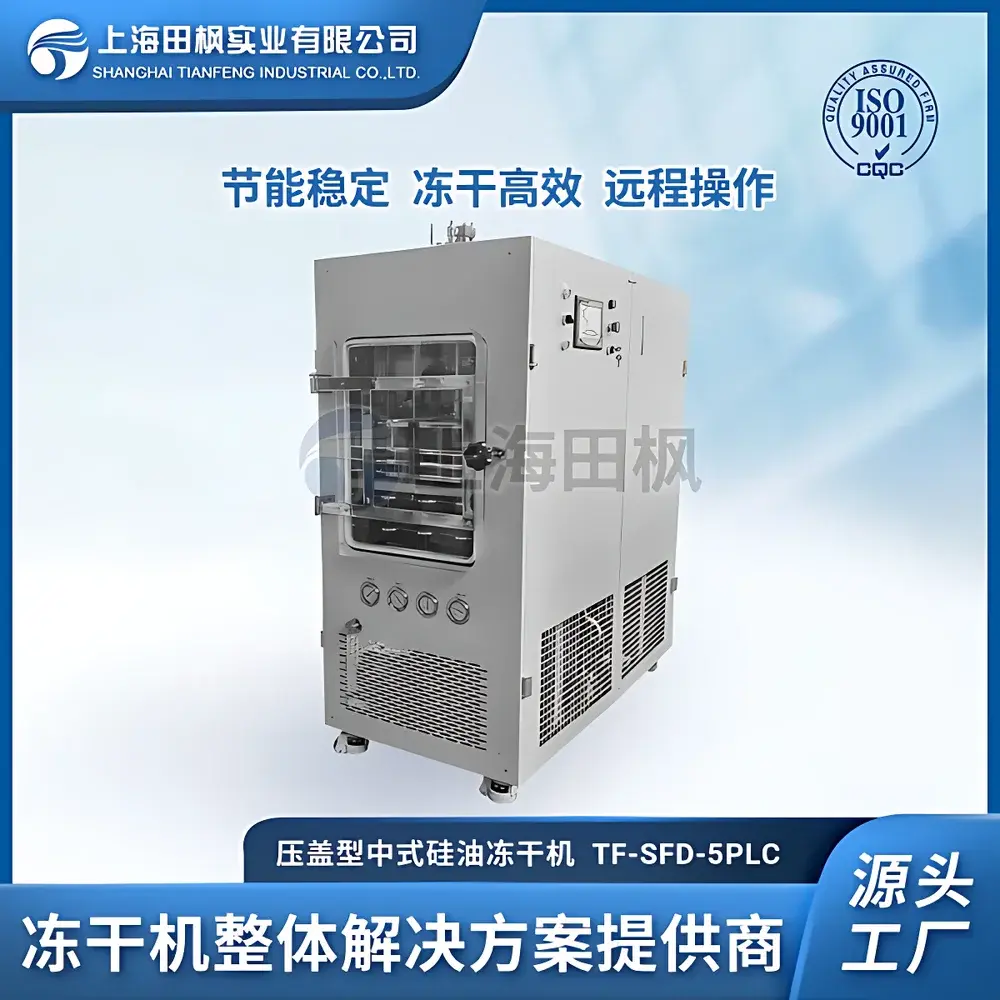
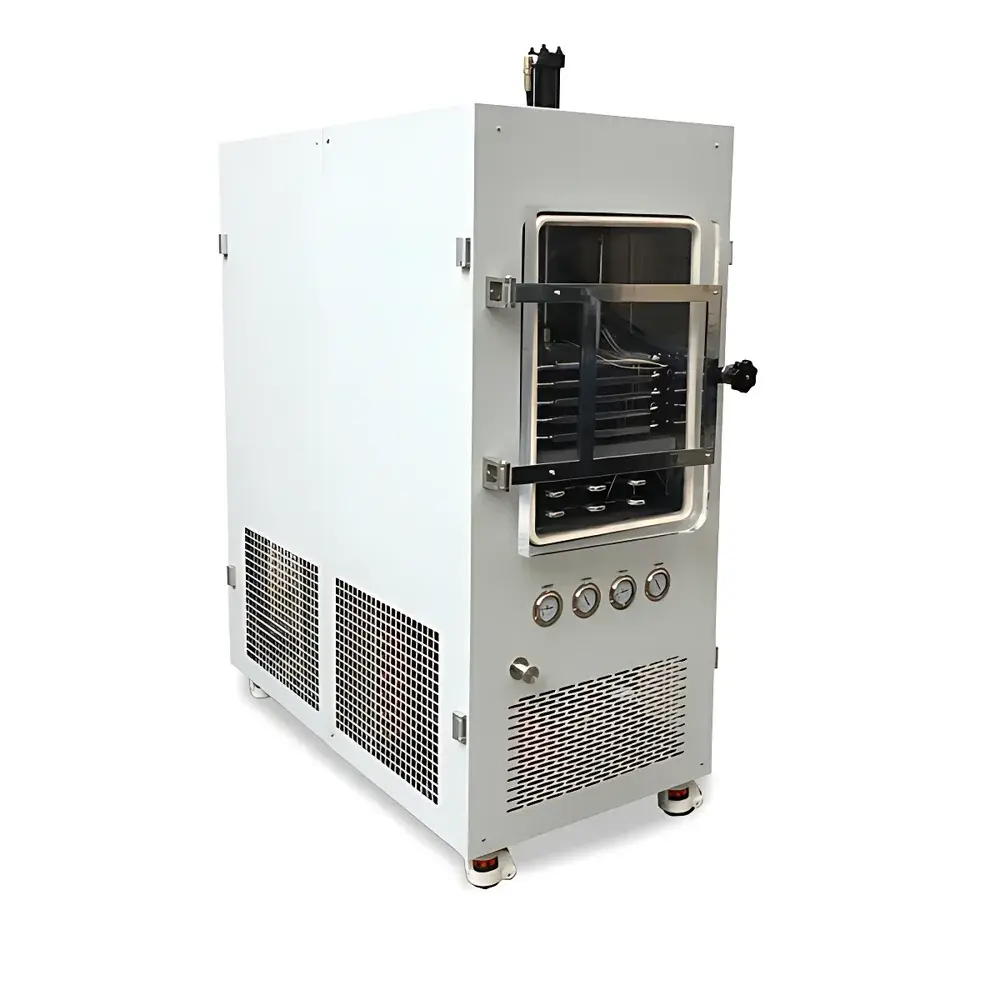
Tianfeng SFD-5 Pilot-Scale Lyophilizer with Hydraulic Stoppering System
| Brand | Tianfeng |
|---|---|
| Origin | Shanghai, China |
| Manufacturer Type | Direct Manufacturer |
| Region Classification | Domestic (China) |
| Model | SFD-5 |
| Instrument Type | In-situ Freeze Dryer with Hydraulic Stoppering |
| Application Scope | Pilot-Scale Processing |
| Shelf Area | 0.5 m² |
| Ultimate Vacuum | ≤5 Pa |
| Condenser Capacity | 8 kg/24 h |
| Condenser Temperature | ≤−70 °C |
| Main Unit Dimensions (W×D×H) | 800×800×800 mm |
| Shelf Temperature Range | −50 to +80 °C |
| Shelf Uniformity | ≤±1 °C |
| Control System | PLC with 7-inch Touchscreen Interface |
| Programmable Cycles | 5 stored protocols, up to 24 segments per cycle |
| Data Logging | Real-time vacuum & shelf temperature curves, full audit trail, operation history |
| Optional Features | In-situ eutectic point detection, inert gas backfilling valve (N₂ or Ar), transparent acrylic chamber door |
Overview
The Tianfeng SFD-5 is a pilot-scale, in-situ freeze dryer engineered for reproducible, scalable lyophilization of heat-sensitive biopharmaceuticals, probiotics (e.g., Lactobacillus strains), diagnostic reagents, and biological intermediates. It operates on the fundamental principle of sublimation under controlled low-pressure and cryogenic conditions: aqueous samples are first frozen uniformly on temperature-regulated shelves, then subjected to primary drying (ice sublimation) and secondary drying (adsorbed water desorption) under vacuum (≤5 Pa). This preserves structural integrity, bioactivity, and reconstitution fidelity—critical for live bacterial cultures, monoclonal antibodies, enzymes, and sterile injectables. Unlike conventional thermal drying methods, lyophilization avoids degradation pathways associated with elevated temperatures (>0 °C), oxidation, or shear stress, enabling long-term ambient storage stability without refrigeration.
Key Features
- In-situ pre-freezing and drying within a single chamber eliminates manual transfer, minimizing contamination risk and process variability.
- Silicone oil-heated shelves provide precise, uniform temperature control (±1 °C across 0.5 m² surface), ensuring consistent cake morphology and residual moisture distribution.
- Four adjustable shelves (plus one fixed bottom plate), each 278 mm wide × 460 mm long, spaced 70 mm apart—optimized for standard vial formats (Φ16 mm: up to 2,112 units/batch; Φ20 mm: up to 1,056 units/batch).
- High-efficiency condenser operating at ≤−70 °C achieves rapid vapor capture (8 kg/24 h capacity), reducing cycle time and improving batch throughput.
- Hydraulic stoppering mechanism enables sterile, automated vial sealing under vacuum or inert gas (N₂/Ar), supporting aseptic processing compliance.
- PLC-based control system with 7-inch HMI touchscreen supports up to five user-defined protocols, each configurable with 24 independent time–temperature–vacuum segments.
- Comprehensive data logging includes real-time shelf temperature, chamber pressure, condenser temperature, and elapsed time—exportable via USB for regulatory review.
- Transparent acrylic chamber door allows continuous visual monitoring of product appearance, ice formation, and drying front progression without vacuum break.
- Robust stainless-steel construction (316L contact surfaces optional), integrated leak-check function, and password-protected operator access align with GMP design principles.
Sample Compatibility & Compliance
The SFD-5 accommodates diverse sample matrices including microbial suspensions (e.g., lactic acid bacteria cultures), protein formulations, vaccine candidates, serum-based diagnostics, and herbal extracts. Its design supports lyophilization of aqueous solutions ranging from 1–8 L total volume per batch. The system meets foundational requirements for ISO 22000, ISO 9001, and GLP-compliant environments. While not inherently 21 CFR Part 11 validated, its audit-trail-capable software architecture facilitates qualification (IQ/OQ/PQ) and supports traceability for FDA, EMA, and NMPA submissions. Optional eutectic point detection aids in rational cycle development per ICH Q5C and Ph. Eur. 2.9.40 guidelines.
Software & Data Management
The embedded control software records all critical process parameters at user-configurable intervals (default: 10 s), generating timestamped CSV files with full metadata (operator ID, protocol name, batch ID, start/stop time). All parameter modifications during active runs are logged with reason codes. Data export requires physical USB media—no network connectivity is implemented, enhancing cybersecurity and preventing unauthorized remote access. Audit trails include login/logout events, alarm acknowledgments, and emergency stop triggers—fully compliant with ALCOA+ (Attributable, Legible, Contemporaneous, Original, Accurate, Complete, Consistent, Enduring, Available) data integrity standards.
Applications
- Biopharmaceutical Development: Stabilization of monoclonal antibodies, recombinant proteins, and viral vectors during preclinical and phase I–II manufacturing.
- Probiotic Formulation: Preservation of viable Lactobacillus, Bifidobacterium, and Streptococcus thermophilus without cryoprotectant-induced osmotic shock.
- Vaccine Production: Lyophilization of live-attenuated vaccines (e.g., measles, varicella) and adjuvanted subunit antigens.
- Diagnostic Reagents: Long-term stabilization of enzyme-linked immunosorbent assay (ELISA) kits, PCR master mixes, and lateral flow conjugates.
- Natural Product Processing: Dehydration of traditional Chinese medicine extracts (e.g., ginseng, cordyceps) while retaining glycoside and polysaccharide bioactivity.
- Research Use: Cryopreservation of cell lines, tissue scaffolds, and extracellular vesicles for regenerative medicine studies.
FAQ
What is the maximum batch capacity for 2R vials (Φ16 mm)?
Up to 2,112 vials per batch, assuming standard 2R geometry and 5 mm fill depth.
Does the system support validation documentation packages?
Yes—Tianfeng provides IQ/OQ templates, FAT/SAT reports, and calibration certificates traceable to NIST standards upon request.
Can shelf temperature be ramped linearly or held isothermally during primary drying?
Both modes are supported: programmable ramp rates (°C/min) and dwell times per segment allow precise control over ice interface velocity and mass transfer resistance.
Is the condenser defrost cycle automated?
Yes—manual or scheduled automatic defrost with condensate drainage port; cycle duration and temperature setpoints are fully configurable.
What electrical supply is required for stable operation?
3-phase 380 V ±10%, 50 Hz, 4.5 kW connected load; dedicated grounding and voltage stabilization recommended for uninterrupted operation.



