
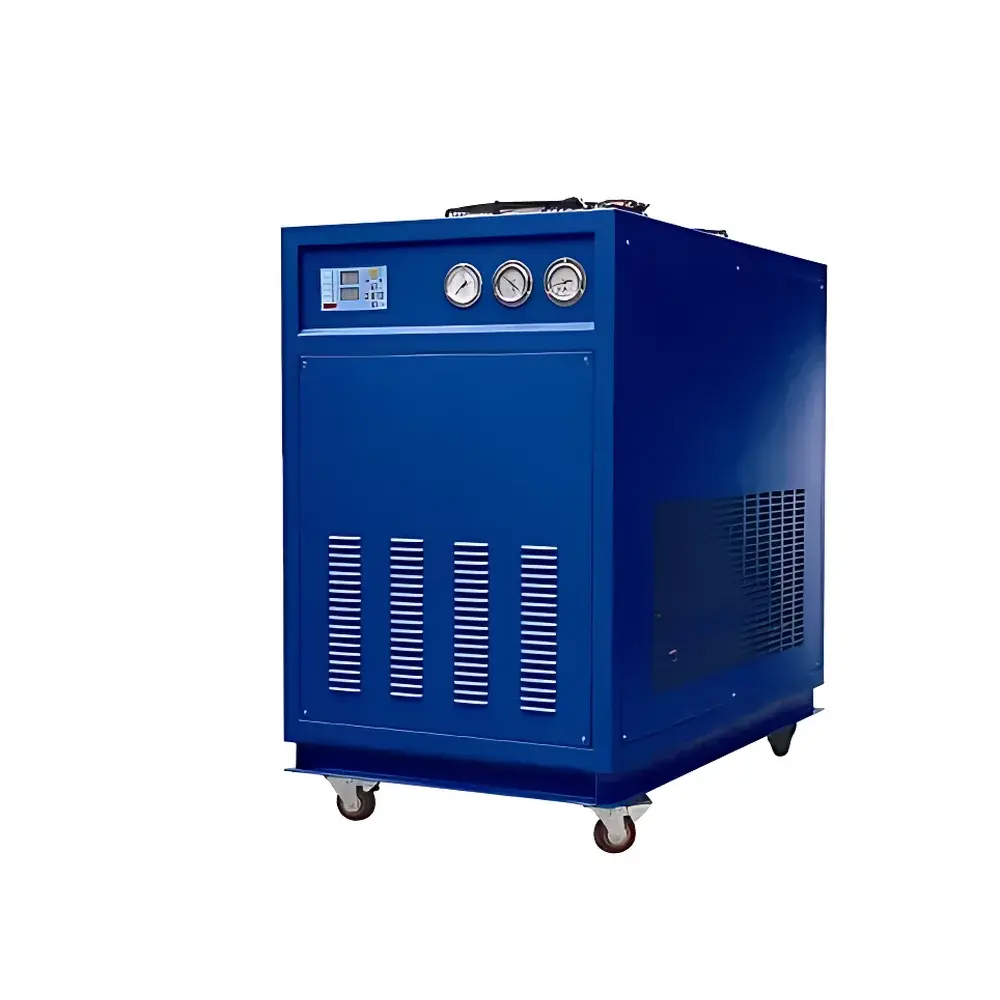
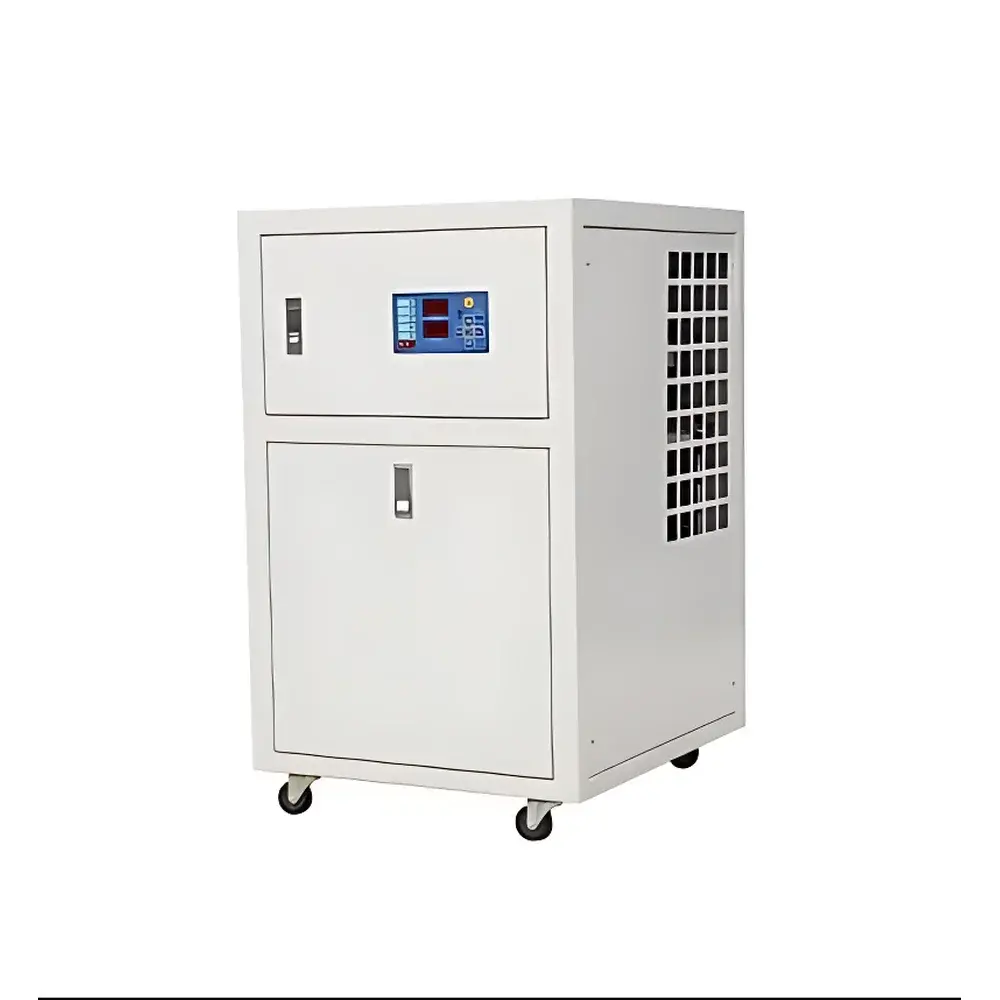
Tianfeng LS-23000W Integrated Screw-Type Circulating Chiller
| Brand | Tianfeng |
|---|---|
| Origin | Shanghai, China |
| Manufacturer Type | Direct Manufacturer |
| Instrument Type | Integrated Circulating Chiller |
| Cooling Method | Water-Cooled |
| Temperature Control Range | 0–10 °C |
| Cooling Capacity | 23 kW |
| Temperature Stability | ±0.1 °C |
| Circulating Pump Pressure | 2.0 bar |
| Circulating Flow Rate | 2 L/min |
| Reservoir Volume | 200 L |
| Operation Mode | Continuous Duty |
Overview
The Tianfeng LS-23000W Integrated Screw-Type Circulating Chiller is an industrial-grade, water-cooled temperature control system engineered for high-reliability thermal management of precision laboratory and analytical instrumentation. It operates on the principle of vapor-compression refrigeration, utilizing a twin-screw rotary compressor to deliver stable, continuous cooling across a tightly controlled range of 0–10 °C. Unlike scroll or piston compressors, the screw-type architecture provides superior volumetric efficiency, reduced mechanical wear, and extended service life under sustained load—critical for uninterrupted operation in demanding applications such as plasma spectrometry, electron microscopy, and X-ray diffraction systems. The chiller’s integrated design eliminates external condenser piping and minimizes footprint, while its stainless-steel reservoir and pump ensure corrosion resistance and compatibility with deionized or inhibited coolant solutions commonly used in sensitive instrumentation loops.
Key Features
- High-efficiency twin-screw rotary compressor (European-sourced) for consistent 23 kW cooling output at 7/12 °C chilled water inlet/outlet conditions
- Precision PID temperature control with ±0.1 °C stability over full operating range (0–10 °C), digitally displayed via industrial-grade controller (standard Chinese OEM unit; optional RKC Japan model available)
- Stainless-steel 200 L reservoir and circulation pump rated for 2.0 bar pressure and 2 L/min flow—optimized for low-impedance instrument cooling loops
- Comprehensive safety architecture: high/low pressure cutouts, phase failure protection, flow loss detection, and overtemperature shutdown with fault signal output
- Continuous-duty operation certified per IEC 60034-1; ambient operating limit ≤35 °C dry-bulb with ≤8–10 °C condenser water ΔT
- Full compliance with CE electromagnetic compatibility (EMC) directives and RoHS material restrictions
Sample Compatibility & Compliance
This chiller is specifically engineered to interface with high-heat-load analytical platforms requiring stable, low-temperature coolant delivery—including graphite furnace atomic absorption spectrometers (GFAAS), inductively coupled plasma optical emission spectrometers (ICP-OES), inductively coupled plasma mass spectrometers (ICP-MS), X-ray fluorescence (XRF) and X-ray diffraction (XRD) systems, scanning electron microscopes (SEM), and transmission electron microscopes (TEM). Its flow and pressure characteristics meet the hydraulic requirements of OEM instrument cooling circuits specified in ASTM E1998 (Standard Guide for Selection of Chillers for Analytical Instruments) and ISO/IEC 17025:2017 Annex A.3 (thermal stability validation). All electrical components conform to UL 61010-1 and IEC 61010-1 safety standards for laboratory equipment. The unit is manufactured under ISO 9001:2015 quality management certification, with traceable component sourcing (e.g., Italian expansion valves, German solenoid valves, Siemens/Schneider/Omron control relays).
Software & Data Management
The LS-23000W features embedded logic for local setpoint adjustment, real-time temperature monitoring, and event logging of operational faults (e.g., low flow, high head pressure, sensor drift). While it does not include Ethernet or USB connectivity as standard, analog 4–20 mA output signals are provided for integration into centralized building management systems (BMS) or lab-wide SCADA networks. For regulated environments—including GLP, GMP, and FDA 21 CFR Part 11–compliant laboratories—the optional RKC controller supports audit-trail-enabled parameter logging, user-access level configuration, and electronic signature-capable operation. Calibration records for temperature sensors (PT100 class B) and pressure transducers are maintained per ISO/IEC 17025 requirements, with annual verification recommended using NIST-traceable reference standards.
Applications
- Materials Characterization: Thermal stabilization of XRD goniometers and SEM/TEM column cooling jackets to minimize thermal drift during long-duration acquisitions
- Elemental Analysis: Maintaining optimal plasma torch and detector temperatures in ICP-OES/ICP-MS systems to ensure spectral resolution and signal-to-noise ratio consistency
- Atomic Spectroscopy: Precise graphite furnace cooling in GFAAS to prevent memory effects and ensure reproducible atomization kinetics
- Vacuum Systems: Condenser cooling for vacuum coating and sputtering equipment where substrate temperature directly affects film morphology and adhesion
- Pharmaceutical QC: Controlled cooling of dissolution testers and HPLC column ovens per USP and method validation guidelines
FAQ
What is the maximum allowable return water temperature for safe operation?
The chiller is rated for continuous operation with return water temperatures up to 40 °C. Exceeding this threshold increases condensing pressure and accelerates compressor oil degradation—reducing MTBF and voiding warranty coverage.
Can this unit be integrated into a central plant cooling loop?
Yes. The water-cooled condenser accepts municipal or tower water within 30–40 °C inlet/outlet range. A dedicated isolation heat exchanger is recommended if primary loop water contains biocides or high mineral content.
Is remote monitoring supported out of the box?
Standard configuration includes dry-contact alarm outputs and 4–20 mA analog signals. Modbus RTU or Ethernet/IP communication modules are available as factory-installed options.
What maintenance intervals are recommended for laboratory use?
Condenser cleaning every 6 months; refrigerant circuit leak check annually; PT100 sensor calibration every 12 months using certified reference bath; full compressor oil analysis every 2 years under continuous duty.
Does the chiller comply with noise emission limits for Class A laboratory environments?
Yes. Measured sound pressure level is ≤68 dB(A) at 1 m distance—within ISO 7779 and ANSI S12.55 Class A limits for analytical instrument support spaces.



