
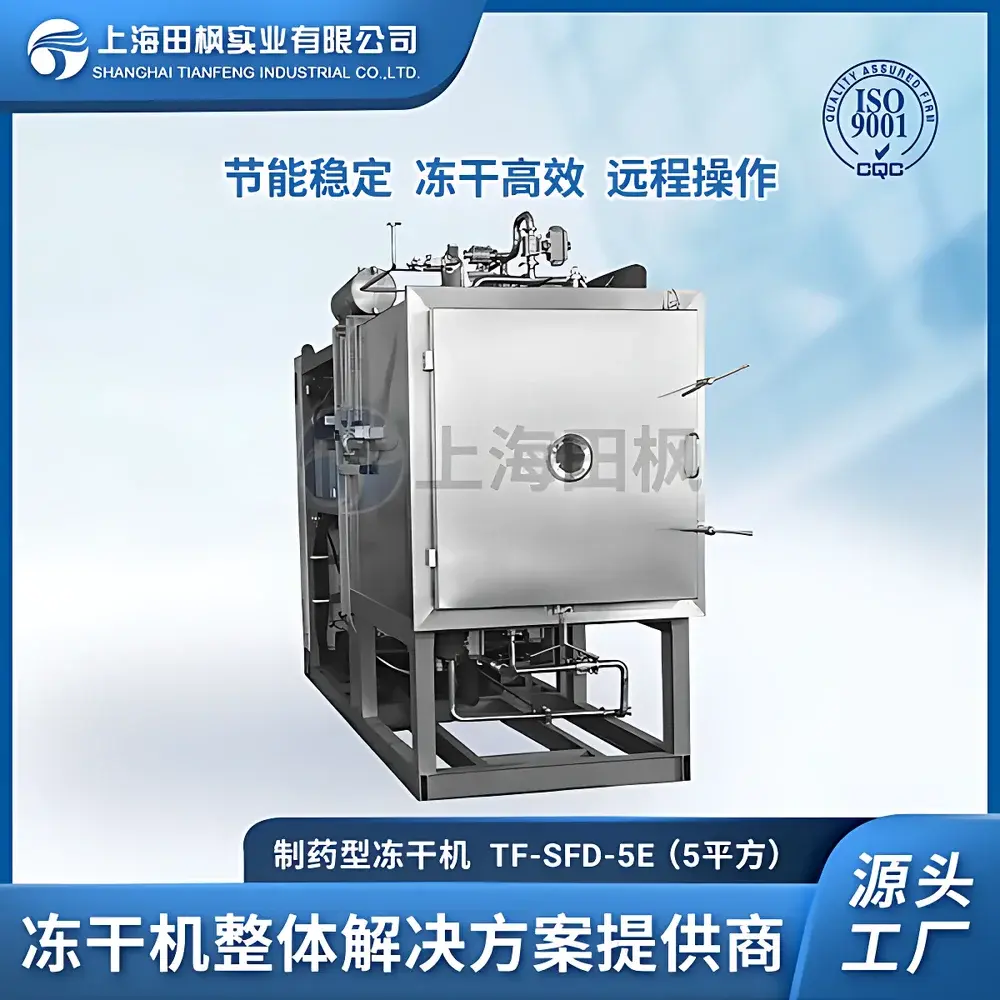
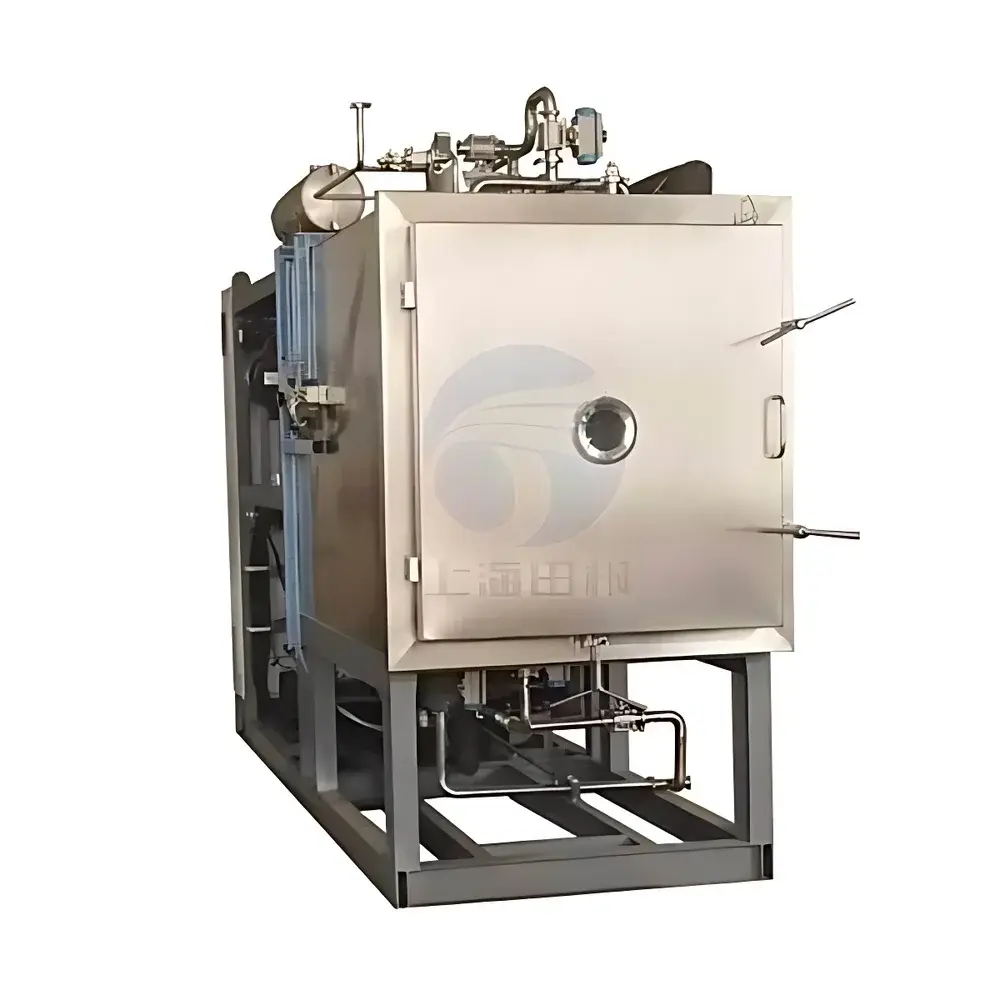
Tianfeng TF-SFD-5m² Pharmaceutical Freeze Dryer with Graphene-Compatible Chamber Design
| Brand | Tianfeng |
|---|---|
| Origin | Shanghai, China |
| Manufacturer Type | OEM/ODM Producer |
| Product Category | Domestic |
| Model | TF-SFD-5m² |
| Instrument Type | Standard Shelf-Type Production Freeze Dryer |
| Lyophilization Area | 5.5 m² |
| Ultimate Vacuum | 2.7 Pa |
| Condenser Temperature | −75 °C |
| Ice Capacity (24 h) | 105 kg |
| Chamber Dimensions (L×W×H) | 5.3 × 2.0 × 3.05 m |
| Shelf Configuration | 5+1 shelves |
| Shelf Spacing | 100 mm |
| Shelf Dimensions (W×D) | 915 × 1215 mm |
| Shelf Temp Range | −55 °C to +70 °C |
| Heating Power | 10 kW |
| Total Installed Power | 43 kW |
| System Leak Rate | ≤0.1 Pa·m³/s |
| Chamber Material | AISI 304 stainless steel |
| Compliance | cGMP, ISO 9001 certified |
| Qualification Support | Full 3Q documentation (IQ/OQ/PQ) available |
Overview
The Tianfeng TF-SFD-5m² Pharmaceutical Freeze Dryer is a fully integrated, cGMP-compliant production-scale lyophilization system engineered for the reliable, repeatable, and scalable freeze-drying of thermolabile pharmaceuticals, biologics, and advanced materials—including graphene-based dispersions and nanosuspensions. Operating on the fundamental principles of sublimation under deep vacuum and controlled heat transfer, this system removes water from frozen samples via primary drying (ice sublimation) followed by secondary drying (desorption of bound moisture), preserving structural integrity, biological activity, and chemical stability. Its design accommodates both batch processing of vials and bulk tray loading, making it suitable for preclinical formulation development, clinical trial material manufacturing, and commercial-scale production up to 5.5 m² shelf area. The chamber’s optimized geometry, seamless AISI 304 interior with electropolished welds and radius-free corners, ensures cleanability, minimizes microbial retention, and supports rigorous cleaning validation protocols required in regulated environments.
Key Features
- Robust stainless-steel chamber (AISI 304) with fully polished internal surfaces, zero-dead-leg welding, and rounded internal corners—designed for compliance with ASME BPE and EU Annex 1 surface finish requirements.
- Five actively temperature-controlled shelves plus one reference shelf, each fabricated via uniform thermal stress-relief annealing to ensure ±0.5 °C temperature uniformity across the full shelf surface—even at −55 °C.
- Low-viscosity silicone oil as heat transfer medium, enabling precise shelf temperature ramping and stable hold profiles from −55 °C to +70 °C with ≤±0.3 °C control accuracy.
- High-capacity condenser operating at −75 °C with 105 kg/24 h ice-trapping capacity, equipped with dual-stage cascade refrigeration and auto-defrost functionality to maintain vacuum integrity during extended cycles.
- PLC-based control architecture with HMI touchscreen interface, supporting recipe-driven operation, real-time data logging (≥1 Hz sampling), and full audit trail per FDA 21 CFR Part 11 requirements—including electronic signatures, user access levels, and change history.
- Integrated vacuum system featuring oil-free dry scroll pump and high-vacuum booster, achieving ultimate pressure ≤2.7 Pa with leak rate ≤0.1 Pa·m³/s—validated per ISO 20517 and ASTM F2698.
Sample Compatibility & Compliance
This freeze dryer accommodates diverse sample formats: standard serum vials (Φ16 mm, up to 24,800 units/batch; Φ22 mm, up to 12,700 units), trays for bulk solutions (up to 105 L), and specialized carriers for graphene oxide dispersions, liposomal suspensions, and protein-based therapeutics. Its chamber design allows for controlled nucleation and annealing steps critical for crystalline vs. amorphous matrix formation—essential for stabilizing nanomaterials and sensitive biologics. All wetted parts comply with USP Class VI and ISO 10993-5 cytotoxicity standards. The system is manufactured under ISO 9001:2015 quality management systems and conforms to current Good Manufacturing Practice (cGMP) guidelines outlined in FDA Guidance for Industry (2022), EMA CHMP Reflection Paper on Lyophilization (2021), and ICH Q5C stability requirements. Full 3Q qualification packages—including Installation Qualification (IQ), Operational Qualification (OQ), and Performance Qualification (PQ)—are provided upon request.
Software & Data Management
The embedded PLC control system runs proprietary lyoControl™ firmware, offering validated cycle development tools, multi-step ramp/hold programming, pressure rise test (PRT) analysis, and endpoint determination via product temperature monitoring (via calibrated Pt100 sensors embedded in shelf and product mock-ups). Data export is supported in CSV and PDF formats with time-stamped, tamper-evident records. Audit trails capture all operator actions, parameter changes, alarms, and system events with immutable timestamps. Optional integration with MES/SCADA platforms is supported via OPC UA and Modbus TCP protocols. Electronic records meet ALCOA+ principles (Attributable, Legible, Contemporaneous, Original, Accurate, Complete, Consistent, Enduring, Available) and are compatible with long-term archival in validated document management systems.
Applications
- Lyophilization of monoclonal antibodies, vaccines, and mRNA-LNP formulations requiring strict thermal history control.
- Stabilization of graphene quantum dots, reduced graphene oxide (rGO) colloids, and conductive nanocomposites without aggregation or oxidation.
- Processing of herbal extracts, botanical APIs, and probiotic powders where volatile terpenes and enzymatic activity must be preserved.
- cGMP-compliant manufacturing of sterile injectables (e.g., lyophilized antibiotics, oncology agents) in vial or dual-chamber syringe formats.
- Development of accelerated stability protocols per ICH Q1A(R3) using controlled shelf temperature mapping and dynamic vacuum profiling.
FAQ
Does this system support process analytical technology (PAT) integration?
Yes—equipped with analog/digital I/O ports and communication protocols (OPC UA, Modbus TCP) for seamless connection to NIR probes, tunable diode laser absorption spectroscopy (TDLAS) sensors, and manometric temperature measurement (MTM) systems.
Can the TF-SFD-5m² be qualified for FDA submission batches?
Absolutely—full 3Q documentation, including PQ executed with placebo and active-product cycles under worst-case load conditions, is provided and compliant with FDA guidance on Process Validation (2011) and EU Annex 15.
Is graphene dispersion compatibility verified experimentally?
Yes—validation studies conducted with aqueous GO dispersions (0.1–2 mg/mL) confirmed no nozzle clogging, uniform cake morphology, and retained colloidal stability post-reconstitution, attributable to low-turbulence chamber design and non-pulsating vacuum control.
What maintenance intervals are recommended for GMP operation?
Preventive maintenance is scheduled every 500 operational hours or annually—whichever occurs first—with documented calibration of temperature sensors, vacuum gauges, and pressure transducers traceable to NIST standards.
Is remote monitoring and troubleshooting supported?
Yes—optional secure VPN-enabled remote access allows authorized engineers to perform diagnostics, review historical trends, and assist with cycle optimization without compromising data integrity or network security.



