
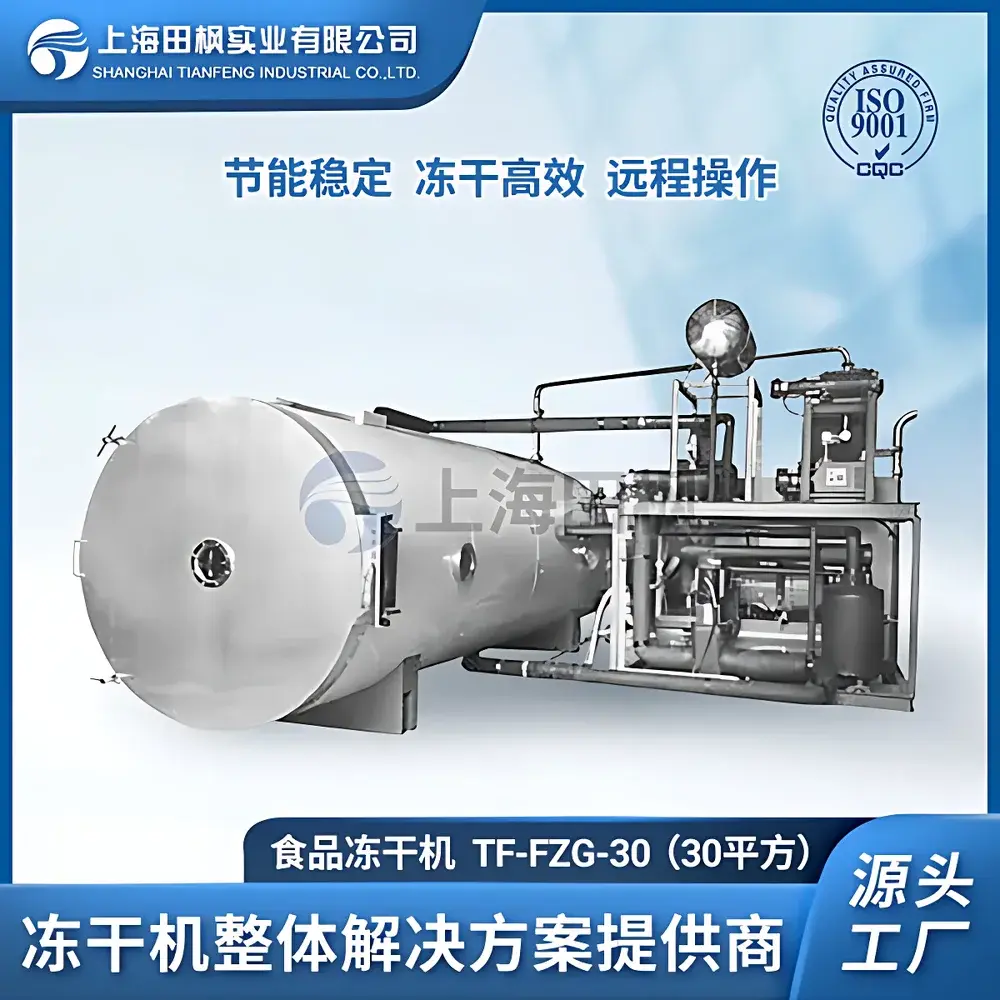
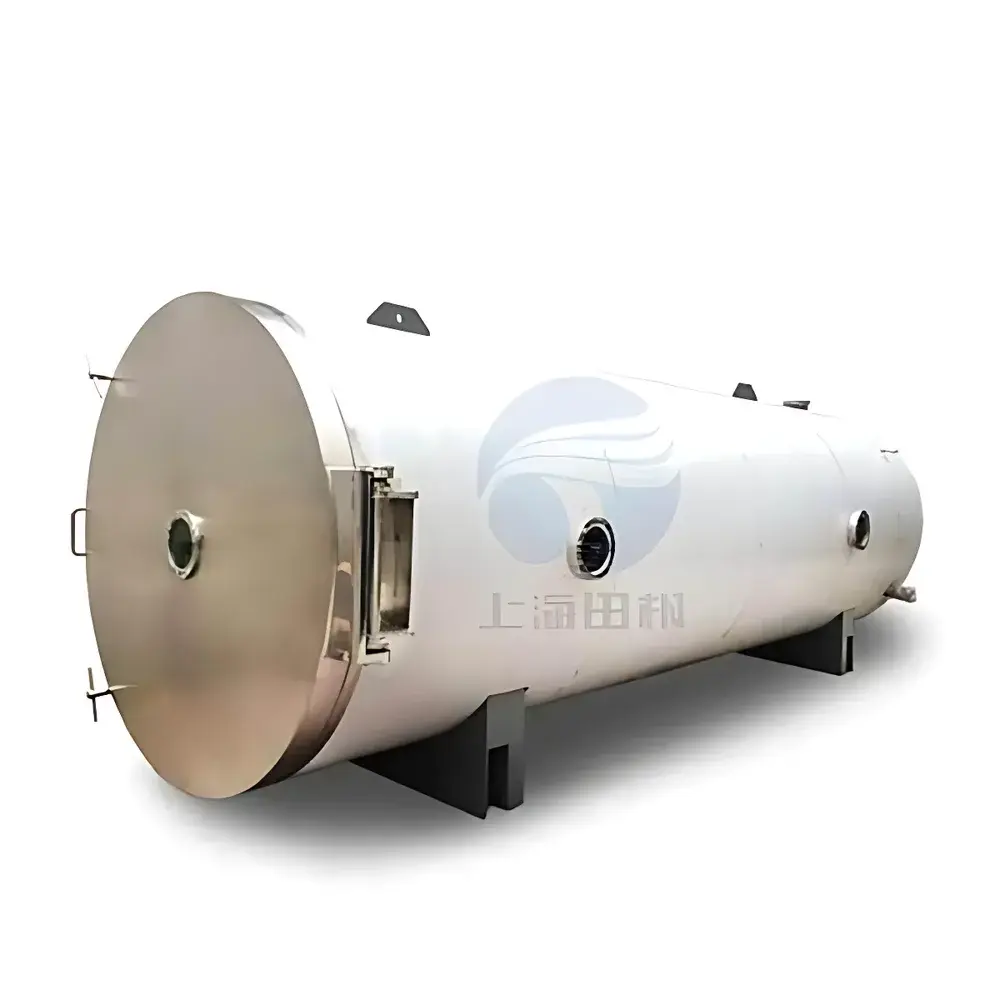
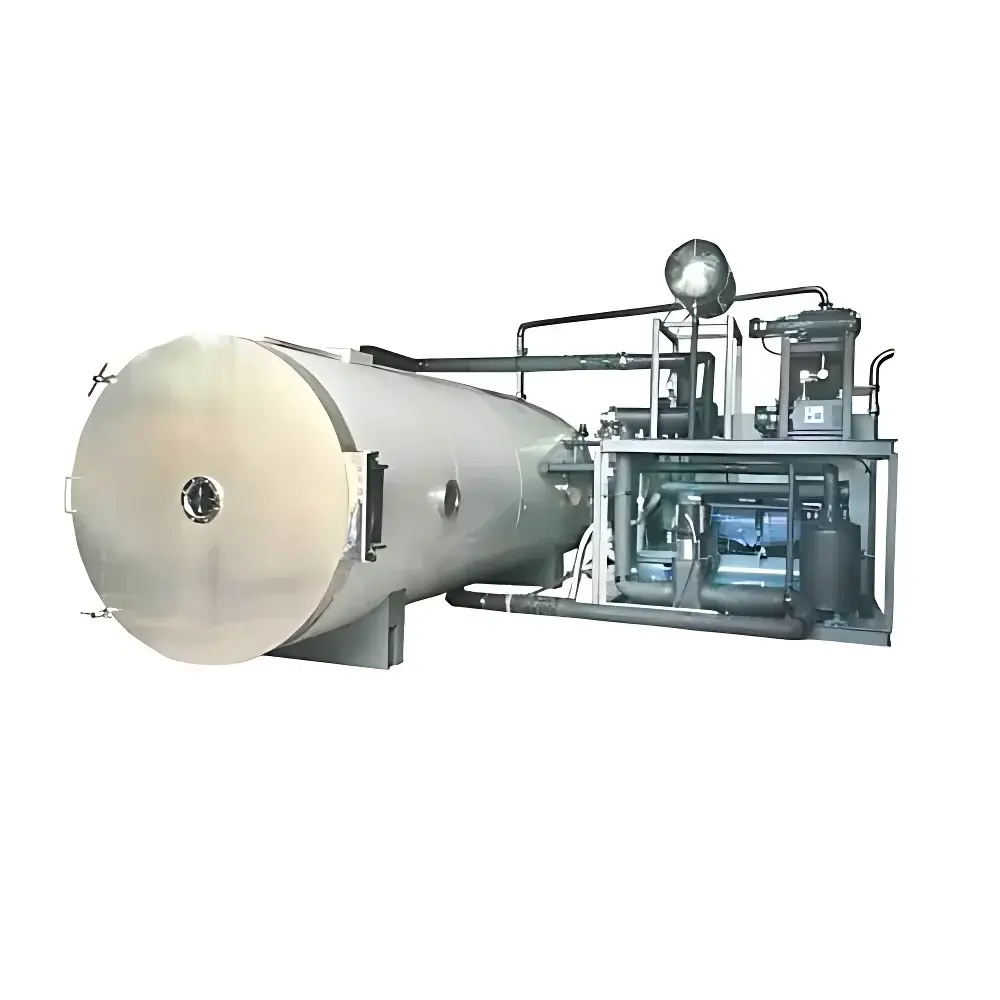
Tianfeng FZG-30 Industrial-Scale Freeze Dryer for Food Applications
| Brand | Tianfeng |
|---|---|
| Origin | Shanghai, China |
| Manufacturer Type | Direct Manufacturer |
| Product Category | Domestic |
| Model | FZG-30 |
| Instrument Type | Standard Shelf-Type Freeze Dryer |
| Application Scope | Pilot-to-Production Scale |
| Lyophilization Area | 30 m² |
| Ultimate Vacuum | ≤2.7 Pa |
| Condenser Capacity (24 h) | 600 kg |
| Condenser Temperature | ≤−65 °C |
| Chamber Dimensions (W × D) | 1400 × 2300 mm |
| Shelf Quantity | 10 + 1 |
| Shelf Spacing | 65 mm |
| Shelf Temperature Range | −45 to +70 °C |
| Load Capacity (Bulk Solution) | 300 L |
| Installed Power | 120 kW |
| Cooling Water Requirement | 42 m³/h |
| Net Weight | 16 t |
| Construction Material | AISI 304 Stainless Steel (Mirror-Polished Interior) |
| Control System | Omron PLC with Auto/Manual Mode, Multi-Recipe Storage & Real-Time Step Editing |
| Defrost Method | Immersion or Steam-Assisted |
| Vacuum Pump | ULVAC (Edwards/Airco-equivalent grade) |
| Compliance | Designed per GMP principles for food-grade processing environments |
Overview
The Tianfeng FZG-30 is an industrial-scale, shelf-type freeze dryer engineered for pilot-line validation and small-batch production of thermolabile food matrices—including floral botanicals (e.g., honeysuckle), tropical fruit powders (e.g., durian), vegetables, seafood, and functional ingredients. It operates on the fundamental principle of lyophilization: a three-stage process comprising pre-freezing (solidification of water into ice), primary drying (sublimation under vacuum), and secondary drying (desorption of bound moisture). All stages occur under controlled low-temperature and high-vacuum conditions—typically below −45 °C shelf temperature and ≤2.7 Pa absolute pressure—to preserve native conformation, enzymatic activity, volatile aroma profiles, and nutritional integrity. Unlike conventional thermal drying methods, which induce Maillard reactions, oxidation, or structural collapse, this system maintains microstructural porosity and reconstitution fidelity, enabling full hydration recovery without textural degradation or solubility loss.
Key Features
- Monolithic chamber–condenser architecture with front-chamber/rear-trap layout minimizes footprint while maximizing thermal efficiency and vacuum integrity.
- GMP-compliant chamber fabricated from electropolished AISI 304 stainless steel; internal surface roughness Ra ≤ 0.4 µm ensures cleanability and prevents biofilm retention.
- Modular shelf configuration: 11 total shelves (10 working + 1 bottom support); spacing fixed at 65 mm to accommodate standard ISO trays (600 × 400 mm) or custom-sized pans.
- Dual-material shelf options: precision-extruded anodized aluminum (optimized for rapid heat transfer) or mirror-finished 304 stainless steel (enhanced hygiene and corrosion resistance).
- Cryogenic condenser employs seamless, passivated stainless steel coil tubing; achieves ≤−65 °C operating temperature with ≥600 kg/24 h ice capture capacity.
- High-reliability refrigeration circuit utilizes premium imported compressors (Bitzer or Danfoss equivalents), ensuring stable sub-zero shelf cooling rates >1.2 °C/min and condenser pull-down <90 min.
- Omnidirectional observation window with integrated LED illumination enables real-time visual monitoring without vacuum break.
- Omron CJ2M-series PLC control platform supports audit-trail-enabled operation: recipe versioning, parameter logging (shelf temp, chamber pressure, condenser temp, time), and user-access-level management.
- Steam-assisted or immersion defrost cycle reduces downtime; fully automated sequence includes condensate drainage, sterilization-grade rinse, and dry purge.
Sample Compatibility & Compliance
The FZG-30 accommodates diverse biological feedstocks across regulatory categories: fresh-cut produce (e.g., asparagus, carrots), delicate botanicals (Lonicera japonica flowers), high-sugar fruits (durian pulp), lean proteins (shrimp, chicken breast), and viscous suspensions (soy protein isolates, egg yolk dispersions). Its design aligns with core hygienic engineering principles outlined in EHEDG Doc. Type A and ISO 22000:2018. While not certified for pharmaceutical cGMP (21 CFR Part 211), its construction, documentation traceability, and operational controls meet baseline requirements for FDA-regulated food manufacturing (21 CFR Part 117 – Preventive Controls for Human Food). All wetted surfaces comply with FDA 21 CFR 178.3570 (indirect food additives – lubricants) and EC 1935/2004 (materials in contact with food).
Software & Data Management
The embedded HMI interface provides intuitive navigation through setup, run, and post-processing menus. Process data—including shelf setpoints, actual temperatures (±0.3 °C accuracy), chamber pressure (capacitance manometer, ±0.05 Pa resolution), and condenser load—are logged at user-defined intervals (1–60 s) and stored locally on SD card (≥32 GB) with timestamped CSV export capability. Optional Ethernet/IP or Modbus TCP integration enables SCADA connectivity for centralized MES reporting. Electronic signatures, change logs, and alarm history fulfill ALCOA+ (Attributable, Legible, Contemporaneous, Original, Accurate, Complete, Consistent, Enduring, Available) data integrity criteria required under food safety management systems.
Applications
This system serves R&D labs and contract manufacturers developing shelf-stable food ingredients requiring minimal thermal impact: instant beverage powders (freeze-dried coffee, matcha, fruit concentrates), infant nutrition blends (probiotic-fortified cereals), clinical nutrition formulations (hydrolyzed whey peptides), sports nutrition matrices (BCAA-enriched berry powders), and ethnic specialty products (dried goji, osmanthus, or lotus root slices). It is routinely deployed for stability testing per ICH Q1A(R2), accelerated aging studies (40 °C/75% RH), and sensory panel evaluation of reconstituted samples. The 30 m² drying area supports batch sizes up to 300 L liquid equivalent—sufficient for validating scale-up parameters prior to commercial rotary drum or manifold freeze drying.
FAQ
What is the maximum allowable moisture content for optimal reconstitution of freeze-dried durian powder?
For full structural recovery and flavor retention, residual moisture should be maintained between 1.5–2.8% w/w—achievable via extended secondary drying at +35 °C shelf temperature under ≤10 Pa.
Can the FZG-30 process sterile-filtered liquid cultures (e.g., lactic acid bacteria suspensions)?
Yes—provided pre-freezing occurs under aseptic conditions and loading is performed in ISO Class 5 environment; however, terminal sterilization of the chamber is not supported.
Is remote monitoring supported out-of-the-box?
Standard configuration includes local HMI only; optional IoT gateway module enables secure cloud-based telemetry (via MQTT/TLS) with configurable alert thresholds.
Does the system include validation documentation (DQ/IQ/OQ)?
Factory-supplied FAT report and mechanical completion dossier are included; site-specific IQ/OQ protocols must be developed jointly with client QA and executed under witnessed conditions.
What maintenance intervals are recommended for the ULVAC vacuum pump?
Oil changes every 2,000 operating hours; inlet filter replacement every 500 hours; annual calibration of capacitance manometer and Pt100 sensors by accredited metrology lab.



