
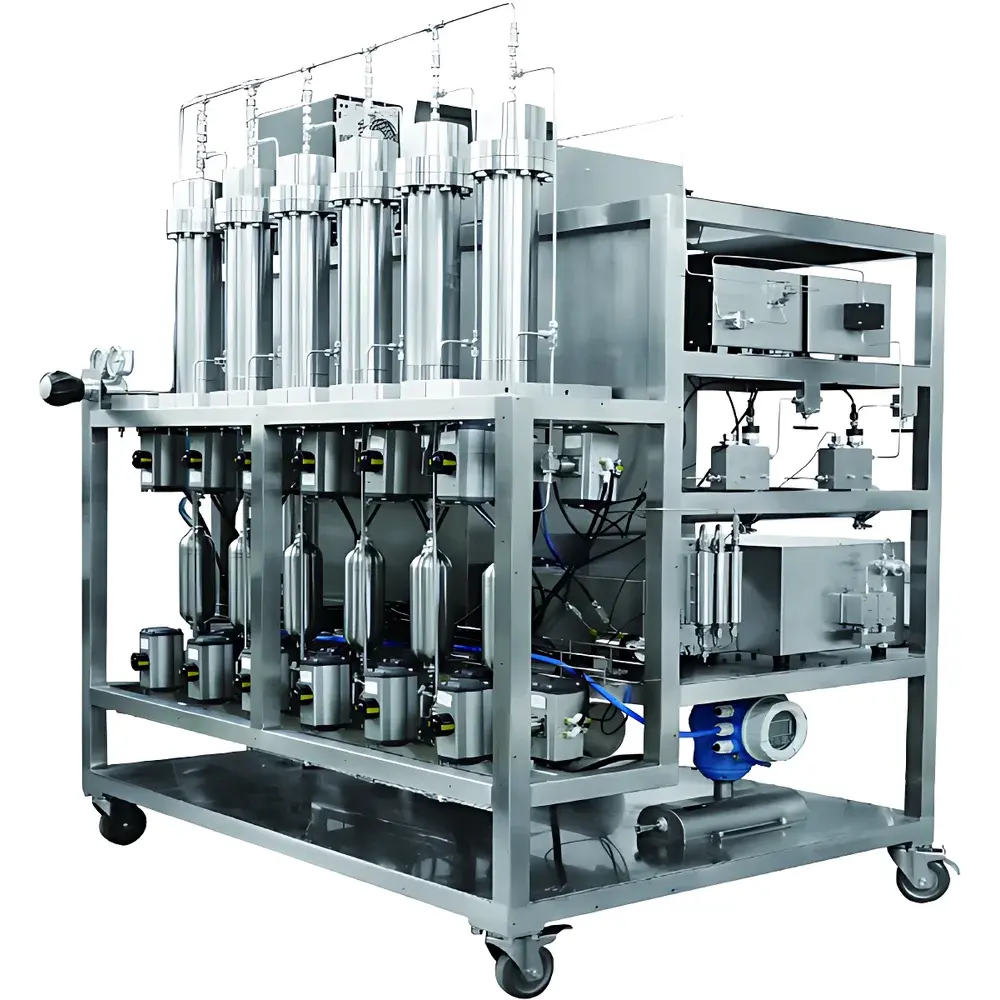
Hanbon NS8300A/B Industrial-Scale Supercritical Fluid Chromatography System
| Brand | Hanbon |
|---|---|
| Origin | Jiangsu, China |
| Manufacturer Type | Direct Manufacturer |
| Product Origin | Domestic (China) |
| Model | NS8300A/B |
| Instrument Type | Preparative |
| Detector Type | UV |
| Maximum Operating Pressure | 20 MPa |
| Flow Rate Range | 0–3000 mL/min |
Overview
The Hanbon NS8300A/B Industrial-Scale Supercritical Fluid Chromatography (SFC) System is a purpose-engineered preparative chromatographic platform designed for high-throughput chiral and achiral separation, purification, and method development in pharmaceutical, fine chemical, and natural product laboratories. Leveraging supercritical carbon dioxide (scCO₂) as the primary mobile phase—modulated with co-solvents such as methanol, ethanol, or isopropanol—the system operates on the fundamental principles of density-dependent solvation power and tunable selectivity. Unlike conventional liquid chromatography, SFC enables precise, real-time control over separation thermodynamics through independent adjustment of pressure (up to 20 MPa), temperature, and modifier composition. This dynamic modulation allows for rapid optimization of resolution between structurally analogous compounds—including enantiomers, diastereomers, positional isomers, and regioisomers—where traditional HPLC or GC often reach practical limitations. As a complementary orthogonal technique to reversed-phase HPLC and normal-phase silica-based LC, the NS8300A/B delivers enhanced peak capacity, reduced analysis time, and significantly lower solvent consumption—making it a core technology for green process development and regulatory-compliant purification workflows.
Key Features
- Industrial-grade modular architecture supporting continuous operation under sustained 20 MPa system pressure, engineered for long-term stability in GMP-aligned environments.
- High-flow precision pumping system delivering accurate, pulse-free flow rates from 0 to 3000 mL/min—enabling both analytical scouting and multi-gram preparative fraction collection.
- Dual-wavelength UV detector (190–400 nm) with variable pathlength cell options, optimized for sensitivity across diverse compound classes including low-UV-absorbing chiral intermediates.
- Integrated back-pressure regulator (BPR) with active pressure feedback control, ensuring consistent fluid density and retention time reproducibility across temperature and flow gradients.
- Modular column oven with ±0.1 °C temperature uniformity and programmable ramping (ambient to 80 °C), supporting method transfer from analytical to preparative scale.
- Robust CO₂ delivery subsystem with integrated cooling, phase monitoring, and automatic leak detection—designed for safe, unattended operation in 24/7 laboratory settings.
Sample Compatibility & Compliance
The NS8300A/B accommodates a broad polarity spectrum—from highly nonpolar hydrocarbons to moderately polar heterocycles and functionalized biomolecules—by leveraging scCO₂’s tunable solvation strength via co-solvent blending (5–40% v/v). It supports standard 10–50 mm ID preparative columns packed with silica, polysaccharide-based chiral stationary phases (e.g., Chiralpak AD-H, AS-H, OD-H), and hybrid silica-C18 materials. The system complies with key industry standards for data integrity and operational traceability: full audit trail functionality, electronic signature support, and configurable user access levels align with FDA 21 CFR Part 11 requirements. Method parameters, instrument logs, and fraction collection metadata are timestamped and stored in encrypted binary format, facilitating GLP/GMP audits and regulatory submissions (ICH Q5, Q6, Q7).
Software & Data Management
Hanbon ChromaControl™ v3.2 software provides unified control of all hardware modules—including pump sequencing, BPR setpoint profiling, UV spectral acquisition, and fraction-trigger logic—via an intuitive graphical interface. All methods are saved as XML-based protocol files, enabling version-controlled sharing across instruments and labs. Raw chromatograms and collected fractions are automatically linked to metadata (pressure, temperature, modifier gradient, flow rate), supporting retrospective analysis and DOE-driven method optimization. Export options include CSV, AIA (.cdf), and PDF reports compliant with LIMS integration protocols. Data backups adhere to ISO/IEC 27001-aligned encryption standards, with optional network storage synchronization and role-based cloud archive permissions.
Applications
- Chiral purification of API intermediates and final drug substances (e.g., enantioselective isolation of QD803 analogues with ≥99.5% ee).
- Rapid method development for complex natural product extracts—resolving co-eluting flavonoids, alkaloids, and terpenoids without derivatization.
- Green-scale-up of synthetic routes: replacing hexane/isopropanol normal-phase systems with scCO₂/methanol, reducing solvent use by >80% and waste disposal costs by >65%.
- Stability-indicating assays for oxidized/degraded species in biologics formulations, where SFC offers superior selectivity over RPLC for labile diastereomeric impurities.
- Support of Quality-by-Design (QbD) initiatives through systematic DoE studies mapping pressure–temperature–modifier interactions to critical quality attributes (CQAs).
FAQ
What types of chiral columns are compatible with the NS8300A/B?
Standard 10–50 mm ID columns packed with immobilized polysaccharide derivatives (e.g., cellulose tris(3,5-dimethylphenylcarbamate), amylose tris(3,5-dimethylphenylcarbamate)) or silica-bonded Pirkle-type phases are fully supported.
Can the system operate without organic modifiers?
Yes—pure scCO₂ is viable for nonpolar analytes; however, >90% of pharmaceutical applications require 5–30% polar co-solvent for adequate solubility and elution strength.
Is method transfer from analytical SFC to NS8300A/B straightforward?
With consistent column chemistry, particle size, and mobile phase composition, linear scaling of flow rate and injection volume enables robust transfer—validated per ICH Q2(R2) guidelines.
Does the system support automated fraction collection based on UV threshold or time windows?
Yes—programmable fraction triggers include real-time absorbance thresholds, time-based windows, and peak apex tracking with configurable delay and hold functions.
What maintenance intervals are recommended for the CO₂ delivery subsystem?
Filter cartridges require replacement every 6 months under continuous operation; high-pressure seals are rated for ≥5000 cycles and inspected during quarterly PM checks.
Related Products





