
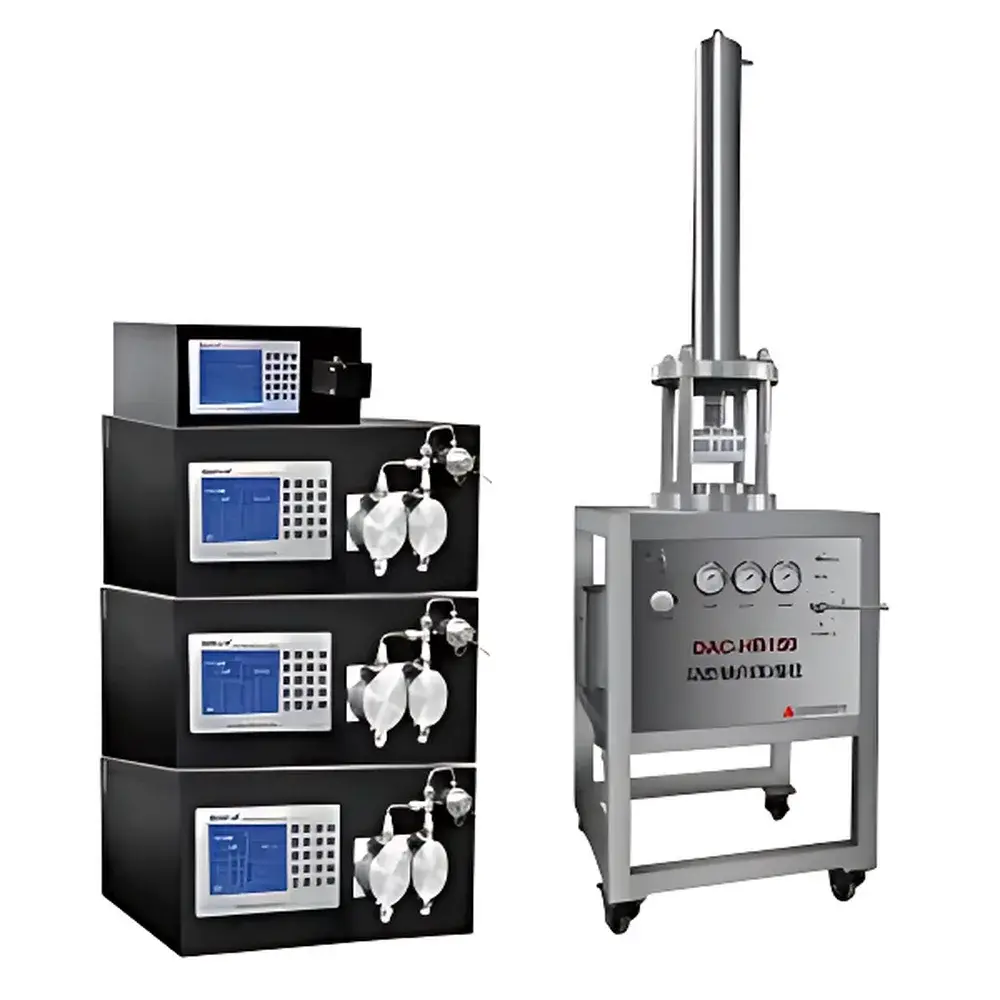
Hanbon NS43100 Preparative HPLC Plunger Pump System
| Brand | Hanbon |
|---|---|
| Origin | Jiangsu, China |
| Manufacturer Type | Direct Manufacturer |
| Product Category | Domestic |
| Model | NS43100 |
| Application Level | Industrial-Scale Preparative |
| Instrument Type | High-Pressure Preparative Liquid Chromatography System |
| Flow Rate Range | 0.01–599.99 mL/min |
| Flow Accuracy | ±1% |
| Flow Precision (RSD) | ≤1% |
| Maximum Operating Pressure | 15 MPa |
| Wavelength Range | ±2 nm |
| Wavelength Reproducibility | 0.2 nm |
| Baseline Noise | 2 × 10⁻⁵ AU (254 nm, TC = 1 s) |
| Data Acquisition Frequency | 5 Hz |
Overview
The Hanbon NS43100 Preparative HPLC Plunger Pump System is a high-pressure, dual-pump gradient-capable preparative liquid chromatography platform engineered for scalable purification workflows—from analytical method development and lab-scale optimization through pilot-scale and industrial batch production. Built upon a robust plunger pump architecture, the system delivers precise solvent delivery via electronically damped flow control, ensuring stable pressure profiles and reproducible gradient formation under demanding load conditions. Its modular design supports integration with UV-Vis detectors, optional refractive index (RI) or evaporative light scattering detectors (ELSD), and automated fraction collectors—enabling full workflow automation in compliance with GLP and GMP-aligned laboratory practices. The system operates within a maximum pressure limit of 15 MPa (150 bar), accommodating both standard silica-based and specialty stationary phases used in natural product isolation, synthetic pharmaceutical intermediate purification, and bioprocess stream polishing.
Key Features
- High-precision dual-plunger reciprocating pump with electronic flow damping for enhanced gradient fidelity and reduced pulsation
- Floating piston design minimizes seal wear and extends maintenance intervals without compromising pressure integrity
- Chemically resistant fluidic path options—including 316L stainless steel, titanium alloy, and PEEK—allow compatibility with aggressive solvents (e.g., TFA, HFIP) and corrosive mobile phases
- Dual-wavelength UV-Vis detector with wavelength accuracy ±2 nm and reproducibility of 0.2 nm, supporting simultaneous monitoring at two critical absorption maxima
- Low baseline noise (2 × 10⁻⁵ AU at 254 nm, 1 s time constant) ensures high signal-to-noise ratio for trace-level compound detection during fractionation
- 5 Hz data acquisition rate enables high-resolution peak tracking and accurate retention time alignment across multi-run campaigns
- Integrated control architecture supports ASTM E1782-compliant method transfer protocols and FDA 21 CFR Part 11–ready audit trails when paired with compliant software
Sample Compatibility & Compliance
The NS43100 accommodates a broad spectrum of sample matrices—including fermentation broths, plant extracts, peptide libraries, and synthetic small molecules—without requiring extensive pre-filtration or derivatization. Its pressure and flow stability enable reliable operation with dynamic axial compression (DAC) columns, spring-loaded preparative columns, and multi-functional axial compression systems up to 100 mm ID. All wetted materials conform to ISO 10993-1 biocompatibility guidelines where applicable, and system validation documentation supports IQ/OQ/PQ execution per USP and ICH Q5C recommendations. Regulatory-ready configuration options include electronic signature support, user role-based access control, and secure data archiving aligned with ALCOA+ principles.
Software & Data Management
Control and data acquisition are managed via Hanbon’s proprietary ChromaMaster Prep software—a Windows-based application certified for use in regulated environments. The software provides real-time pressure/flow/wavelength monitoring, customizable gradient tables, and automated method sequencing. Fraction collection logic includes retention time–triggered, peak-threshold–activated, and manual override modes—all logged with timestamped metadata. Raw data files adhere to ANDI/NetCDF format standards for third-party processing (e.g., Chromeleon, Empower), and export modules generate PDF reports compliant with ISO/IEC 17025 documentation requirements. Audit trail functionality records all parameter changes, user logins, and method edits with immutable timestamps.
Applications
- Purification of active pharmaceutical ingredients (APIs) and chiral intermediates under cGMP pilot manufacturing conditions
- Isolation of bioactive natural products (e.g., alkaloids, flavonoids, terpenoids) from crude botanical extracts
- Downstream processing of monoclonal antibody fragments and synthetic peptides following solid-phase synthesis
- Process development for continuous chromatography coupling (e.g., SMB, MCSGP) via external valve interface support
- Stability-indicating method development for forced degradation studies per ICH Q1A–Q5E guidelines
- Preparative-scale separation of oligonucleotides and mRNA cap analogs using ion-pairing reversed-phase media
FAQ
What column hardware is compatible with the NS43100 system?
The system supports standard 1/4″ and 1/8″ tubing connections and integrates seamlessly with DAC columns (up to 100 mm ID), spring-loaded preparative columns, and multi-zone axial compression systems.
Does the UV-Vis detector support spectral scanning?
No—the detector is configured for fixed-wavelength dual-channel measurement only; spectral scanning requires optional add-on modules.
Can the system be validated for GMP production use?
Yes—when deployed with validated software, calibrated transducers, and documented IQ/OQ protocols, the NS43100 meets baseline requirements for Phase III clinical material purification per FDA and EMA guidance.
Is remote monitoring supported?
Remote desktop access is permitted via secure LAN/VLAN; however, cloud-based telemetry is not natively embedded and requires customer-supplied IT infrastructure.
What maintenance intervals are recommended for the plunger seals?
Under typical operation (≤10 MPa, acetonitrile/water mobile phase), seal replacement is advised every 6–12 months based on usage logs and pressure decay diagnostics.





