
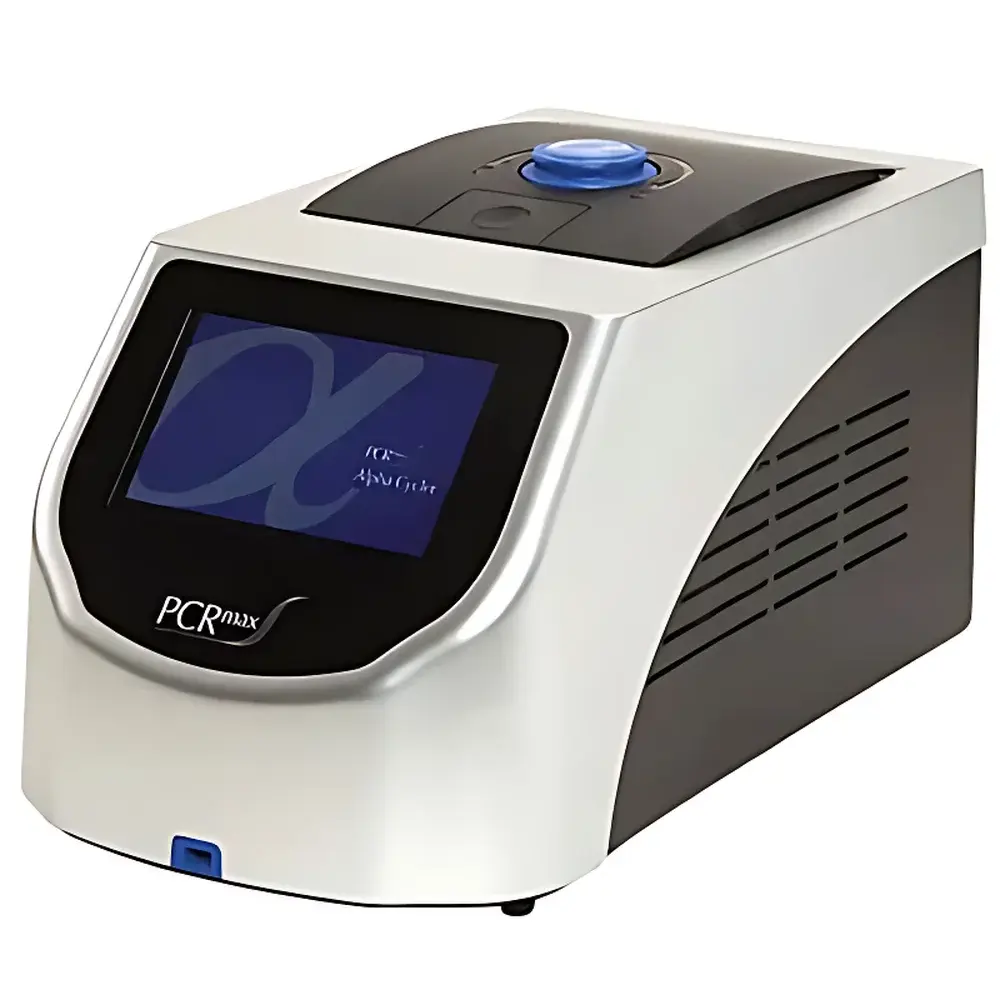
PCRmax AC-1 Gradient PCR Thermal Cycler
| Brand | PCRmax |
|---|---|
| Origin | United Kingdom |
| Model | AC-1 |
| Instrument Type | Gradient PCR Thermal Cycler |
| Sample Capacity | 96-well (0.2 mL) or 384-well module (field-replaceable) |
| Max Heating/Cooling Rate | 3.4 °C/s |
| Temperature Accuracy | ±0.25 °C |
| Inter-well Temperature Uniformity | ±0.3 °C |
| Temperature Range | 4–100 °C |
| Gradient Range | 10–100 °C |
| Gradient Span | 1–29 °C |
| Gradient Channels | 12 independent temperature zones |
| Heat Lid Temperature | 35–115 °C (adjustable, manually pressure-controlled) |
| Heat Lid Uniformity | ±5 °C |
| Heat Lid Preheating Time | <2 min |
| Display | 7" 1080P full-color LCD touchscreen |
| OS | Embedded Android-based firmware |
| Onboard Program Storage | ≥1,000 protocols |
| USB Expansion Support | Yes (USB-A & USB-B) |
| Power Consumption (30-cycle run) | 0.3 kWh |
| Dimensions (W×D×H) | 200 × 260 × 430 mm |
| Rated Power | 425 W |
| Noise Level | <50 dB(A) |
Overview
The PCRmax AC-1 Gradient PCR Thermal Cycler is a precision-engineered, modular thermal cycler designed for high-fidelity nucleic acid amplification in research, clinical diagnostics, and quality control laboratories. Based on Peltier semiconductor heating and cooling technology, the AC-1 delivers rapid, reproducible thermal transitions with tightly controlled ramp rates and exceptional inter-well temperature uniformity—critical for optimizing primer annealing specificity and minimizing non-specific amplification. Its dual-mode operation supports both standard two-step and three-step cycling protocols, while its dynamic gradient functionality enables empirical optimization of annealing conditions across 12 discrete temperature zones within a single run. The instrument operates across a broad thermal range (4–100 °C), with programmable heat lid control (35–115 °C) and manual pressure adjustment to accommodate variable-height consumables—including standard 0.2 mL tubes, 96-well plates, and 384-well microplates.
Key Features
- 7-inch 1080P full-color capacitive touchscreen with intuitive graphical programming interface and real-time thermal trajectory visualization
- Dynamic 12-zone temperature gradient capability: simultaneous incubation at 12 independently controlled temperatures, each with identical dwell times and adjustable span (1–29 °C)
- Touchdown PCR protocol support: automated stepwise reduction of annealing temperature over successive cycles to enhance specificity
- Pre-cooling function: lowers block temperature to 4 °C prior to sample loading to minimize premature extension or enzyme degradation
- Heat lid preheating: achieves target lid temperature in under 2 minutes, reducing condensation and improving reaction consistency
- Auto-programming wizard: generates optimized cycling protocols based on user-input parameters including amplicon length, primer Tm, and polymerase kinetics
- Secure user authentication via encrypted USB login key: no local account storage; session terminates automatically upon USB removal
- Robust embedded Android-based firmware with ≥1,000 onboard protocol slots and seamless USB-based program import/export
- Power-loss recovery: resumes interrupted runs from the exact cycle and step where interruption occurred
- Remote status monitoring via QR code scanning using any web-enabled mobile device—no proprietary app required
Sample Compatibility & Compliance
The AC-1 accommodates interchangeable reaction modules: a standard 96-well (0.2 mL) gradient block and an optional 384-well high-density block—both engineered for minimal thermal lag and maximal cross-platform protocol compatibility within the Alpha Cycler series. Module interchangeability ensures consistent thermal profiles across instrument configurations, supporting method transfer between labs and validation continuity. The system complies with ISO/IEC 17025 requirements for calibration traceability and supports audit-ready documentation through timestamped protocol logs and USB-exportable run reports. While not certified for IVD use out-of-the-box, its architecture aligns with design controls referenced in ISO 13485 and FDA 21 CFR Part 820, and its data integrity features—including immutable session logs and user-authenticated execution—facilitate alignment with GLP and GMP environments when integrated into validated workflows.
Software & Data Management
The AC-1 runs a purpose-built Android-derived operating system optimized for laboratory thermal cycling operations. All protocols are stored in non-volatile memory with SHA-256 checksum verification to prevent corruption. Each run generates a timestamped metadata file containing block temperature profiles, gradient settings, lid status, and user ID (if authenticated). Data export is supported via USB-A port to FAT32-formatted drives; exported files follow CSV and JSON schemas compatible with LIMS integration and third-party analysis tools. No cloud connectivity or remote data transmission occurs by default—data residency remains fully under user control. Firmware updates are delivered as signed binary packages verified at boot time, ensuring integrity and version traceability per ICH GCP Annex 11 principles.
Applications
- Optimization of primer annealing conditions via gradient PCR in gene expression studies and SNP detection
- High-throughput genotyping assays requiring precise thermal reproducibility across 96- or 384-well formats
- Preparation of templates for next-generation sequencing library construction
- Validation of qPCR assay robustness under variable thermal conditions
- Routine amplification of GC-rich or secondary-structure-prone targets using touchdown protocols
- Teaching laboratory applications where intuitive interface and protocol portability reduce training overhead
FAQ
Is the AC-1 compliant with FDA 21 CFR Part 11 for electronic records?
The AC-1 does not include built-in electronic signature or audit trail modules required for full Part 11 compliance; however, its secure USB login, immutable run logs, and exportable metadata support implementation within a broader validated IT infrastructure meeting Part 11 criteria.
Can the 96-well and 384-well modules be interchanged without recalibration?
Yes—the modules are factory-calibrated and mechanically indexed for drop-in replacement; no field recalibration is required.
Does the instrument support external network connectivity or Wi-Fi?
No—network interfaces are intentionally omitted to ensure data sovereignty and eliminate cybersecurity attack vectors; remote monitoring is limited to QR-based read-only status checks.
What is the expected lifetime of the Peltier modules under continuous use?
Based on accelerated life testing per IEC 60068-2-64, the thermoelectric assemblies are rated for >500,000 thermal cycles at maximum ramp rate, corresponding to approximately 8–10 years of typical academic lab usage.
Are protocols created on the AC-1 compatible with other Alpha Cycler models?
Yes—AC-series instruments share a common protocol binary format; programs can be transferred seamlessly between AC-1, AC-2, and AC-4 units via USB drive without conversion or revalidation.




