
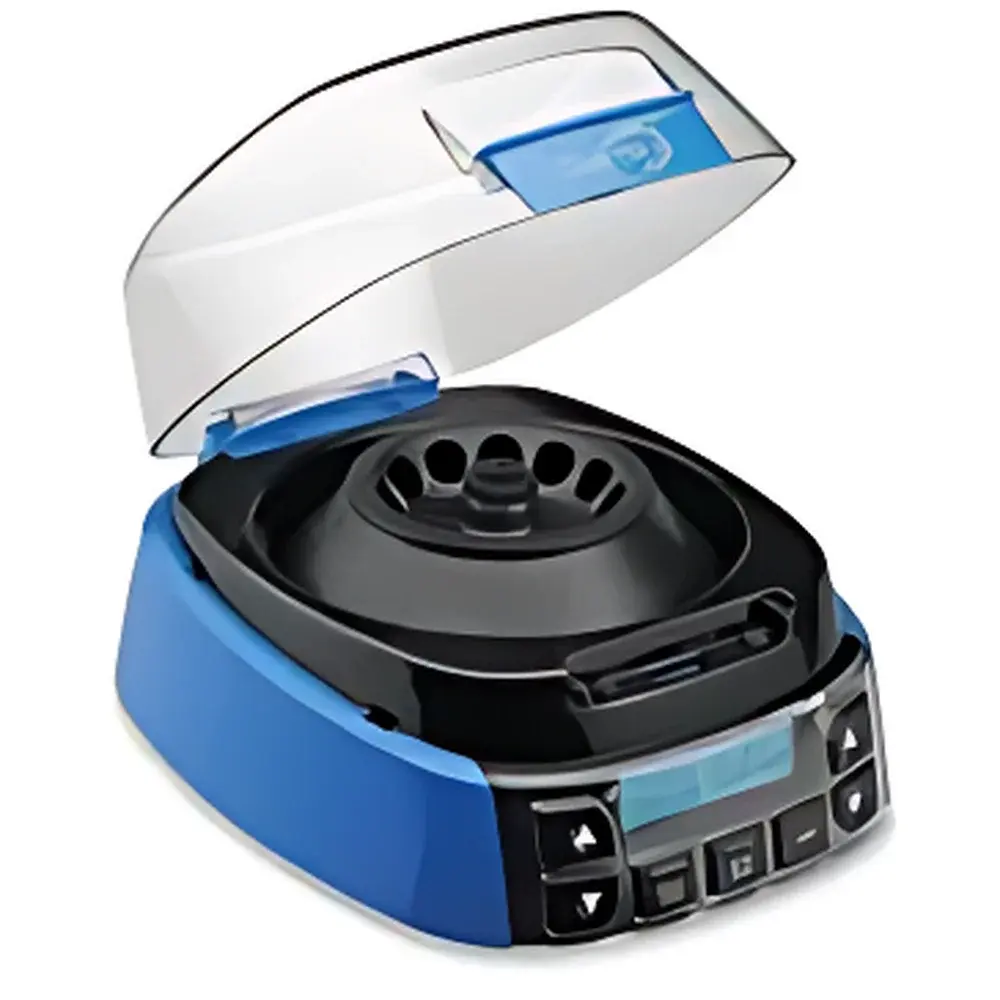
Heathrow Scientific Gusto High-Speed Mini Centrifuge
| Brand | Heathrow Scientific |
|---|---|
| Origin | USA |
| Model | Gusto |
| Instrument Type | Palm-Sized Centrifuge |
| Speed Range | 500–12,500 rpm (in 100-rpm increments) |
| RCF Max | 9,800 × g |
| Capacity | 12 × 1.5 mL tubes (compatible with 0.2/0.5/1.5/2.0 mL microtubes) |
| Timer Range | 1 s – 30 min (1-s increment) |
| Dimensions | 203 × 171 × 114 mm |
| Power Input | 100–240 V AC, 50/60 Hz |
| Safety Features | Lid interlock, imbalance detection, automatic rotor stop |
| Noise Level | <55 dB(A) |
| Compliance | CE, RoHS, IEC 61010-1 |
Overview
The Heathrow Scientific Gusto High-Speed Mini Centrifuge is an engineered solution for rapid, precise, and space-efficient microcentrifugation in modern life science laboratories. Designed around a brushless DC motor and precision-balanced aluminum rotor assembly, the Gusto operates on the principle of radial acceleration to separate suspended particles—such as nucleic acids, proteins, cellular organelles, and precipitated reagents—based on density, size, and shape. Its compact footprint and high-speed capability (up to 12,500 rpm and 9,800 × g) make it especially suited for benchtop workflows where throughput, reproducibility, and ergonomic integration are critical—ranging from PCR setup and column-based purification to sample concentration prior to HPLC or mass spectrometry analysis.
Key Features
- Brushless DC motor delivering stable rotational performance across the full speed range (500–12,500 rpm), with ±50 rpm speed accuracy and <1% speed fluctuation under load.
- Quick-lock aluminum rotor accommodating up to twelve 1.5 mL microcentrifuge tubes—or mixed configurations including 0.2 mL, 0.5 mL, and 2.0 mL tubes—without adapters.
- Programmable timer (1 second to 30 minutes) with 1-second resolution and auto-brake function ensuring consistent deceleration profiles across runs.
- Dual-mode display: optional digital RPM/RCF readout with backlight, configurable via front-panel push-button interface; intuitive tactile feedback minimizes operational error.
- Integrated safety architecture compliant with IEC 61010-1: includes lid interlock switch, real-time imbalance sensing, and immediate motor cutoff if rotor asymmetry exceeds 5% mass differential.
- Acoustically damped housing and vibration-isolated base reduce operational noise to <55 dB(A) at 1 m distance—enabling continuous use in shared lab environments without acoustic disturbance.
Sample Compatibility & Compliance
The Gusto supports standard polypropylene and polyethylene microcentrifuge tubes (including low-retention variants) used in molecular biology, clinical diagnostics, and pharmaceutical QC labs. It is validated for routine centrifugation of viscous samples (e.g., glycerol stocks, lysates, and ethanol precipitates) and temperature-sensitive preparations when operated within ambient conditions (15–30°C). The device meets CE marking requirements for electrical safety and electromagnetic compatibility (EMC Directive 2014/30/EU), complies with RoHS 2011/65/EU restrictions on hazardous substances, and adheres to IEC 61010-1:2010 for laboratory equipment safety. While not certified for biosafety containment, its sealed rotor design prevents aerosol leakage during normal operation—supporting GLP-aligned documentation practices in regulated environments.
Software & Data Management
The Gusto operates as a standalone instrument with no embedded software or connectivity interfaces. All parameters—including speed, time, and RCF—are set and stored locally via non-volatile memory, retaining user-defined presets after power cycling. No firmware updates or driver installation are required. For laboratories maintaining electronic records under FDA 21 CFR Part 11 or ISO/IEC 17025, manual logbook entries (date, operator ID, protocol number, speed/time settings, tube configuration) are recommended per run. Optional third-party lab information management systems (LIMS) may integrate Gusto usage data via barcode-scanned protocol cards or timestamped audit trails generated by external timers.
Applications
- Routine pelleting of DNA, RNA, and plasmid preparations following enzymatic reactions or column elution.
- Clarification of bacterial and mammalian cell lysates prior to electrophoresis or immunoassay.
- Concentration of dilute protein solutions using spin-column devices or ultrafiltration membranes.
- Separation of phase-separated organic/aqueous mixtures in extraction protocols (e.g., phenol-chloroform).
- Micro-volume sample preparation for MALDI-TOF MS, capillary electrophoresis, and microfluidic assays.
- Quality control checks in diagnostic kit manufacturing, including reagent mixing verification and particulate removal.
FAQ
Is the Gusto suitable for continuous operation?
Yes—the brushless motor and thermally optimized chassis support uninterrupted runs up to 30 minutes; however, extended sequential use (>4 hours/day) requires ≥10-minute cooldown intervals between cycles to maintain bearing longevity.
Can I centrifuge capped PCR strips or 8-tube strips in the Gusto?
No—the rotor geometry is designed exclusively for individual round-bottom microcentrifuge tubes; strip formats are incompatible due to dimensional constraints and unbalanced mass distribution.
Does the Gusto meet ISO 13485 or GMP requirements?
The Gusto itself is not certified to ISO 13485 or GMP, but its design, traceable manufacturing, and compliance with IEC 61010-1 enable qualification within GMP-compliant facilities when included in a validated equipment master list and subjected to periodic performance verification (e.g., speed calibration, timer accuracy, and safety interlock testing).
What maintenance is required?
Routine cleaning of the rotor chamber with 70% ethanol and visual inspection of rotor threads and lid seal integrity every 6 months; no lubrication or internal servicing is required under normal operating conditions.
Is rotor balancing necessary before each run?
No—the Gusto’s auto-detect imbalance system and symmetrical 12-position rotor eliminate the need for manual tube balancing; however, users must ensure identical tube types and fill volumes are placed opposite one another to maximize rotor lifetime and minimize mechanical stress.



