
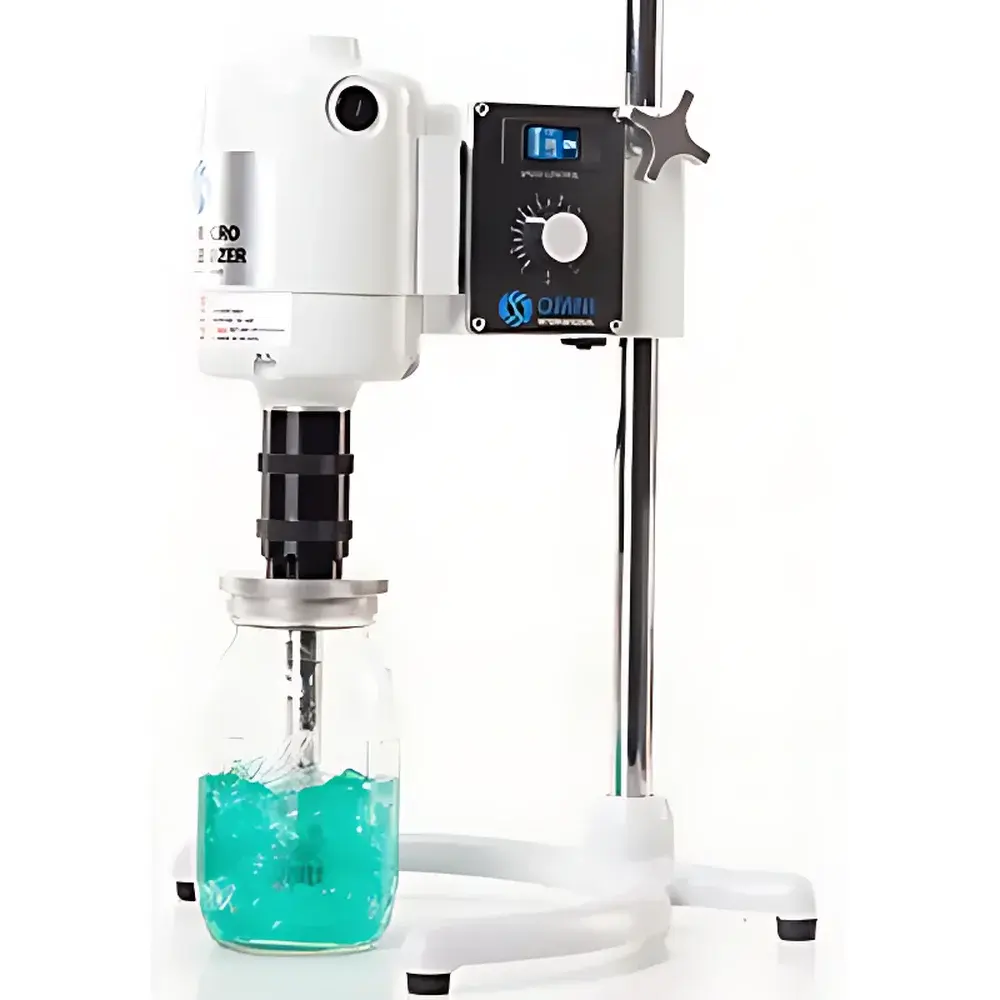
OMNI International Macro High-Power Benchtop Homogenizer
| Brand | OMNI International |
|---|---|
| Origin | USA |
| Model | Macro |
| Instrument Type | Probe-Type Rotor-Stator Homogenizer |
| Power | 1800 W |
| Speed Range | 500–20,000 rpm |
| Noise Level | <68 dB(A) |
| Dimensions (W×D×H) | 254×254×610 mm |
| Weight | 9.5 kg |
| Sample Volume Capacity | 0.25 mL – 30 L |
| Standard Configuration | Main unit, support stand, probe adapter, tool kit, and user manual |
| Optional Probes | Stainless steel probes with diameters of 10, 20, 30, 45, and 55 mm |
| Optional Homogenizing Cups | Glass, polycarbonate (PC), and stainless steel cups with volumes from 13 mL to 1892 mL |
Overview
The OMNI International Macro High-Power Benchtop Homogenizer is an industrial-grade rotor-stator homogenizer engineered for reproducible, high-shear mechanical disruption of biological, chemical, and material samples in research, quality control, and process development laboratories. Operating on the principle of intense fluid shear generated between a rapidly rotating probe tip and a stationary stator (or cup wall), the Macro delivers consistent particle size reduction, cell lysis, emulsification, and dispersion across a broad dynamic range—from microliter-scale tissue biopsies to multi-liter suspensions. Its 1800 W brushless motor ensures stable torque delivery at all speeds (500–20,000 rpm), minimizing thermal drift and enabling extended operation under load without performance degradation. Designed for benchtop integration in ISO 17025-accredited labs and GMP-compliant environments, the system meets structural and electromagnetic compatibility requirements per IEC 61000-6-2/6-3 and carries CE marking for safe operation in EU-regulated facilities.
Key Features
- High-power 1800 W motor with closed-loop speed control—maintains set rpm within ±1% accuracy across full load range
- Broad processing capacity: validated for volumes from 0.25 mL (micro-tissue homogenization) to 30 L (batch emulsion preparation)
- Low-noise design (<68 dB[A] at 1 m distance) achieved via precision-balanced rotor assembly and vibration-damped housing
- Modular probe architecture supporting interchangeable stainless steel probes (10–55 mm diameter) with standardized 1/2″ NPT thread interface
- Dual probe variants: standard probes optimized for fine particulate dispersion; wide-window probes engineered for higher throughput and reduced clogging with fibrous or viscous matrices
- Integrated safety interlocks—including probe insertion detection, overtemperature cutoff, and emergency stop—compliant with EN 61000-1-2 functional safety guidelines
- Robust aluminum alloy chassis with powder-coated finish and IP20-rated enclosure for routine lab use
Sample Compatibility & Compliance
The Macro accommodates diverse sample types including mammalian and bacterial cell cultures, plant tissues, soft polymers, pharmaceutical suspensions, food emulsions, and nanomaterial dispersions. Probe and cup selection is guided by viscosity, solids content, and desired final particle/droplet size distribution. Glass cups (borosilicate 3.3) meet ASTM E438 Type I Class A specifications for volumetric accuracy and chemical resistance. Polycarbonate cups comply with USP Class VI biocompatibility testing for non-implantable device contact. Stainless steel cups are suitable for high-pressure, high-temperature, or corrosive applications per ASTM A276 standards. All homogenization protocols can be documented with timestamped operational logs, supporting GLP/GMP traceability and audit readiness per FDA 21 CFR Part 11 when paired with compliant LIMS integration.
Software & Data Management
While the Macro operates as a standalone analog-controlled instrument, its digital-ready architecture supports optional RS-232/USB interface modules (sold separately) for integration into laboratory automation frameworks. When connected, users may log speed, runtime, and probe ID via third-party SCADA or ELN systems. The host PC application enables creation of method templates—including ramp profiles, dwell times, and probe-specific torque limits—to ensure cross-operator consistency. Audit trails include operator ID, method version, date/time stamps, and environmental metadata (e.g., ambient temperature), satisfying ISO/IEC 17025 clause 7.7.2 requirements for result validity assurance.
Applications
- Cell lysis for nucleic acid and protein extraction in molecular biology workflows
- Homogenization of adipose tissue, liver, or tumor specimens prior to histopathological analysis
- Preparation of uniform suspensions for particle size analysis (e.g., laser diffraction per ISO 13320)
- Emulsification of oil-in-water and water-in-oil formulations in pharmaceutical and cosmetic development
- Disaggregation of aggregated nanoparticles and carbon nanotubes for TEM/SEM sample prep
- Routine QC testing of suspension stability in oral liquid dosage forms per USP <1151>
- Processing of fermentation broths and microbial lysates in bioprocess scale-down studies
FAQ
What is the maximum recommended continuous run time per cycle?
For optimal probe longevity and thermal management, continuous operation should not exceed 60 seconds at speeds above 15,000 rpm; longer cycles require 30-second cooling intervals between bursts.
Can the Macro be used for sterile applications?
Yes—autoclavable stainless steel probes (10–30 mm) and glass cups are compatible with steam sterilization at 121°C for 20 minutes; PC cups are ethylene oxide or gamma sterilizable only.
Is calibration required, and how often?
Speed calibration is factory-performed and traceable to NIST standards; annual verification using an optical tachometer is recommended per ISO/IEC 17025 Section 6.5.
How does probe geometry affect shear rate and sample heating?
Shear rate scales linearly with tip speed and inversely with gap width; wider-diameter probes generate lower peak shear but higher bulk energy transfer, reducing localized heating in heat-sensitive samples.
Are replacement parts and service support available globally?
OMNI International maintains authorized service centers in North America, Europe, and APAC regions; probe wear parts carry 24-month warranty; firmware updates and technical bulletins are accessible via secure customer portal.



