
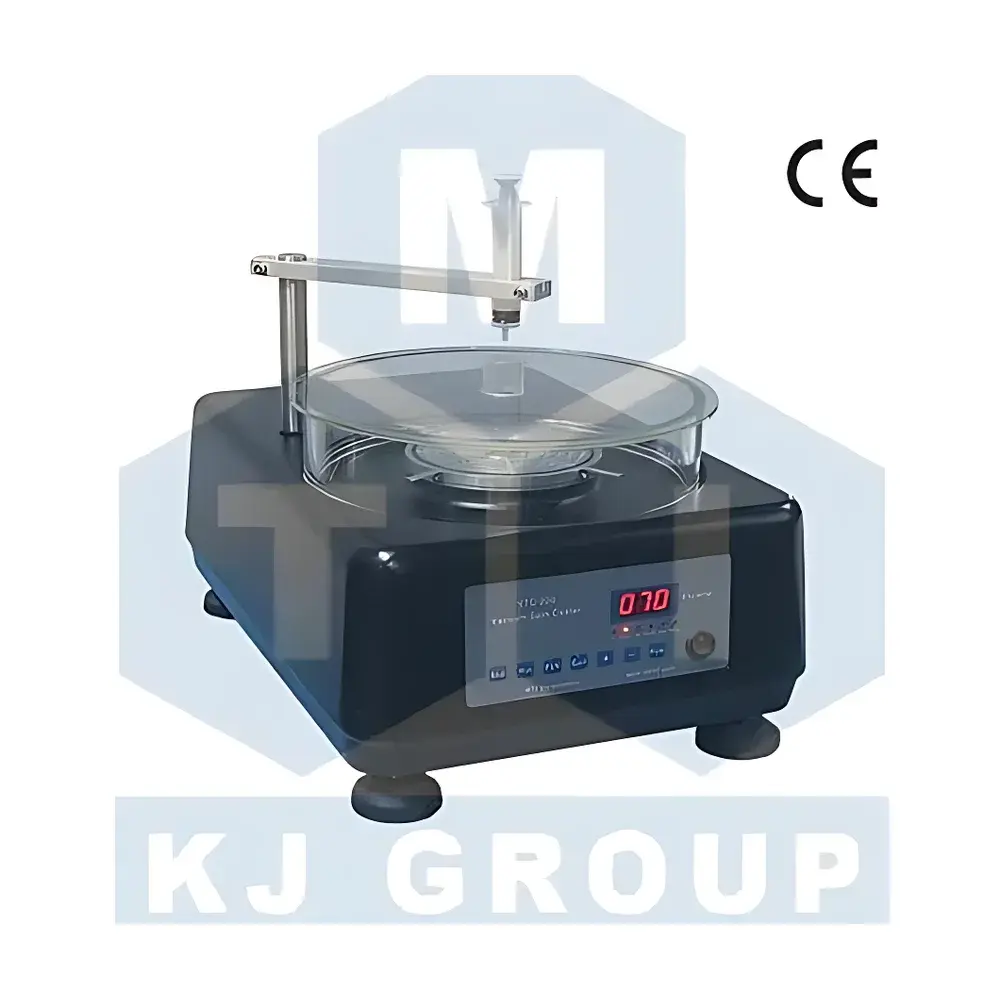
Kojin VTC-200 Benchtop Vacuum Spin Coater
| Brand | Kojin |
|---|---|
| Model | VTC-200 |
| Certification | CE |
| Max Substrate Size | Ø203 mm (8") or 127 × 127 mm (5" × 5") |
| Spin Speed Range | 500–6000 rpm (dual-stage programmable) |
| Vacuum System | Integrated oil-free pump with inline particulate/liquid trap |
| Chamber Material | Polypropylene (PP), chemically resistant to acids and bases |
| Baseplate | 152 mm (6") vacuum chuck compatible with Ø152 mm and Ø203 mm substrates |
| Dispensing | 20 mL syringe mount with lateral swivel arm |
| Optional Accessories | German-made precision pipette (20–200 µL), IR heating module (up to 120 °C, K-type thermocouple + digital PID controller) |
| Power Supply | AC 110 V / 220 V selectable, 150 W |
| Dimensions (W × D × H) | 500 × 400 × 400 mm |
| Net Weight | 20 kg |
Overview
The Kojin VTC-200 is a CE-certified, benchtop vacuum spin coater engineered for reproducible thin-film deposition via sol-gel and solution-based coating techniques. It operates on the principle of centrifugal force-driven fluid dispersion: a precisely metered volume of precursor solution is dispensed onto a rotating substrate, where controlled acceleration and dwell time govern film thickness, uniformity, and morphology. Unlike conventional hotplate-based drying, the VTC-200 integrates vacuum-assisted solvent evaporation—reducing bubble formation, minimizing edge bead effects, and enhancing interfacial adhesion—making it particularly suitable for optical coatings, perovskite photovoltaic layers, metal oxide semiconductors, and functional polymer films. Its modular architecture supports both ambient and thermally assisted processing, enabling in-situ post-coating drying without sample transfer—a critical advantage for air-sensitive or multi-layer stack fabrication.
Key Features
- Dual-stage programmable spin control: independent low-speed (0–500 rpm) and high-speed (500–6000 rpm) phases with digital RPM display and timer resolution down to 0.1 s
- Chemically inert polypropylene (PP) vacuum chamber—resistant to common solvents (e.g., ethanol, isopropanol, chlorobenzene), acids (HCl, HNO₃), and bases (NH₄OH, NaOH)—ensuring long-term compatibility with aggressive sol-gel chemistries
- Integrated oil-free vacuum pump with built-in liquid/particulate filter, preventing backstreaming contamination and extending pump service life
- 6-inch (152 mm) vacuum chuck with adjustable sealing profile—accommodates both Ø152 mm and Ø203 mm (8″) wafers or square substrates up to 127 × 127 mm (5″ × 5″)
- Customizable substrate mounting: includes 6″ × 24″ pressure-sensitive tape roll for secure fixation of non-standard or irregularly shaped substrates (e.g., glass slides, flexible PET, ceramic tiles)
- Modular heating option: IR lamp array embedded in lid, monitored by K-type thermocouple and regulated via digital PID controller (temperature range: ambient to 120 °C, ±1.5 °C stability)
- Ergonomic syringe holder with 180° lateral rotation—enabling precise drop-on-demand dispensing at optimal radial position relative to substrate center
Sample Compatibility & Compliance
The VTC-200 supports substrates ranging from silicon wafers and fused silica to ITO-coated glass, stainless steel foils, and flexible polymer films. Its PP chamber meets ISO 14644-1 Class 5 cleanroom compatibility when operated under laminar flow hoods. The integrated vacuum system complies with EN 61000-6-3 (EMC emission standards) and EN 61000-6-2 (immunity). CE marking confirms conformity with EU Machinery Directive 2006/42/EC and Low Voltage Directive 2014/35/EU. While not GMP-certified out-of-the-box, the instrument’s repeatable process parameters (RPM, time, vacuum level, temperature) support GLP-compliant documentation when paired with external audit-trail-capable software.
Software & Data Management
The VTC-200 operates via front-panel digital controls—no proprietary software required—ensuring full manual reproducibility and eliminating driver dependency. All operational parameters (spin speed, duration, vacuum status, optional heater setpoint) are logged locally on an internal EEPROM with timestamping. For laboratory information management systems (LIMS) integration, RS-232 or USB-to-serial adapters enable ASCII protocol communication (ASCII command set available upon request). Optional third-party LabVIEW or Python drivers facilitate automated recipe sequencing and data export to CSV or HDF5 formats—supporting traceability requirements under FDA 21 CFR Part 11 when deployed with electronic signature-enabled platforms.
Applications
- Sol-gel derived metal oxide films (TiO₂, ZnO, SiO₂) for dye-sensitized and perovskite solar cells
- Polymer electrolyte membranes (e.g., Nafion®, PEDOT:PSS) in fuel cell and OLED R&D
- Antireflective and hydrophobic coatings on optical lenses and sensor windows
- Patterned resist layers for microfabrication prototyping (pre-lithography spin-cast PMMA, SU-8)
- Biopolymer thin films (chitosan, collagen) for biosensor interface engineering
- Multi-layer heterostructures requiring sequential spin-coating under inert or reduced-pressure environments
FAQ
What vacuum level does the integrated pump achieve?
The oil-free diaphragm pump delivers a base pressure of ≤5 × 10⁻² mbar (50 Pa), sufficient for rapid solvent removal during spin-off without inducing substrate warping.
Can the VTC-200 be used with corrosive precursors like titanium isopropoxide (TTIP)?
Yes—the PP chamber and fluoropolymer-sealed chuck provide full compatibility with TTIP, acetylacetone, and other moisture-sensitive alkoxides when operated under dry nitrogen purge (optional gas inlet port available).
Is the heating module compatible with temperature ramping profiles?
No—the IR heater operates in on/off mode with fixed setpoint control; for programmable ramp/soak thermal profiles, external hotplates or convection ovens are recommended post-spin.
How is film thickness calibrated on the VTC-200?
Thickness is governed empirically by spin speed, solution viscosity, solid content, and acceleration rate; users establish calibration curves using ellipsometry or profilometry—typical range: 10 nm–2 µm per coat.
Does the unit support remote monitoring or Ethernet connectivity?
Not natively—but RS-232 output allows connection to industrial PLCs or SCADA systems via standard Modbus RTU gateways for centralized lab equipment monitoring.



