
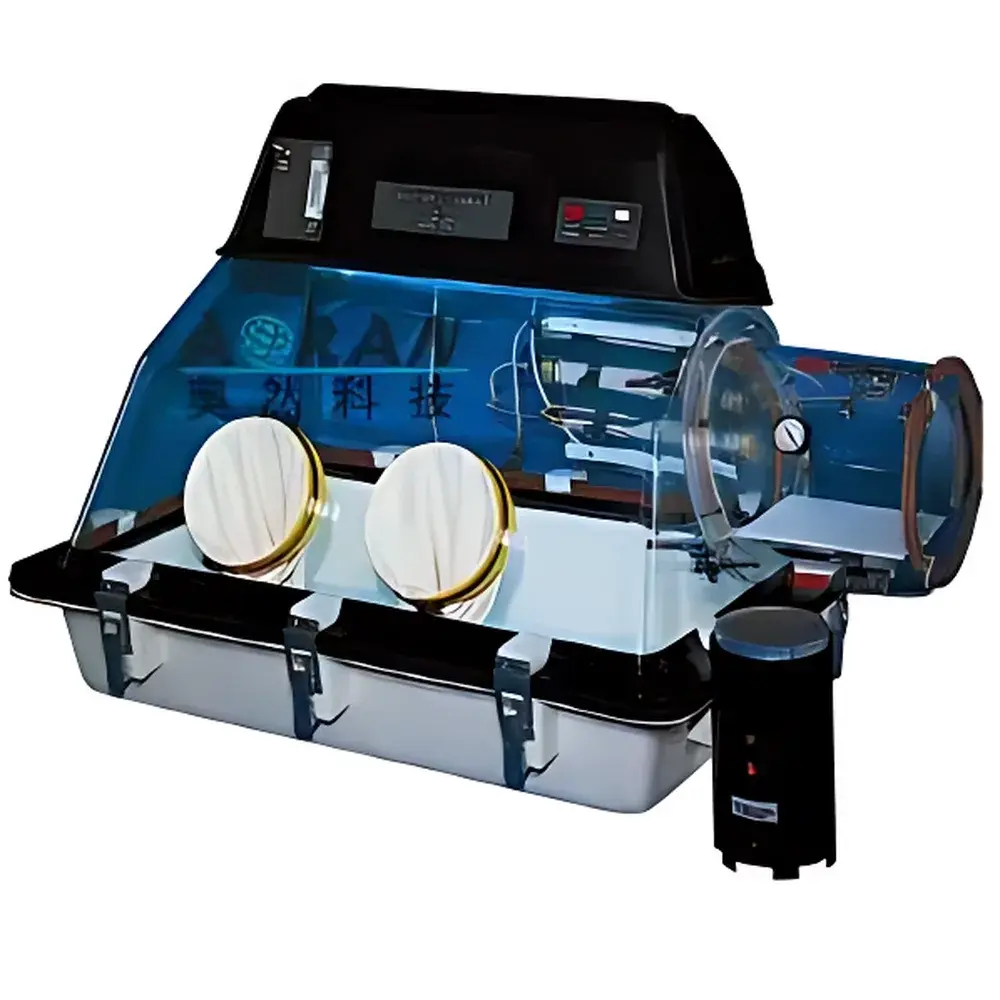
Plas-Labs 855-AC Anaerobic Biological Glove Box
| Brand | Plas-Labs |
|---|---|
| Origin | USA |
| Model | 855-AC |
| Cabinet Material | Acrylic (PMMA) |
| External Dimensions (W×D×H) | 1400 mm × 890 mm × 970 mm |
| Internal Cabinet Volume | 489 L |
| Transfer Chamber Volume | 22 L |
| Number of Gloves | 2 |
| Residual H₂O Level | <1 ppm |
| Operating Temperature | 37 °C |
| Leak Rate | Compliant with cylinder-supplied pre-mixed gas (85% N₂ / 10% H₂ / 5% CO₂) |
| Vacuum Pumps | Dual diaphragm pumps (independent for transfer chamber and desiccant regeneration) |
| Lighting | Bright Light™ LED system (40,000 hr rated life) |
| Desiccant System | Triple regenerable molecular sieve columns with self-sealing quick-connect fittings |
| Catalyst | Heated palladium catalyst for O₂ scavenging |
| Compliance | Designed for ISO 14644-1 Class 5 clean environment operation in anaerobic workflows |
Overview
The Plas-Labs 855-AC Anaerobic Biological Glove Box is an engineered isolation platform designed for rigorous, long-term maintenance of strictly oxygen-free environments—critical for culturing obligate anaerobes, handling air-sensitive biological reagents, and conducting reproducible microbiological assays under controlled atmospheric conditions. Unlike general-purpose inert-atmosphere glove boxes, the 855-AC integrates a closed-loop gas management architecture specifically optimized for anaerobic workflows: it continuously recirculates and purifies a pre-mixed gas blend (typically 85% N₂ / 10% H₂ / 5% CO₂) via catalytic deoxygenation and deep desiccation. The hydrogen component enables rapid, quantitative removal of residual O₂ through palladium-catalyzed recombination into water vapor, which is then adsorbed by high-capacity molecular sieves. This dual-stage purification ensures stable internal conditions at <1 ppm H₂O and <1 ppm O₂—meeting the stringent requirements of CLSI M45, USP , and ISO 11133 Annex B for anaerobic culture validation.
Key Features
- Monolithic acrylic (PMMA) main chamber construction: seamless, optically clear, chemically resistant, and electrostatically dissipative—enabling unobstructed visual monitoring and minimizing particle entrapment.
- Heated palladium catalyst module: actively maintained at elevated temperature to sustain catalytic efficiency across extended operation cycles; integrated with real-time thermal feedback control.
- Triple independent regenerable desiccant columns: filled with 4Å molecular sieve, each equipped with self-sealing quick-disconnect fittings to preserve internal pressure integrity during media replacement.
- Dual independent vacuum diaphragm pumps: one dedicated to transfer chamber evacuation and purge cycling, the other assigned exclusively to desiccant column regeneration—ensuring no cross-contamination or pressure interference.
- Bright Light™ LED illumination system: uniform, shadow-free 5000K white light distributed across the entire work surface; rated for 40,000 hours with minimal heat emission and zero UV output.
- Adjustable stainless-steel sealing clamps: fully articulating design prevents localized stress fatigue on glove cuffs and extends glove service life beyond 12 months under continuous use.
- Calibrated transfer chamber pressure gauge: analog dial with ±0.5 kPa accuracy, enabling precise verification of purge sequence completion prior to sample ingress/egress.
Sample Compatibility & Compliance
The 855-AC accommodates standard microbiological consumables including Petri dishes (up to 330 units with optional shelf kit), anaerobic jars, serum bottles, microcentrifuge tubes, and electrophoresis apparatus. Its interior geometry supports both manual manipulation and integration with automated liquid handlers or colony pickers via rear-mounted feedthroughs. All wetted surfaces comply with USP Class VI biocompatibility standards. The system meets ISO 14644-1 Class 5 particulate cleanliness when operated with HEPA-filtered supply air and conforms to ASTM E2992-15 for anaerobic chamber performance verification. It supports GLP-compliant documentation through optional data logging modules (temperature, pressure, cycle count) traceable to NIST-traceable references.
Software & Data Management
While the 855-AC operates as a standalone hardware platform without embedded firmware, it is fully compatible with third-party environmental monitoring systems via analog 4–20 mA and digital RS-485 interfaces. Optional I/O modules enable integration into LabVantage, Thermo Fisher SampleManager, or LabWare LIMS environments for audit-trail generation per FDA 21 CFR Part 11 requirements. Real-time O₂ and H₂O sensor outputs (via external analyzers such as Michell Easidew or Systech Illinois 7000 series) can be logged with timestamped metadata, supporting retrospective analysis for regulatory submissions.
Applications
- Cultivation and subculturing of obligate anaerobes (e.g., Clostridium difficile, Bacteroides fragilis, Fusobacterium nucleatum) in clinical and research microbiology laboratories.
- Preparation and handling of oxygen-labile enzymes (e.g., nitrogenase, hydrogenase) and redox-sensitive cofactors (e.g., ferredoxin, FADH₂).
- Anaerobic toxicity testing in regulatory toxicology (OECD 471, 476) where atmospheric control directly impacts metabolic activation pathways.
- Electron microscopy specimen preparation under reducing atmospheres to prevent oxidation artifacts in cryo-EM grid vitrification.
- Low-oxygen cell culture for modeling hypoxic tumor microenvironments or stem cell niche studies requiring <0.1% O₂.
FAQ
What gas mixture is required for optimal operation?
The system is calibrated for 85% N₂ / 10% H₂ / 5% CO₂ pre-mixed gas supplied from certified cylinders. Alternative blends (e.g., 90/5/5) may be used but require recalibration of the catalytic heater setpoint and desiccant regeneration timing.
Can the 855-AC be validated for GMP compliance?
Yes—when paired with qualified sensors, calibrated gauges, and documented IQ/OQ protocols, the unit satisfies baseline qualification requirements for Annex 1 sterile processing environments and USP microbial control strategies.
How often must the molecular sieve desiccant be regenerated?
Under continuous 24/7 operation at 37 °C and ambient RH ≤50%, regeneration intervals average 14–21 days per column, monitored via integrated dew point sensors or optional inline hygrometers.
Is the acrylic chamber resistant to common disinfectants?
Yes—PMMA exhibits excellent compatibility with 70% ethanol, isopropyl alcohol, and quaternary ammonium compounds; however, prolonged exposure to chlorine-based agents (e.g., sodium hypochlorite >0.5%) is not recommended.
What electrical requirements does the 855-AC support?
Standard configuration accepts 100–240 V AC, 50/60 Hz, single-phase input with CE and UL 61010-1 certification; no external cooling water or compressed air is required.



