
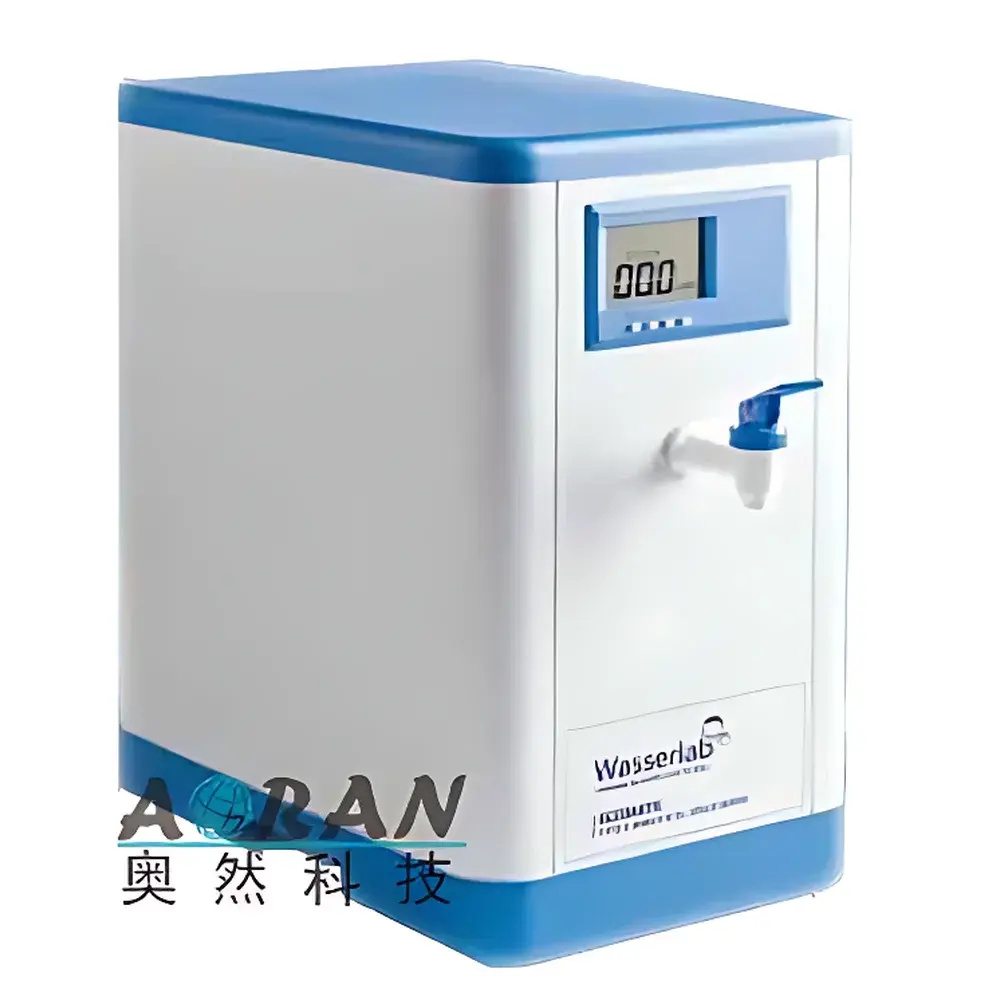
Wasserlab ECOMATIC Compact Economical Pure Water System
| Brand | Wasserlab |
|---|---|
| Origin | Spain |
| Model | ECOMATIC |
| Output Water Grade | ASTM Type II & Type III (RO Water) |
| Conductivity | < 1 µS/cm |
| Flow Rates | 3 / 5 / 10 L/h |
| Max Daily Production | 30–100 L |
| RO Tank Capacity | 30 / 50 L |
| Control Interface | Membrane Keypad with Visual/Audible Alarms |
| Power Supply | 110–220 VAC, 50–60 Hz |
| Dimensions (H×W×D) | 45 × 25 × 48 cm |
| Weight | 12 kg |
| Feed Water Requirements | Min. Pressure 2 bar, Max. Pressure 6 bar, Max. Temp. 30 °C, Max. Hardness 300 ppm (as CaCO₃), SDI < 5, Max. Feed Conductivity 1000 µS/cm, Free Chlorine < 1 ppm, Turbidity < 1 NTU |
Overview
The Wasserlab ECOMATIC is a compact, cost-optimized pure water system engineered for laboratories requiring reliable, on-demand production of ASTM Type II and Type III water—specifically deionized (DI) water meeting ISO 3696:1987 Class 2 specifications and reverse osmosis (RO) water suitable for general lab applications including buffer preparation, glassware rinsing, and instrument feed water. Designed around a dual-stage purification architecture—comprising pre-filtration (sediment + activated carbon), high-rejection RO membrane, and post-RO mixed-bed ion exchange—the ECOMATIC delivers consistent conductivity < 1 µS/cm at point-of-use. Its modular design integrates an internal booster pump and pressurized storage tank (30 or 50 L options), eliminating dependence on municipal water pressure fluctuations and enabling stable flow delivery across variable demand cycles. The system operates under ambient temperature conditions (max. 30 °C feed) and complies with key feed water constraints defined in ISO 13485-aligned installation protocols, including SDI < 5, turbidity < 1 NTU, and free chlorine < 1 ppm to ensure long-term RO membrane integrity.
Key Features
- Integrated self-pressurizing RO storage tank with selectable capacities (30 L or 50 L) for uninterrupted water supply during peak usage
- Dual-output capability: simultaneous dispensing of ASTM Type II DI water and Type III RO water via dedicated outlets
- Intuitive membrane keypad interface with real-time status indicators and multilingual support (English, Spanish, German, French)
- Comprehensive parameter monitoring: feed/RO/DI conductivity, operating hours, temperature-compensated conductivity readings, and alarm-triggered diagnostics
- Proactive maintenance management: automated alerts for pre-filter replacement, RO membrane service, DI cartridge exhaustion, and feed water fault detection (e.g., low pressure, high turbidity)
- Energy-efficient operation with auto-start/stop logic synchronized to tank level and user demand, reducing standby power consumption
- Compact footprint (45 × 25 × 48 cm) and lightweight chassis (12 kg) optimized for benchtop integration in space-constrained QC labs and teaching facilities
Sample Compatibility & Compliance
The ECOMATIC is validated for use with standard laboratory feed water sources meeting EN 1555-1:2010 and ASTM D1193-22 input criteria. It produces water compliant with ISO 3696:1987 Class 2 (Type II) for analytical reagent preparation and CLSI EP28-A3c-defined Type III water for non-critical applications. While not designed for ultrapure (Type I) applications such as HPLC mobile phase preparation or cell culture media formulation, its output meets GLP documentation requirements for routine wet chemistry workflows. All electrical components conform to IEC 61010-1:2010 safety standards; the system supports audit-ready log generation for maintenance history and alarm events, facilitating alignment with ISO/IEC 17025:2017 clause 7.7 (equipment records) and FDA 21 CFR Part 11–compatible data traceability when paired with optional external logging hardware.
Software & Data Management
The ECOMATIC operates without proprietary software dependency—its embedded firmware manages all operational logic, calibration routines, and event logging locally. Critical parameters—including conductivity trends, cumulative runtime, and consumable lifespan—are stored in non-volatile memory and accessible via the front-panel interface. Alarm logs retain timestamps and error codes (e.g., “AL-07: RO pressure low”, “AL-12: DI exhaustion”) for root-cause analysis. For laboratories implementing centralized asset tracking, the system provides analog output signals (0–10 V DC) corresponding to conductivity and tank level, compatible with SCADA platforms or building management systems (BMS). No cloud connectivity or remote access capabilities are included, preserving network security per NIST SP 800-53 Rev. 5 AC-17 controls.
Applications
- Preparation of buffers, standards, and diluents for titration, spectrophotometry, and pH calibration
- Rinsing of volumetric glassware and analytical instrumentation (e.g., AAS, ICP-OES sample introduction systems)
- Feed water for autoclaves, steam generators, and environmental test chambers
- General-purpose cleaning in pharmaceutical QC labs operating under EU GMP Annex 11-compliant infrastructure
- Undergraduate and graduate teaching labs where reproducibility, safety, and operational transparency are prioritized over ultra-low TOC or silica specifications
FAQ
Does the ECOMATIC produce Type I ultrapure water?
No. It is certified for ASTM Type II and Type III water only. For applications requiring resistivity > 18.2 MΩ·cm, TOC < 5 ppb, or bacterial counts < 1 CFU/mL, a dedicated Type I system with UV oxidation and 0.22 µm final filtration is required.
Can the system be connected to a central distribution loop?
Not natively. The ECOMATIC is a point-of-use system with fixed outlet fittings. Integration into a loop requires external booster pumps, loop sanitization controls, and continuous recirculation—components outside its design scope.
Is feed water pre-treatment mandatory?
Yes. Installation requires adherence to specified feed limits: SDI < 5, turbidity < 1 NTU, free chlorine < 1 ppm, and hardness ≤ 300 ppm (as CaCO₃). Failure to meet these may accelerate fouling and invalidate warranty coverage.
How often must DI cartridges be replaced?
Replacement frequency depends on feed water quality and daily usage volume. Under typical European municipal water conditions (conductivity ~500 µS/cm), a 30-L tank configuration averages 6–9 months per DI cartridge—monitored automatically via conductivity breakthrough detection.
Does the unit support temperature compensation for conductivity measurements?
Yes. All conductivity readings are automatically compensated to 25 °C using the built-in NTC sensor, ensuring compliance with ISO 7888:2019 reporting conventions.
Related Products



