
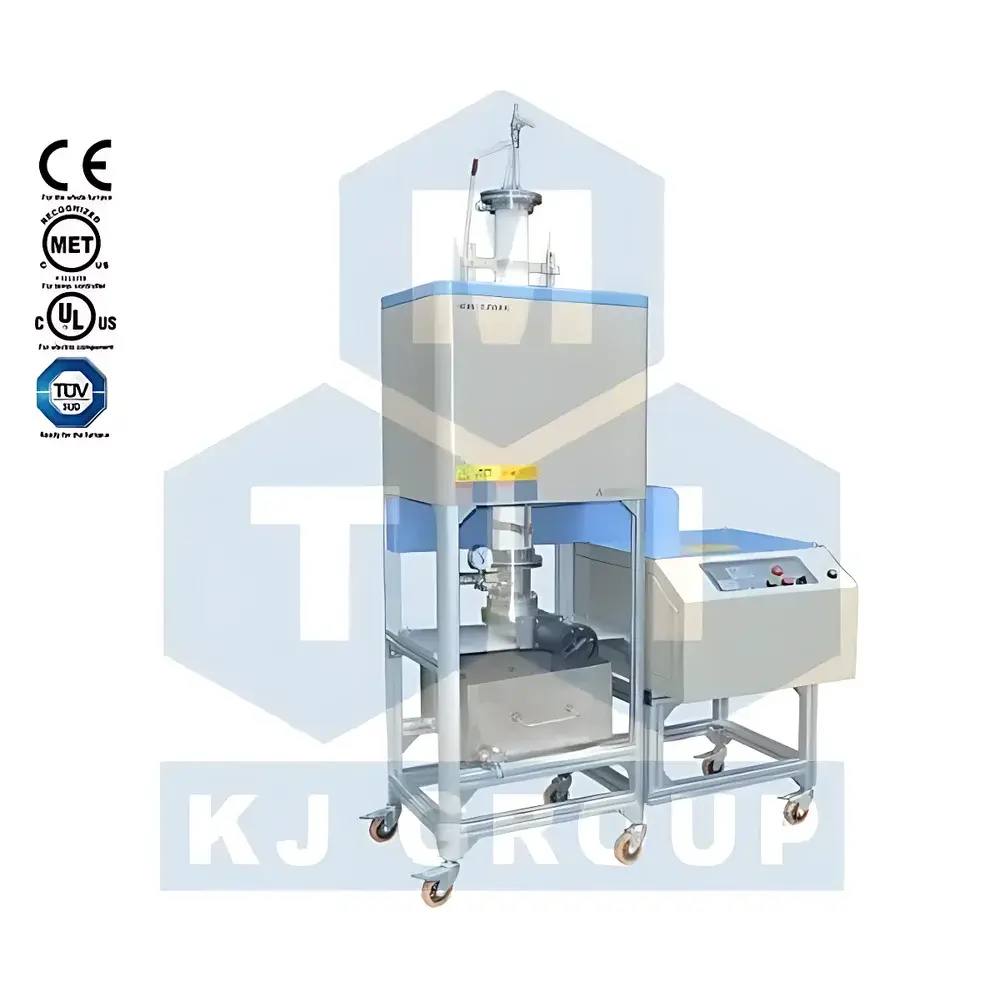
KEJING GSL-1700X-VTQ Vertical Vacuum Tube Quenching Furnace
| Brand | KEJING |
|---|---|
| Model | GSL-1700X-VTQ |
| Max Temperature | 1700 °C |
| Temp Control Accuracy | ±1 °C |
| Max Power | 4 kW |
| Heating Rate | 5 °C/min above 1200 °C, 10 °C/min below 1200 °C |
| Heating Element | Four U-shaped MoSi₂ rods |
| Tube Dimensions (Std) | OD 60 mm × ID 54 mm × L 850 mm |
| Hot Zone Length | 130 mm |
| Uniform Zone Length | 65 mm |
| Vacuum Level (Mechanical Pump) | 50 mTorr |
| Vacuum Level (High-Vac Option) | 10⁻⁵ Torr |
| Input Voltage | 220 V AC, 50/60 Hz |
| Weight | 190 kg |
| Certifications | CE, UL/MET/CSA (components >24 V), RoHS-compliant |
Overview
The KEJING GSL-1700X-VTQ is a vertically oriented, vacuum-capable tube furnace engineered for controlled high-temperature thermal processing followed by rapid quenching—enabling precise investigation of solid-state phase transformations, metastable phase stabilization, and microstructural evolution in advanced ceramics, refractory metals, and functional oxides. Unlike conventional horizontal tube furnaces, its vertical architecture integrates a gravity-driven sample drop mechanism directly into the heated zone, allowing specimens to transition from peak temperature (up to 1700 °C) to liquid quench media—such as water, oil, or inert cryogenic baths—in under 1 second. This design minimizes thermal lag and ensures reproducible cooling rates critical for kinetic studies governed by Avrami-type nucleation models or Johnson–Mehl–Avrami–Kolmogorov (JMAK) analysis. The furnace operates under programmable vacuum or inert gas (Ar, N₂) environments, supporting both oxidation-sensitive synthesis and quenching under controlled partial pressures. Its dual-shell construction with high-purity alumina fiber insulation maintains external surface temperatures below 65 °C at full operating load, complying with IEC 61000-3-2 harmonic emission limits and OSHA 1910.1096 thermal safety guidelines.
Key Features
- Vertical gravity-drop quenching system with electromagnetic sample release and manual gate valve control—enabling sub-second transfer from 1700 °C to liquid media
- UL/MET/CSA-certified electrical components (>24 V) and CE-marked mechanical assembly—fully compliant with EU Machinery Directive 2006/42/EC
- Four U-shaped MoSi₂ heating elements delivering stable operation up to 1700 °C for ≤1 h; optional imported-grade rods available for extended service life under cyclic thermal stress
- Integrated vacuum manifold with KF-25 flange, stainless steel needle valve, analog pressure gauge, and bottom-mounted slide gate valve—compatible with standard two-stage rotary vane pumps or optional turbomolecular systems
- PID-based 30-segment programmable temperature controller with RS485 interface, over-temperature cutoff, and real-time data logging capability via optional PC software (KEJING TempLog Pro)
- Alumina (Al₂O₃) tube configuration (standard: OD 60 mm, ID 54 mm, L 850 mm); optional 80 mm OD variant for larger sample holders or multi-position crucible racks
Sample Compatibility & Compliance
The GSL-1700X-VTQ accommodates cylindrical samples up to 50 mm in diameter and 100 mm in length, mounted on quartz or graphite hangers suspended from the electromagnetic release hook. It supports inert-atmosphere sintering (Ar/N₂), vacuum annealing (down to 10⁻⁵ Torr with turbo pump), and reactive gas treatments (e.g., low-pO₂ carburization). All wetted components—including the stainless steel quench vessel, gate valves, and flanges—meet ASTM A240 Type 316L material specifications for corrosion resistance. Vacuum integrity is validated per ISO 2859-1 sampling plans, and thermal uniformity across the 65 mm isothermal zone conforms to ASTM E220 calibration standards for thermocouple placement. The system meets GLP audit requirements for traceable temperature profiles, including electronic signature support and 21 CFR Part 11–compliant audit trails when paired with KEJING’s certified software module.
Software & Data Management
KEJING TempLog Pro (optional add-on) provides bidirectional communication via RS485-to-USB interface, enabling remote program upload/download, real-time temperature curve visualization, and export of .csv/.xlsx datasets with timestamped metadata (setpoint, actual, ramp rate, dwell time, vacuum level). Each logged session includes automatic checksum validation and tamper-evident file hashing. The software supports batch-mode execution of identical thermal cycles across multiple runs, with built-in deviation alerts if measured temperature deviates >±2 °C from setpoint for >30 s. All firmware updates are digitally signed and verified prior to installation, satisfying IEC 62443-3-3 SL2 cybersecurity requirements for laboratory instrumentation.
Applications
- Quench kinetics studies of Ni-based superalloys and Ti-6Al-4V to map martensite start (Ms) and finish (Mf) temperatures
- Rapid solidification processing of bulk metallic glasses (BMGs) and amorphous oxide thin films
- Thermally induced phase separation in multiferroic perovskites (e.g., BiFeO₃–BaTiO₃)
- Controlled decomposition of precursor salts for nanostructured cathode materials (e.g., LiNi₀.₈Co₀.₁₅Al₀.₀₅O₂)
- High-temperature oxidation resistance testing of C/SiC composites under dynamic vacuum–inert gas switching protocols
FAQ
What vacuum level can be achieved with the standard mechanical pump?
With the included two-stage rotary vane pump, base pressure reaches ≤50 mTorr (6.7 Pa) after 45 minutes of pumping; this is sufficient for most oxide ceramic annealing and inert-gas quenching applications.
Is the furnace compatible with hydrogen atmospheres?
Hydrogen use requires optional H₂-rated stainless steel seals, leak-tested bellows valves, and explosion-proof electrical enclosures—available as a factory-configured option (KEJING H₂-Ready Package).
Can the quench vessel be cooled externally during operation?
Yes—the stainless steel quench box features threaded ports for integration with recirculating chillers (e.g., Julabo F25) to maintain bath temperatures between –40 °C and +80 °C.
Does the system support automated vacuum–gas cycling?
When equipped with KEJING’s optional Mass Flow Controller (MFC) Kit and vacuum interlock logic board, the furnace executes fully automated sequences of evacuation, backfilling, and pressure-hold steps per user-defined recipes.
What is the expected lifetime of the MoSi₂ heating elements at 1700 °C?
At continuous operation near 1700 °C, standard MoSi₂ rods exhibit ~200–300 hours of service life; imported high-density variants extend this to ≥500 hours under identical conditions, as verified per ASTM C1161 flexural strength retention testing.



