
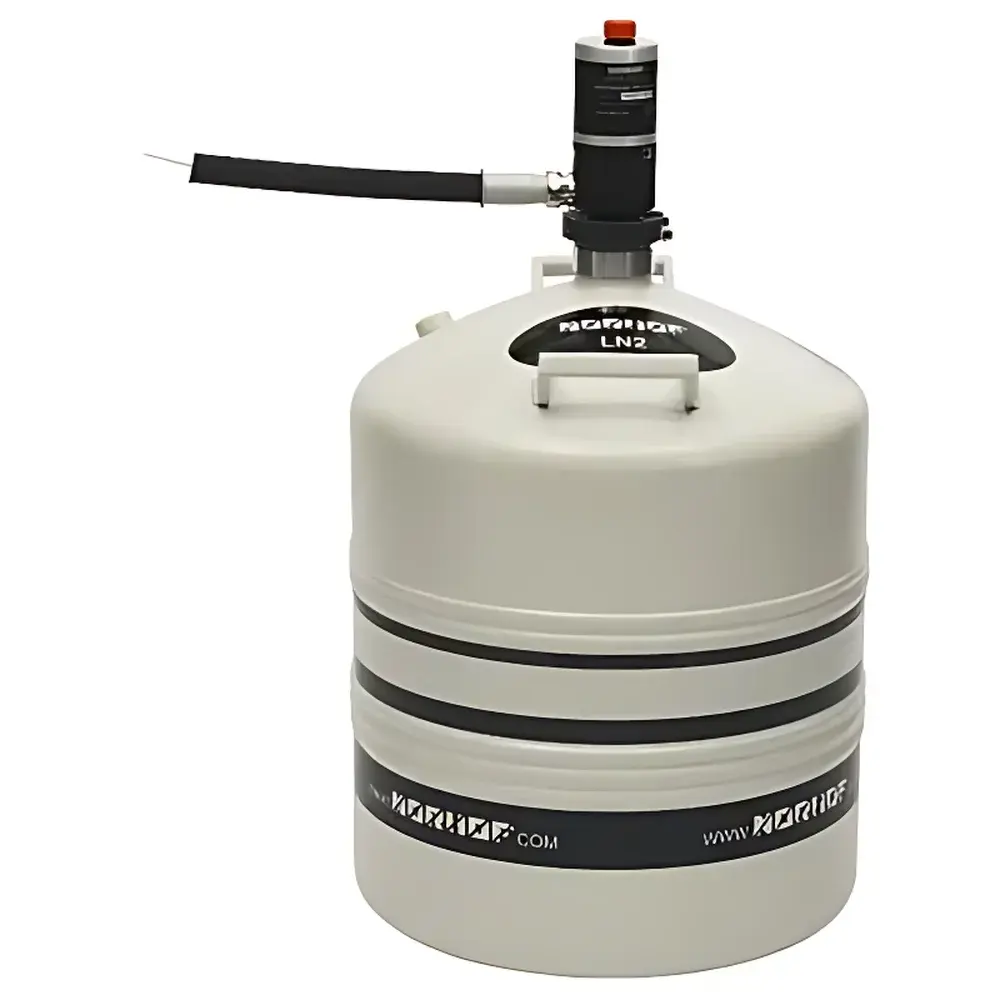
Norhof 855 Fully Automated Cryogenic Liquid Nitrogen Supply System
| Brand | Norhof |
|---|---|
| Origin | Netherlands |
| Model | 855 |
| Supply Flow Rate | 0–60 L/hr |
| Temperature Range | Ambient to –160 °C |
| Pressure Control | PID-regulated |
| Static Evaporation Rate | <0.5 L/day |
| Nominal Dewar Capacities | 50 L and 100 L |
| Power Input | 115/230 V AC or 24 V DC |
| Average Power Consumption | 125 W (up to 250 W during delivery) |
| Standard Tubing | PTFE-lined, OD 9.6 mm / ID 6.6 mm, insulated with 32 mm closed-cell foam |
| Pre-cooling Time (2 m line) | ±1 min |
| Control Interface | RS232 + 5 V TTL trigger |
| Software | PC-based monitoring & parameter configuration |
| Safety Features | Dual-level LN₂ level sensing, freeze detection, overpressure mechanical relief valve, audible/visual alarms |
Overview
The Norhof 855 Fully Automated Cryogenic Liquid Nitrogen Supply System is an engineered solution for precise, low-heat-load delivery of liquid nitrogen (LN₂) in life science laboratories requiring stable ultra-low temperature environments. Unlike conventional pressurized dewar transfer systems, the 855 employs a closed-loop, pump-driven distribution architecture that eliminates reliance on vented headspace pressure—thereby removing uncontrolled thermal ingress through open valves. Its core operation is based on positive-displacement cryogenic pumping, coupled with real-time PID-controlled thermal regulation of the gas-phase nitrogen stream downstream of vaporization. This enables accurate temperature modulation (from ambient to –160 °C) via dynamic adjustment of mass flow rate, rather than passive pressure throttling. Designed specifically for integration with biological cryostorage infrastructure—including automated sample retrieval systems, cryo-microtomes, and controlled-rate freezers—the 855 ensures consistent thermal stability, minimal boil-off, and operational silence during LN₂ dispensing.
Key Features
- Zero-valve LN₂ delivery architecture: Eliminates thermal leakage pathways associated with solenoid or manual isolation valves, reducing standby heat load and improving static evaporation performance (<0.5 L/day).
- Integrated PID temperature control: Maintains setpoint accuracy within ±0.5 °C across the full output range (0–60 L/hr), with response stabilization achieved within ±1 minute after line pre-cooling.
- Modular dewar compatibility: Supports standard 50 L and 100 L Norhof-certified LN₂ dewars with validated thermal mass and structural integrity for long-term vacuum retention.
- Low-noise, vibration-free operation: Optimized pump dynamics and acoustic damping reduce mechanical transmission—critical for proximity to sensitive instrumentation such as electron microscopes or high-resolution imaging platforms.
- Embedded dual-level sensing: Primary and secondary capacitive LN₂ level sensors provide redundant monitoring; system triggers alarm at ≤5 L remaining and disables delivery if sensor fault or freeze condition is detected.
- Compliance-ready control interface: RS232 serial port and TTL-compatible 5 V trigger inputs enable synchronization with laboratory automation controllers (e.g., PLCs, LIMS), supporting audit-trail-capable workflows under GLP/GMP frameworks.
Sample Compatibility & Compliance
The Norhof 855 is intended for use with biological samples stored in vapor-phase or two-phase cryogenic environments, including but not limited to cryovials, straws, canes, and cassette-based biobanking formats. It meets ISO 13485 design control principles for medical device support equipment and conforms to IEC 61000-6-2 (immunity) and IEC 61000-6-4 (emission) electromagnetic compatibility standards. All wetted components—including PTFE-lined stainless steel tubing, Viton® seals, and vacuum-jacketed dewar neck tubes—are certified biocompatible per USP Class VI and EU Regulation (EC) No 1935/2004. The system supports 21 CFR Part 11-compliant data logging when used with validated third-party software extensions.
Software & Data Management
The included Windows-based monitoring application provides real-time visualization of pump status, flow rate, outlet temperature, dewar level, and alarm history. Users may configure up to seven predefined operating modes (Mode 1–7), each assigning distinct flow/temperature profiles for specific applications—for example, slow ramp-down for tissue vitrification versus rapid cooldown for cryo-EM grid preparation. All parameter changes are timestamped and logged locally; export options include CSV and XML formats compatible with laboratory information management systems (LIMS). Audit trail functionality records operator ID (via Windows login), action type, and pre-/post-change values—enabling traceability required for FDA inspection readiness.
Applications
- Automated replenishment of cryogenic storage units (e.g., -150 °C vapor-phase freezers) without manual intervention or thermal disturbance.
- Controlled-rate freezing of primary cells, stem cell lines, and oocytes using programmable thermal profiles synchronized with external cooling stages.
- Stable nitrogen supply for cryo-electron microscopy sample preparation stations, where vibration and temperature drift compromise ice-layer uniformity.
- Integration into robotic biobanking workflows requiring repeatable, low-variability LN₂ dosing per sample rack or storage box.
- On-demand cooling for cryogenic machining test benches and materials science thermal cycling rigs.
FAQ
What is the maximum continuous flow rate, and how is it maintained across varying ambient conditions?
The system delivers up to 60 L/hr continuously under nominal inlet pressure (<300 mBar) and ambient temperatures ≤30 °C. Flow stability is ensured by active pressure regulation and real-time feedback from inline Coriolis-type mass flow sensors.
Can the 855 be integrated into a facility-wide BMS or SCADA system?
Yes—via its RS232 port and Modbus RTU protocol support (available as optional firmware upgrade), enabling read/write access to all operational parameters and alarm states.
Is remote diagnostics supported?
Remote troubleshooting is possible through secure RDP-enabled PC connection to the host controller; however, no cloud connectivity or vendor telemetry is embedded in the base configuration.
Does the system require annual calibration?
No scheduled recalibration is mandated; however, users are advised to verify flow accuracy annually using NIST-traceable thermal mass flow calibrators per ISO/IEC 17025 guidelines.
What safety certifications does the 855 hold for installation in cleanroom environments?
It carries CE marking per Machinery Directive 2006/42/EC and ATEX Category 3G certification (II 3G Ex nA IIC T4 Gc) for use in Zone 2 explosive atmospheres—common in centralized LN₂ utility rooms.
Related Products



