
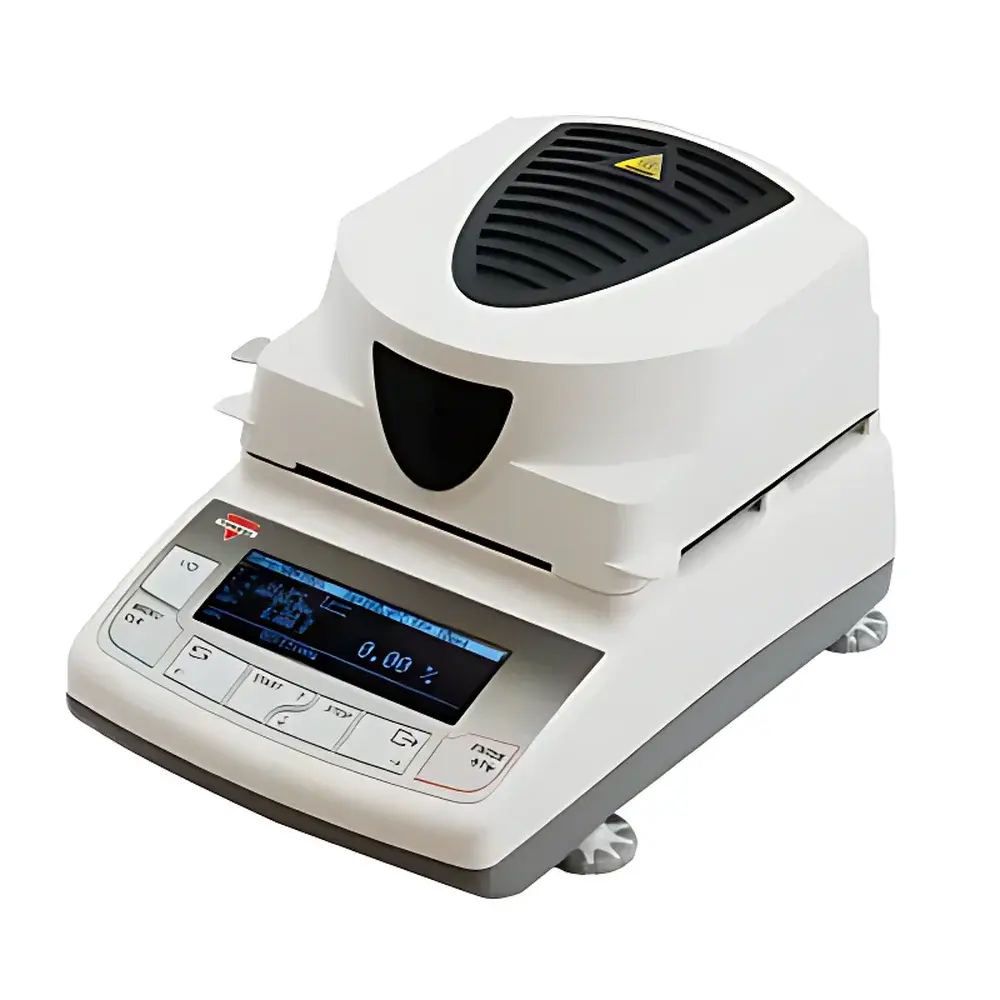
SI Torbal ATS Series Precision Infrared Moisture Analyzer
| Brand | Scientific Industries |
|---|---|
| Origin | USA |
| Model | ATS60, ATS120 |
| Heating Method | Halogen Lamp |
| Max Capacity | 60 g / 120 g |
| Readability | 0.001 g |
| Linearity | ±0.002 g |
| Accuracy Class | II |
| Resolution | 0.01% |
| Moisture Measurement Accuracy | ±0.1% (2 g sample), ±0.04% (5 g sample), 1% (0.02–0.5 g sample) |
| Drying Temperature Range | Up to 160 °C |
| Drying Time Range | 1–600 s (10 hr max) |
| Drying Power | 200 W |
| Preheat Time | ~60 s |
| Pan Diameter | 90 mm |
| Drying Chamber Dimensions | 108 × 20 mm |
| External Dimensions | 185 × 290 × 170 mm |
| Net Weight | 6.8 kg |
| Interfaces | USB, RS232C, PS2 |
Overview
The SI Torbal ATS Series Precision Infrared Moisture Analyzer is a dual-function analytical instrument engineered for rapid, gravimetric moisture determination in solid and semi-solid samples. It integrates high-precision electromagnetic force compensation weighing technology with controlled halogen lamp heating—enabling real-time mass loss monitoring during thermal drying. Unlike traditional oven-dry methods requiring hours, the ATS system delivers repeatable moisture content results in minutes by applying programmable temperature profiles and precisely tracking weight change until endpoint stability is achieved. Designed for routine quality control laboratories, pharmaceutical manufacturing environments, food processing facilities, and academic research settings, the ATS platform complies with core principles outlined in ASTM D4442 (Standard Test Methods for Direct Moisture Content of Wood and Wood-Based Materials), ISO 712 (Cereals and Cereal Products – Determination of Moisture Content), and USP <921> (Water Determination). Its robust architecture supports GLP-compliant workflows through audit-trail-capable data logging and hardware-level calibration traceability.
Key Features
- Electromagnetic force compensation load cell delivering 0.001 g readability and ±0.002 g linearity across full capacity (60 g or 120 g models)
- 200 W adjustable halogen lamp heating system with precise external temperature control up to 160 °C, ensuring uniform thermal energy distribution and minimal sample oxidation
- Backlit graphical LCD display with intuitive icon-driven interface supporting multilingual menus (English, Spanish, German, French)
- Onboard memory storing up to 20 user-defined drying protocols—including four preconfigured drying curve types (Standard, Rapid, Step, Slow) and three analysis modes (Auto, Time, Manual)
- Integrated thermal calibration function with automatic self-diagnostic startup sequence verifying sensor integrity, heater response, and display synchronization
- Dual communication architecture featuring native USB 2.0 (for direct PC connection and firmware updates), RS232C (for legacy LIMS integration), and PS2 (for optional external keyboard input)
Sample Compatibility & Compliance
The ATS analyzer accommodates a broad range of hygroscopic and thermally sensitive materials—including powders, granules, pellets, pastes, and thin films—within its 90 mm diameter stainless-steel weighing pan and compact 108 × 20 mm drying chamber. Sample mass ranges from 0.02 g to 120 g, with optimized accuracy performance validated per ISO 12099:2017 (Animal feeding stuffs — Guidelines on moisture determination). Moisture measurement uncertainty is certified at ±0.1% for 2 g reference samples and ±0.04% for 5 g samples under controlled ambient conditions (23 ± 2 °C, RH ≤ 50%). All units ship with NIST-traceable calibration certificates and comply with IEC 61000-4 electromagnetic compatibility standards. The device meets CE marking requirements and supports FDA 21 CFR Part 11 readiness when paired with validated third-party data management software.
Software & Data Management
Data export and reporting are facilitated via bundled Windows-compatible software that enables real-time graphing of mass vs. time curves, derivative moisture loss rate visualization, and customizable PDF report generation—including sample ID, operator name, timestamp, drying parameters, final moisture %, and statistical deviation metrics. Each measurement record contains embedded metadata (e.g., ambient temperature/humidity logs if connected to optional environmental sensors) and supports CSV/Excel batch export for statistical process control (SPC) analysis. Audit trails capture all parameter modifications, calibration events, and user logins—fully aligned with GMP Annex 11 and ALCOA+ data integrity principles. Firmware updates are delivered over USB without requiring service engineer intervention.
Applications
- Pharmaceutical raw material release testing (excipients, APIs, lyophilized powders)
- Food quality assurance (flour, dairy powders, coffee beans, spices, pet food)
- Chemical manufacturing (catalysts, resins, pigments, battery electrode materials)
- Agricultural product grading (grains, seeds, forage, biomass feedstock)
- Polymer and composite R&D (moisture impact on melt flow index, tensile strength, and shelf-life modeling)
- Environmental lab analysis (soil moisture profiling, sludge dewatering efficiency studies)
FAQ
What is the recommended sample preparation protocol before analysis?
Samples should be homogenized and evenly distributed across the pan surface to maximize heat transfer uniformity. Avoid overloading beyond 70% of pan area; particle size should be consistent (< 2 mm nominal) unless specified otherwise by method validation.
Does the ATS series support method validation per pharmacopeial guidelines?
Yes—the instrument’s repeatability (RSD < 0.5% for n=10 at 5 g sample), intermediate precision, and robustness meet ICH Q2(R2) expectations when operated within defined environmental and procedural constraints.
Can the drying temperature be ramped or held at multiple setpoints during one run?
No—the ATS implements single-stage temperature control. Multi-step thermal profiles require external scripting via PC-connected software or manual intervention between sequential runs.
Is the weighing pan removable for cleaning or replacement?
Yes—the stainless-steel pan is tool-free detachable and autoclavable. Replacement pans (part #ATS-PAN-SS) are available with identical dimensional tolerances and thermal mass characteristics.
How often must the instrument undergo recalibration?
Annual verification against certified weights and temperature references is recommended. Internal diagnostics and daily zero-point checks fulfill routine operational qualification (OQ) requirements.






