
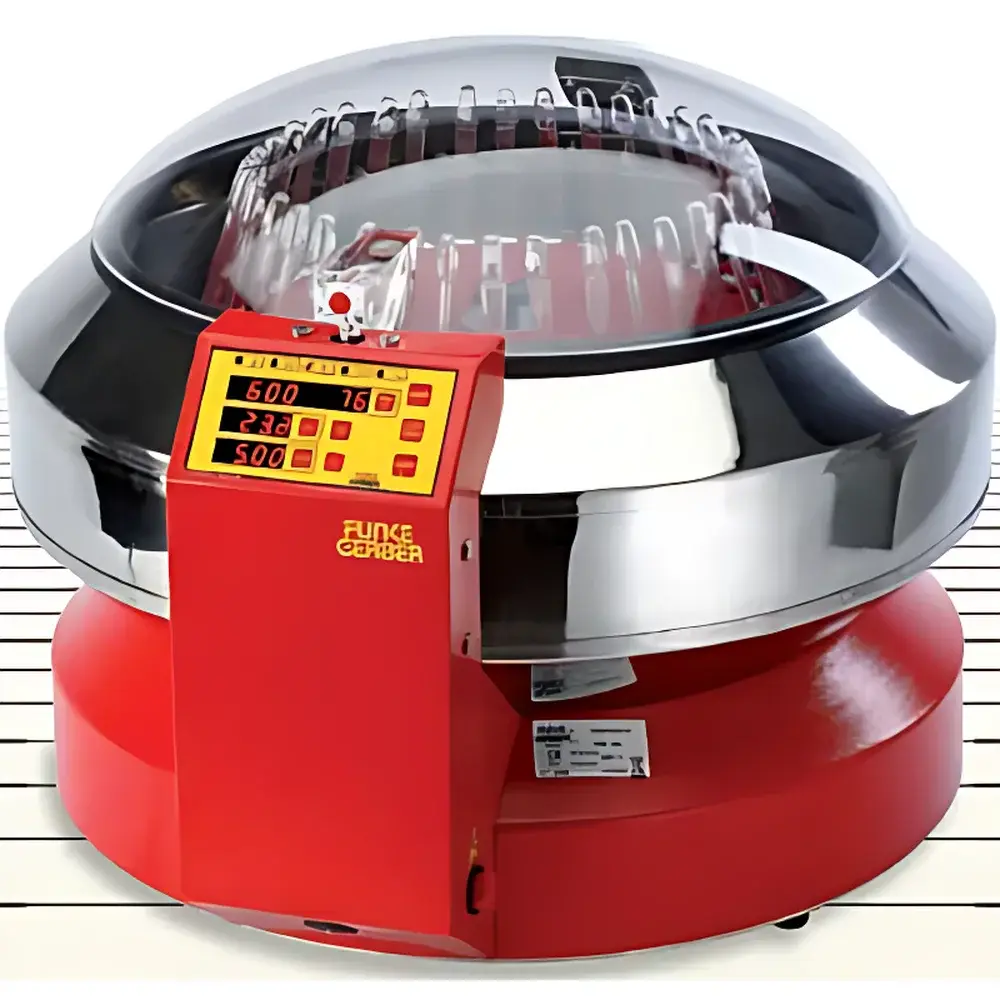
Funke Gerber SuperVario-N Gerber Centrifuge for Dairy Fat Analysis
| Brand | Funke Gerber |
|---|---|
| Origin | Germany |
| Model | SuperVario-N |
| Max Speed | 1130 rpm |
| Max RCF | 372 × g |
| Speed Range | 600–1130 rpm (adjustable in 10 rpm increments) |
| Temperature Range | Ambient to 68 °C (adjustable in 1 °C increments) |
| Time Setting | 1–99 min |
| Heating Function | Yes (maintains sample tube temperature ≥50 °C during operation) |
| Pre-programmed Methods | Gerber, Babcock, Rose-Gottlieb, Solubility Method |
| Safety Features | Automatic lid lock, imbalance detection, electronic braking |
| Power Supply | 230 V / 50 Hz |
| Net Weight | 26 kg |
| Rotor Options | Rotor A (Gerber, 36×31 mm tubes), Rotor B (Babcock, 36×32 mm tubes), Rotor C (Rose-Gottlieb, custom adapter), Rotor D (Solubility/ADMI, 36×33 mm tubes) |
| Compliance | CE-marked, designed per IEC 61010-1 for laboratory equipment safety |
Overview
The Funke Gerber SuperVario-N is a precision-engineered, thermally regulated Gerber centrifuge designed specifically for standardized fat determination in milk, cream, and dairy-based products. It operates on the principle of differential sedimentation under controlled centrifugal force and elevated temperature—key requirements defined in international reference methods including ISO 2446 (Gerber method), ISO 3725 (Babcock), ISO 12151 (Rose-Gottlieb), and AOAC 921.07 (solubility-based fat extraction). Unlike general-purpose centrifuges, the SuperVario-N integrates calibrated heating, programmable rotational profiles, and method-specific rotor configurations to ensure reproducible phase separation of fat globules from aqueous and protein matrices. Its architecture conforms to DIN EN 61010-1 safety standards for laboratory electrical equipment and supports routine compliance with GLP and dairy quality assurance protocols.
Key Features
- Thermally stabilized chamber: Maintains consistent tube wall temperature ≥50 °C during centrifugation—critical for fluidizing milk fat and minimizing interfacial tension artifacts.
- Four pre-validated analytical methods: Gerber (ISO 2446), Babcock (ISO 3725), Rose-Gottlieb (ISO 12151), and solubility-based ADMI method (AOAC 921.07), each with dedicated rotor geometry and calibration routines.
- High-reproducibility speed control: 600–1130 rpm range with 10 rpm resolution; maximum relative centrifugal force (RCF) of 372 × g at 1130 rpm (calculated at maximum radius).
- Intelligent safety system: Motor-driven automatic lid locking, real-time imbalance detection, and fail-safe electronic deceleration with brake energy dissipation.
- Modular rotor platform: Interchangeable rotors (A, B, C, D) with precisely engineered tube holders—ensuring mechanical stability for 31 mm, 32 mm, and 33 mm diameter Gerber tubes across all accredited methods.
- Programmable operational parameters: Independent setting of speed, time (1–99 min), and temperature (ambient to 68 °C, 1 °C resolution) per run sequence.
Sample Compatibility & Compliance
The SuperVario-N accommodates standard Gerber-type glass tubes used in official dairy testing laboratories worldwide. Rotor A supports 36×31 mm tubes for Gerber fat analysis; Rotor B handles 36×32 mm Babcock tubes; Rotor C enables Rose-Gottlieb extractions using specialized narrow-bore adapters; Rotor D fits 36×33 mm tubes for ADMI solubility assays. All rotors are balanced to ISO 21501-4 tolerances and validated for use with sulfuric acid, isoamyl alcohol, and other reagents specified in ISO and AOAC protocols. The instrument bears CE marking per Directive 2014/30/EU (EMC) and 2014/35/EU (LVD), and its firmware architecture allows audit-ready operation under GLP environments requiring traceable parameter logging.
Software & Data Management
While the SuperVario-N operates via an intuitive front-panel interface with tactile rotary encoder and LCD display, it supports optional RS-232 or USB-to-serial connectivity for integration into centralized laboratory information management systems (LIMS). Parameter settings—including method ID, speed, temperature, duration, and operator code—are stored in non-volatile memory with timestamping. When connected to compliant LIMS platforms, full run logs (start/stop time, actual RCF, thermal deviation, imbalance events) can be exported as CSV or XML for regulatory review. The system meets foundational data integrity expectations aligned with FDA 21 CFR Part 11 when paired with appropriate access controls and electronic signature workflows.
Applications
- Routine fat quantification in raw milk, pasteurized milk, skimmed milk, and recombined dairy products per national and Codex Alimentarius standards.
- Quality control in dairy processing plants performing incoming raw material verification and finished product release testing.
- Reference laboratory validation of alternative fat measurement techniques (e.g., FTIR, NMR) against classical gravimetric centrifugation baselines.
- Educational use in food science curricula demonstrating standardized wet chemistry methodologies for lipid analysis.
- Regulatory inspection labs conducting official dairy compositional assessments under EU Regulation (EC) No 853/2004 and US Grade A Milk Ordinance requirements.
FAQ
What standards does the SuperVario-N comply with for dairy fat analysis?
It is engineered to meet the mechanical, thermal, and timing specifications required by ISO 2446 (Gerber), ISO 3725 (Babcock), ISO 12151 (Rose-Gottlieb), and AOAC Official Method 921.07.
Can the instrument be used without external software?
Yes—the built-in control panel enables fully autonomous operation with saved method presets and real-time parameter feedback.
Is calibration documentation available for metrological traceability?
Funke Gerber provides factory calibration certificates for speed (±1 rpm), temperature (±0.5 °C), and timer (±0.1 s), traceable to PTB (Physikalisch-Technische Bundesanstalt) standards.
How is rotor imbalance detected and managed?
Vibration sensors monitor radial acceleration in real time; if deviation exceeds 0.5 mm/s² RMS, the system halts rotation and displays error code while engaging dynamic braking.
What maintenance intervals are recommended for routine operation?
Annual verification of rotor balance, temperature uniformity across chamber volume, and lid lock actuation force is advised per Funke Gerber Service Bulletin SB-SV-N-2023-01.




