
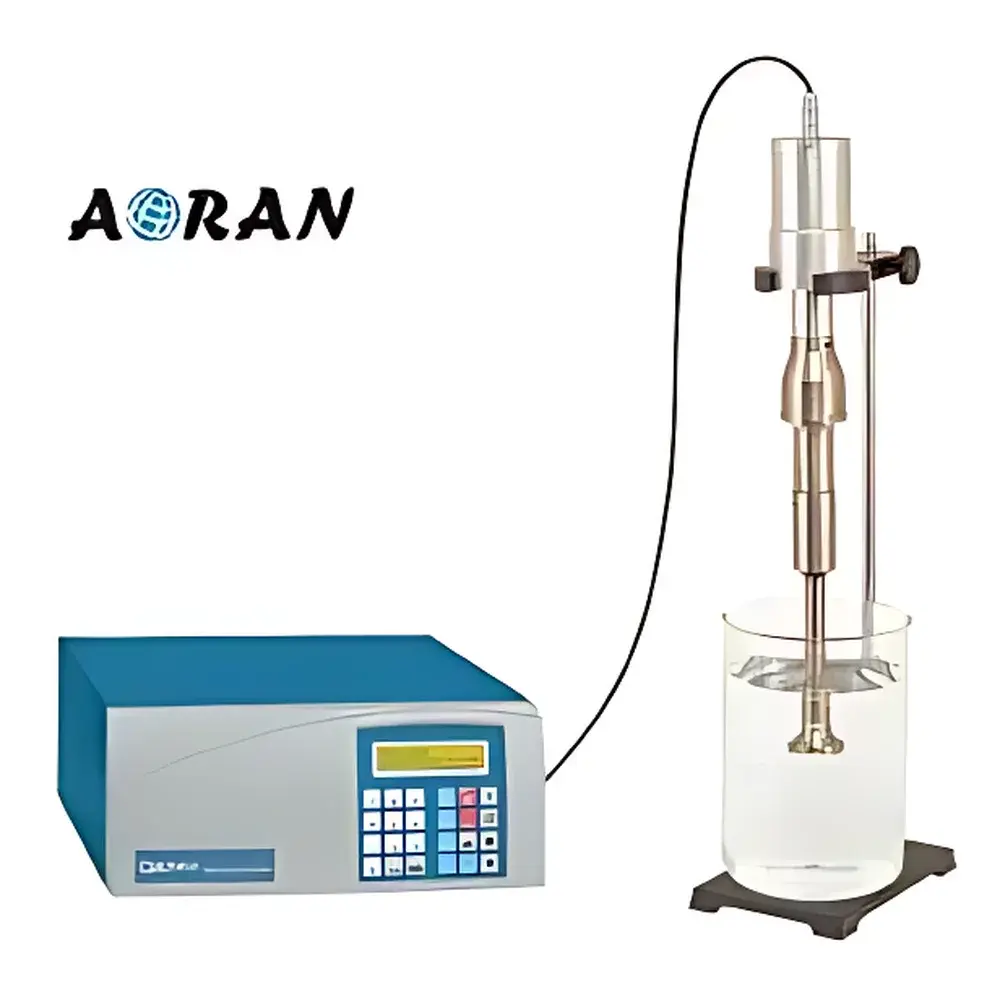
Qsonica Q2000 Industrial Ultrasonic Cell Disruptor
| Brand | Qsonica LLC |
|---|---|
| Origin | USA |
| Model | Q2000 |
| Instrument Type | Ultrasonic Cell Disruptor |
| Ultrasonic Power Output | 2000 W |
| Operating Frequency | 20 kHz |
| Temperature Range | 0–120 °C |
| Maximum Batch Sample Volume | 5 L |
| Flow-Through Capability | Yes (with Flocell chamber) |
| Amplitude Adjustment Range | 20–100% |
| Pulse Mode | Adjustable (1 s–1 min on/off cycles) |
| Continuous Operation Time | 1 s–10 hr |
| Dimensions (H × W × D) | 178 × 380 × 463 mm |
| Standard Probe | 4677 (1/2″ diameter) |
| Optional High-Capacity Probe | 4777 (1.5″ / 38 mm diameter, 25.4 cm length, 100 µm amplitude) |
| Flow Cell | Flocell with 1/2″ NPT ports, optional water-jacketed cooling and acoustic enclosure |
Overview
The Qsonica Q2000 Industrial Ultrasonic Cell Disruptor is an engineered high-power ultrasonic system designed for robust, scalable, and reproducible sample processing in industrial bioprocessing, pharmaceutical manufacturing, and advanced materials development. Based on piezoelectric transduction at a fundamental frequency of 20 kHz, the Q2000 generates intense cavitation fields within liquid media—enabling efficient mechanical disruption of cellular structures, emulsification of immiscible phases, deagglomeration of nanoparticles, and homogenization of viscous suspensions. Unlike benchtop ultrasonicators, the Q2000 integrates a modular architecture supporting both batch-mode operation (up to 5 L per cycle) and continuous-flow processing via the optional Flocell flow-through chamber. Its 2000 W output power, coupled with interchangeable high-amplitude probes—including the 38 mm (1.5″) 4777 probe delivering up to 100 µm peak-to-peak displacement—ensures reliable energy delivery into high-viscosity or highly attenuating matrices such as crude oils, fermentation broths, polymer dispersions, and slurry-based formulations.
Key Features
- Digital microprocessor control with real-time LCD display of amplitude (%), elapsed time, instantaneous power (W), and cumulative energy (J)
- Precise amplitude modulation from 20% to 100% in 1% increments—critical for optimizing shear intensity while minimizing thermal degradation
- Programmable pulse mode (on/off duration adjustable from 1 second to 1 minute) to manage heat accumulation in thermolabile samples
- Integrated overload protection circuitry safeguards transducer and generator electronics during impedance mismatch or probe stall events
- Optional PT100 temperature probe input enables closed-loop thermal monitoring; compatible with external chillers or recirculating baths for active temperature control (0–120 °C range)
- Rugged aluminum chassis and IP20-rated enclosure ensure long-term operational stability in controlled industrial environments
Sample Compatibility & Compliance
The Q2000 accommodates diverse sample types across life science, chemical, and materials applications—including microbial cell lysates, mammalian tissue homogenates, lipid nanoparticle (LNP) suspensions, ceramic slurries, and food-grade emulsions. Its probe-based design allows direct immersion into vessels ranging from beakers to jacketed reactors, while the Flocell flow cell supports GMP-aligned continuous processing with traceable parameter logging. The system complies with IEC 61000-6-3 (EMC emissions) and IEC 61000-6-2 (immunity); when configured with audit-trail-enabled software and electronic signatures, it meets foundational requirements for FDA 21 CFR Part 11 adherence in regulated environments. Routine calibration verification can be performed using ASTM E2810-11 (standard practice for ultrasonic processor performance assessment) and ISO 20483:2017 (acoustic cavitation dosimetry).
Software & Data Management
While the Q2000 operates autonomously via front-panel controls, optional Q-View PC software enables remote configuration, real-time data streaming (amplitude, power, time, temperature), and export of CSV-formatted logs for QA/QC documentation. All parameter changes are timestamped and user-annotated, supporting GLP/GMP traceability. Data files include checksum validation and may be archived in secure network folders compliant with internal document retention policies. Integration with LIMS platforms is achievable via Modbus TCP or ASCII serial protocol upon request.
Applications
- Industrial-scale microbial lysis for recombinant protein recovery (E. coli, yeast, Pichia)
- Preparation of exosome-enriched supernatants from cell culture media
- High-shear nanoemulsion formation for topical drug delivery systems
- Dispersion of carbon nanotubes and graphene oxide in aqueous or organic solvents
- Accelerated solvent extraction (ASE) of botanical compounds under mild thermal conditions
- In-line degassing and deaeration of adhesives, coatings, and battery electrolytes
FAQ
What is the maximum viscosity the Q2000 can effectively process in batch mode?
The Q2000 has demonstrated consistent cavitation efficiency in fluids up to 10,000 cP when used with the 4777 probe and optimized amplitude/pulse settings.
Can the Flocell chamber be sterilized in place (SIP)?
Flocell components are constructed from 316 stainless steel and PTFE; SIP is feasible at ≤121 °C for ≤30 minutes, provided cooling jacket lines are drained and pressure-rated fittings are verified.
Is probe wear monitored or quantified by the system?
No built-in wear sensor exists; however, routine amplitude verification using a calibrated laser vibrometer (e.g., Polytec OFV-5000) is recommended every 200 operational hours or after 5000 cycles.
Does Qsonica provide IQ/OQ documentation packages?
Yes—factory-verified Installation Qualification (IQ) and Operational Qualification (OQ) protocols are available upon order, aligned with ISO 9001:2015 and user-defined URS specifications.
What maintenance intervals are recommended for the transducer and generator?
Annual inspection of transducer bonding integrity and generator capacitor health is advised; consumable parts (gaskets, O-rings, probe tips) should be replaced per usage log or visible erosion.




