
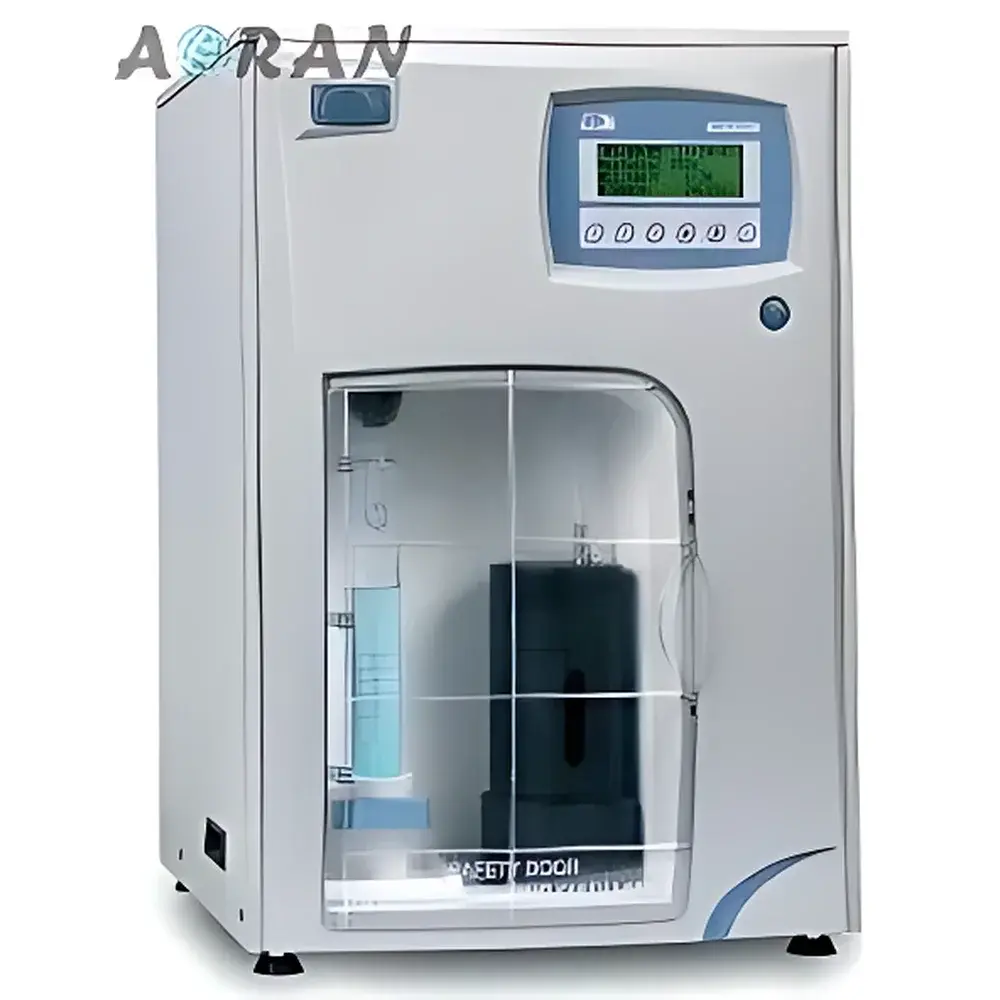
Selecta Pro-Nitro A Automated Kjeldahl Nitrogen Determinator
| Brand | Selecta |
|---|---|
| Origin | Spain |
| Model | Pro-Nitro A |
| Instrument Type | Kjeldahl Nitrogen Determinator |
| Nitrogen Range | 0.1–200 mg |
| Distillation Rate | 35–45 mL/min |
| Repeatability | ≤ ±1% |
| Sample Volume Capacity | 15 mL |
| Recovery Rate | >99.5% |
| Power Consumption | 1800 W |
| Dimensions (L×W×H) | 75×50×50 cm |
| NaOH Reservoir Capacity | 2 L |
| Boric Acid Reservoir Capacity | 2 L |
| Titrant Reservoir Capacity | 2 L |
| Steam Generator Water Tank Capacity | 6 L |
| Steam Generator Water Consumption | 2 L/hr |
| Cooling Water Flow Requirement | 80–100 L/hr |
| Minimum Titrant Dispense Volume | 0.01 mL |
| Reading Accuracy | ±1.5% |
Overview
The Selecta Pro-Nitro A Automated Kjeldahl Nitrogen Determinator is a fully integrated, benchtop analytical system engineered for precise, reproducible quantification of total nitrogen content in organic and inorganic samples via the classical Kjeldahl digestion–distillation–titration method. Based on ISO 8968-1, AOAC 981.10, and ASTM D1142 standards, the instrument automates all critical stages—alkaline distillation under controlled steam flow, boric acid trapping of liberated ammonia, and potentiometric or colorimetric back-titration—with minimal operator intervention. Its modular architecture embeds a steam generator, reagent reservoirs (NaOH, boric acid, HCl/H2SO4), peristaltic dosing pumps, condenser, titration cell, and integrated cooling interface within a compact 75 × 50 × 50 cm footprint. Designed for routine QC laboratories in food, feed, environmental, and agricultural sectors, the Pro-Nitro A delivers trace-level accuracy (0.1 mg N detection limit) and high-throughput capability (typical cycle time < 10 min/sample post-digestion), ensuring compliance with GLP and GMP documentation requirements.
Key Features
- Automated end-point detection via colorimetric analysis using integrated photometric sensor—eliminates subjectivity inherent in manual visual endpoint recognition
- Dual-mode titration support: configurable for either potentiometric or colorimetric titration, with real-time pH or absorbance monitoring
- Intelligent reagent management: independent peristaltic pumps for NaOH (30% w/w), boric acid (4% w/w + indicator), and titrant (0.1 M HCl or H2SO4) ensure consistent delivery and reduce maintenance frequency
- Self-diagnostic safety architecture: interlocked sample tube holder, motorized safety shield, low-coolant-pressure cutoff, steam generator dry-run protection, and thermal over-limit shutdown prevent operational hazards
- Full process automation: automatic sample transfer post-distillation, residual sample evacuation to dedicated waste container, and sequential reagent priming without manual valve actuation
- Embedded LCD interface with membrane keypad enables parameter programming (distillation time, titrant volume limits, delay intervals), real-time monitoring of titrant consumption and calculated nitrogen mass, and time-stamped method recall
Sample Compatibility & Compliance
The Pro-Nitro A accepts standard Kjeldahl digestion tubes (e.g., 15 mL capacity) and accommodates solid, liquid, and semi-solid matrices—including cereals, dairy products, meat, soil extracts, wastewater sludge, and fertilizer formulations—following validated digestion protocols (e.g., ISO 5983-1). All fluid-handling components are chemically resistant to concentrated alkali and acidic reagents. The system meets CE marking requirements and supports audit-ready operation under FDA 21 CFR Part 11 when paired with optional secure user authentication and electronic signature modules. Data integrity is maintained through non-volatile memory storage of method parameters, raw titration curves, and final reports—including nitrogen mass, % protein (using standard conversion factors), and recovery statistics—traceable to individual analyst IDs and timestamps.
Software & Data Management
While the base unit operates autonomously via embedded firmware, optional PC connectivity (RS-232 or USB) enables integration with LIMS or custom laboratory software for centralized data aggregation. All measurements are stored with full metadata: date/time stamp, operator ID, sample ID, method version, reagent lot numbers (if entered manually), distillation duration, titrant volume consumed, and calculated nitrogen concentration. Reports comply with ISO/IEC 17025 documentation guidelines and include uncertainty estimation based on repeatability (≤±1%) and reading accuracy (±1.5%). Optional thermal printer output provides hard-copy validation records suitable for regulatory inspections.
Applications
- Food & Feed Industry: Crude protein determination in grains, flour, soybean meal, pet food, and infant formula per AOAC 981.10 and EN ISO 20483
- Agricultural Testing: Total nitrogen quantification in compost, manure, and soil extracts for nutrient balance modeling
- Environmental Monitoring: Organic nitrogen load assessment in municipal wastewater influent/effluent and sludge digestates (EPA Method 351.2)
- Research Laboratories: Method development and validation studies requiring high inter-day precision and reagent consumption tracking
- Contract Testing Facilities: High-volume routine analysis where walk-away automation and GLP-compliant reporting reduce labor cost and transcription errors
FAQ
What digestion equipment is required upstream of the Pro-Nitro A?
The Pro-Nitro A performs only distillation and titration; digestion must be completed separately using a certified block digester or microwave system prior to loading digested samples.
Can the instrument be configured for both HCl and H2SO4 titrants?
Yes—the titrant reservoir and pump tubing are compatible with either 0.1 M hydrochloric acid or sulfuric acid; switching requires only reagent replacement and method parameter adjustment.
Is calibration required before each analysis series?
No external calibration is needed; the system relies on gravimetrically prepared standard ammonium sulfate solutions for method validation and periodic recovery verification (>99.5% target).
How is cooling water integrated into the system?
A continuous-flow external cooling circuit (80–100 L/hr at 10–25 °C) connects via quick-fit couplings to the condenser; low-flow sensors trigger immediate distillation halt to protect glassware.
What maintenance intervals are recommended for peristaltic pump tubing?
Tubing for NaOH, boric acid, and titrant lines should be inspected weekly and replaced every 3–6 months depending on daily usage volume and reagent aggressiveness.
Related Products




