
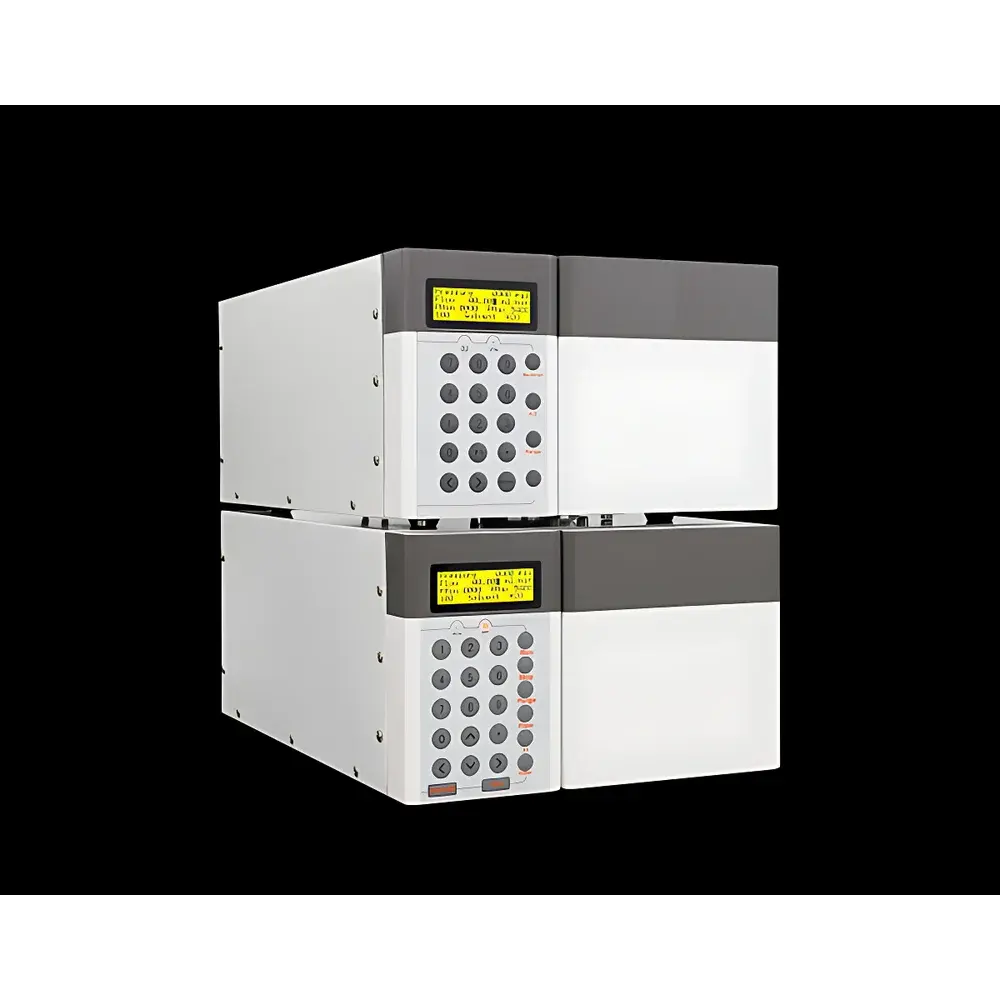
Jinpu LC-4000 High-Performance Liquid Chromatograph (HPLC)
| Brand | Jinpu |
|---|---|
| Origin | Shandong, China |
| Model | LC-4000 |
| Instrument Type | Analytical-Grade High-Performance Liquid Chromatograph |
| Flow Rate Range | 0.001–10.000 mL/min (adjustable in 0.001 mL/min increments) |
| Maximum Operating Pressure | 43 MPa |
| Sample Injection Volume | 1–50 µL |
| Autosampler Capacity | 100 positions (1.5 mL vials) |
| Column Oven Temperature Range | Ambient +10 °C to 60 °C |
| UV-Vis Wavelength Range | 170–900 nm |
| Data Acquisition Rate | 100 Hz |
| Flow Accuracy | ≤ ±1% (at 1.000 mL/min, 8.5 MPa, water, 25 °C) |
| Flow Precision | RSD ≤ 0.25% |
| Baseline Noise | ≤ 2 × 10⁻⁵ AU (methanol, 1 mL/min, 254 nm, 20 °C) |
| Baseline Drift | ≤ 4 × 10⁻⁴ AU/hr (methanol, 1 mL/min, 254 nm, 20 °C, 60 min equilibration) |
| Cell Volume | 10 µL |
| Optical Path Length | 5 mm |
| Light Source | Deuterium Lamp |
Overview
The Jinpu LC-4000 is a fully integrated, analytical-grade high-performance liquid chromatograph engineered for precision, robustness, and regulatory compliance in routine QC laboratories and research environments. It operates on the fundamental principle of reversed-phase (RP-HPLC), normal-phase, or ion-exchange chromatography—separating analytes based on differential partitioning between a mobile phase (liquid solvent gradient) and a stationary phase (packed column). The system comprises a dual-piston series high-pressure constant-flow pump, a 100-position autosampler with precise syringe-driven injection, a thermostatically controlled column compartment, and a digitally stabilized variable-wavelength UV-Vis detector. Its architecture supports isocratic and binary high-pressure gradient elution, enabling method development across pharmaceutical, environmental, food safety, and polymer characterization applications. Designed to meet foundational expectations for GLP-compliant operation, the LC-4000 delivers trace-level detection sensitivity, low baseline noise, and long-term retention time stability—critical for validated methods under ISO/IEC 17025 or USP guidelines.
Key Features
- Dual-piston series reciprocating pump with floating-guided plunger rods, high-grade sapphire-plated pistons, and reinforced PEEK seals—ensuring >10,000 hours of maintenance-free operation at pressures up to 43 MPa.
- Step-motor micro-stepping control enables stable flow delivery down to 0.001 mL/min, minimizing pulse amplitude (<0.1 MPa at 1 mL/min, 5–10 MPa) and supporting ultra-low-flow applications such as nano-LC coupling or narrow-bore column analysis.
- Real-time pressure monitoring with programmable high/low pressure limits, automatic shutdown, and audible/visual alarm activation—enhancing operator safety and column protection.
- Integrated solvent purge function with large-volume flush capability reduces mobile phase transition time by >60% compared to manual purging, improving daily throughput in multi-method workflows.
- OLED graphical interface with intuitive menu navigation, real-time parameter display (flow, pressure, wavelength, temperature), and local method storage—enabling standalone operation without PC dependency.
- UV-Vis detector featuring holographic grating optics, thermally stabilized deuterium lamp, and dual-beam optical path—delivering enhanced photometric accuracy via active reference beam compensation and digital signal processing.
Sample Compatibility & Compliance
The LC-4000 accommodates standard 3.0–4.6 mm ID analytical columns (up to 250 mm length) and supports common HPLC solvents including water, acetonitrile, methanol, tetrahydrofuran, and buffer systems (e.g., phosphate, acetate, ammonium formate). Its autosampler accepts 1.5 mL crimp-top or screw-cap vials, compatible with robotic sample handling integration. The system conforms to core instrumentation requirements outlined in ASTM E260, ISO 17025:2017 (Section 6.4.3), and USP for chromatographic system suitability testing. While not pre-certified for FDA 21 CFR Part 11, its detector’s digital output (RS-485/serial) and pump control interface support third-party LIMS or chromatography data systems (CDS) that implement audit trail, electronic signature, and user access control—facilitating GMP-aligned deployment when paired with validated software.
Software & Data Management
The LC-4000 communicates via RS-485 serial protocol, allowing direct integration with industry-standard chromatography data systems—including OpenLab CDS, Chromeleon, Empower, or open-source platforms such as OpenChrom. Detector output is digitized at 100 Hz with 24-bit resolution, ensuring high-fidelity peak shape capture for accurate integration of sharp or co-eluting compounds. Raw data are stored in vendor-neutral formats (e.g., .cdf or ASCII .csv), enabling cross-platform reprocessing. System suitability parameters—including theoretical plates (N), tailing factor (T), resolution (Rs), and %RSD of retention time and peak area—are automatically calculated per USP criteria. Audit trail functionality must be implemented at the CDS level; the instrument itself logs operational events (power-on, method start/stop, pressure excursions) with timestamps for traceability.
Applications
- Pharmaceutical QC: Assay and impurity profiling of APIs per ICH Q2(R2); dissolution testing; stability-indicating method validation.
- Food & Beverage: Detection of preservatives (sorbic acid, benzoic acid), artificial colors (tartrazine, sunset yellow), mycotoxins (aflatoxin B1), and vitamin quantification (B12, D3).
- Environmental Analysis: PAHs, PCBs, and chlorinated pesticides in soil/water extracts per EPA Method 8330B and ISO 13877.
- Academic Research: Polymer molecular weight distribution (GPC/SEC), natural product isolation monitoring, and metabolomics sample fractionation.
- Chemical Manufacturing: Reaction mixture tracking, catalyst leaching assessment, and monomer purity verification.
FAQ
Is the LC-4000 compliant with 21 CFR Part 11?
The hardware does not include built-in electronic signature or audit trail capabilities. Compliance requires integration with a validated chromatography data system that implements these features per FDA guidance.
Can the detector perform spectral scanning?
No—the LC-4000 UV-Vis detector is a fixed-wavelength or programmable single-wavelength unit; it does not support full-spectrum acquisition or peak purity analysis.
What column oven temperature stability is achievable?
The compartment maintains ±0.3 °C uniformity across the setpoint range (ambient +10 °C to 60 °C), verified per ASTM E260 Annex A3.
Does the pump support gradient delay volume compensation?
Yes—system dwell volume can be manually entered into compatible CDS software to correct for gradient lag during method transfer.
Is preventive maintenance documentation provided?
Yes—comprehensive English-language service manuals, calibration protocols, and spare parts lists (piston seals, check valves, lamp assemblies) are included with shipment.
Related Products




