
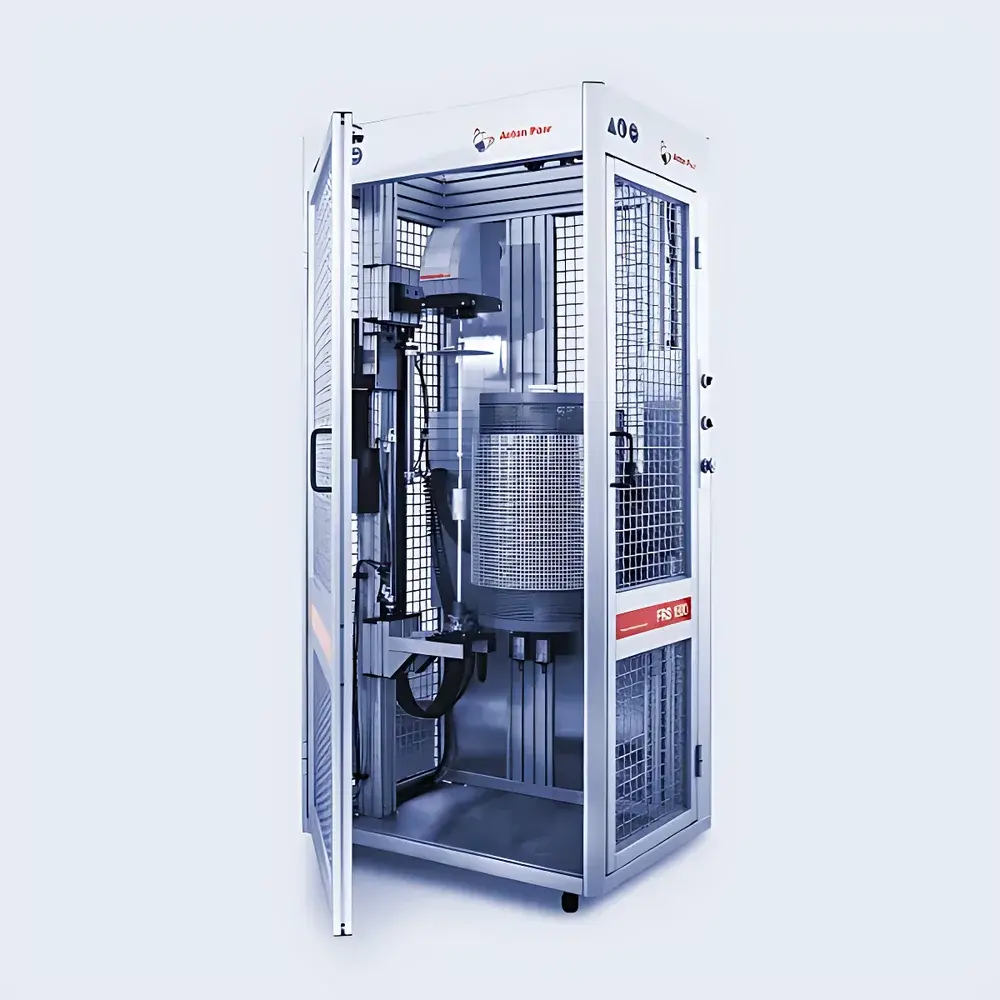
Anton Paar FRS 1600 High-Temperature Rotational Rheometer
| Brand | Anton Paar |
|---|---|
| Origin | Austria |
| Manufacturer | Anton Paar GmbH |
| Instrument Type | Rotational Rheometer |
| Bearing Type | Air Bearing |
| Temperature Range | 300–1530 °C |
| Minimum Rotational Speed | 10⁻⁹ rpm |
| Maximum Rotational Speed | 300 rpm |
| Frequency Range | 10⁻⁷–628 rad/s |
| Maximum Torque | 230 mNm |
| Torque Resolution | 0.1 nNm |
| Normal Force Range | 0.005–50 N |
| Normal Force Resolution | 0.5 mN |
| Sample Cup Max Height | 100 mm |
| Measuring System Materials | Al₂O₃, Graphite, Pt, Custom Options |
| Compliance | ASTM C965, ISO 7884-2 |
| Dimensions (W×H×D) | 680 × 1950 × 920 mm |
| Weight | 120 kg |
Overview
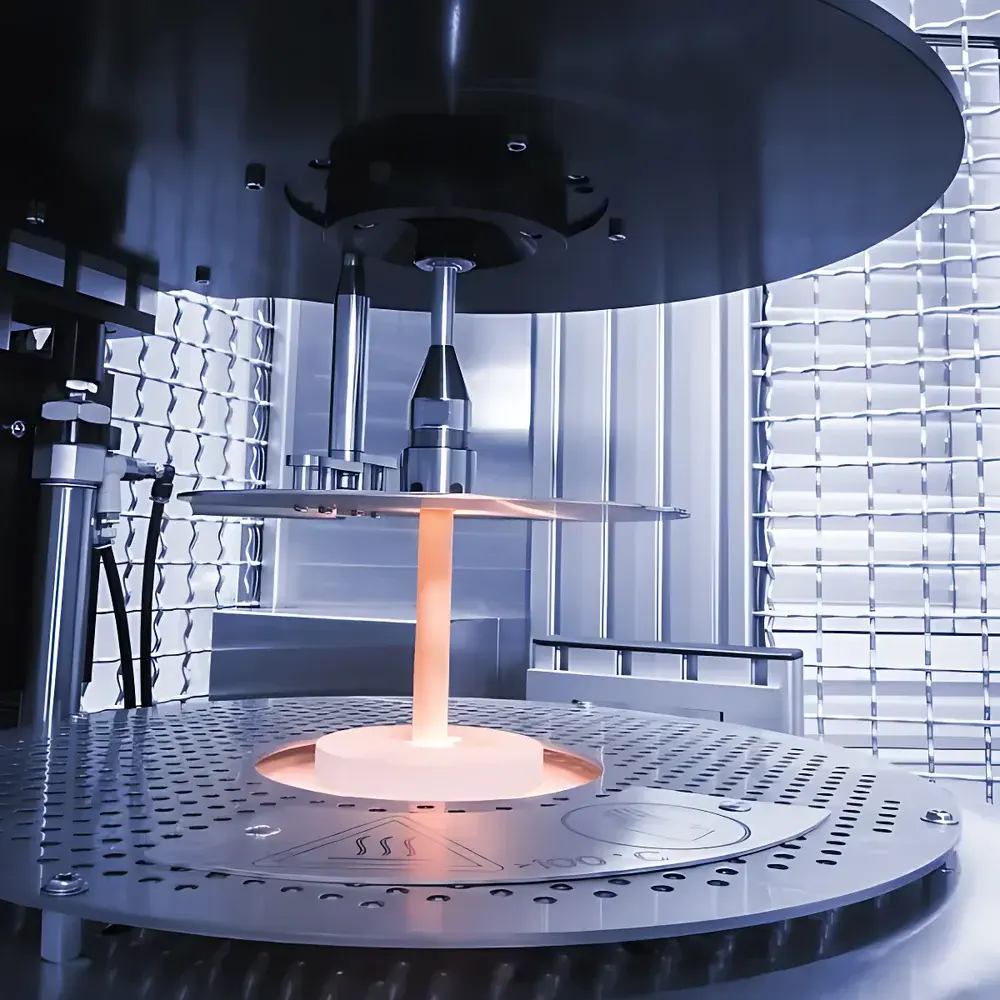
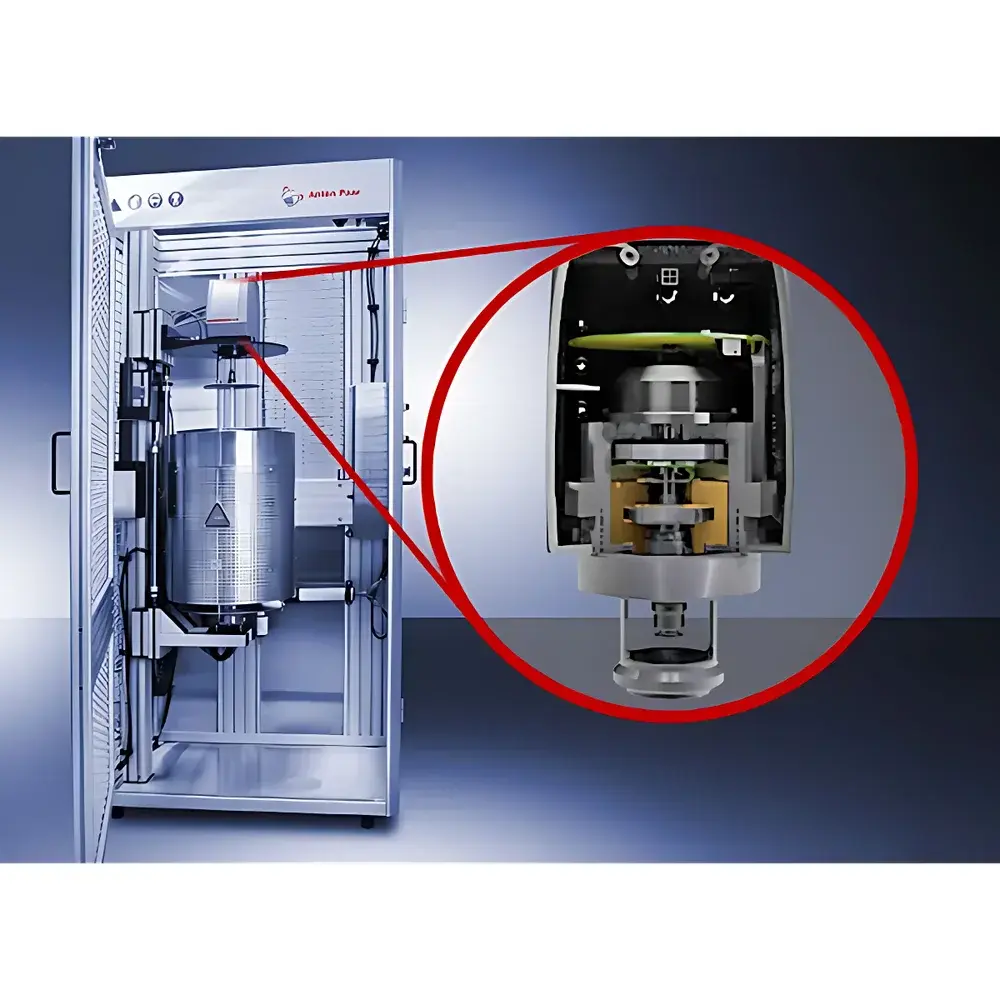
The Anton Paar FRS 1600 is a high-temperature rotational rheometer engineered for precise viscoelastic and viscosity characterization of inorganic melts—including glasses, slags, molten metals, ceramics, and refractory materials—under controlled inert or ambient atmospheres. Operating on the Couette principle with concentric cylinder or parallel-plate geometries, the system employs air-bearing-supported synchronous EC motor technology to deliver ultra-low torque noise and frictionless motion across an exceptional dynamic range. Its core measurement capability spans shear rates from 10−9 to 314 rad/s and angular frequencies from 10−7 to 628 rad/s, enabling both steady-state and dynamic oscillatory analysis at temperatures up to 1530 °C. The integrated laboratory furnace features dual-stage cooling (air + water), B- or S-type thermocouple feedback, and ±0.1 °C temperature stability—critical for detecting subtle thermal transitions such as softening points, glass transition (Tg), and solidification onset during controlled heating/cooling ramps.
Key Features
- Air-bearing motor with high-resolution optical encoder: Eliminates mechanical friction and drift, ensuring torque stability over 60-minute continuous measurements and enabling detection of sub-nN·m signals.
- Automated sample immersion: Pneumatic pre-positioning combined with stepper-motor-driven vertical actuation allows safe, repeatable, and programmable insertion of the measuring system into solid samples prior to melting—fully remote operation behind safety interlocked enclosure.
- Normal force-controlled measurement head: Integrated load cell (0.005–50 N, 0.5 mN resolution) enables real-time detection of phase transitions (e.g., melting point, solidus/liquidus) via normal force discontinuities during temperature sweeps in both rotational and oscillatory modes.
- Dual-mode EC drive: Supports both controlled shear rate (CSR) and controlled shear stress (CSS) protocols, essential for characterizing yield behavior, thixotropy, and time-dependent relaxation in complex melts.
- Inert atmosphere compatibility: Sealed furnace chamber with gas inlet/outlet ports supports operation under Ar, N2, or other protective atmospheres—preventing oxidation, volatilization, or unwanted redox reactions during high-temperature testing.
- Modular geometry support: Interchangeable measuring systems—including alumina, graphite, platinum, and custom-fabricated rotors (diameter: 11–27.6 mm) and sample cups (max height: 100 mm)—optimized for chemical inertness and thermal stability.
Sample Compatibility & Compliance
The FRS 1600 is validated for use with high-viscosity and low-viscosity inorganic melts exhibiting Newtonian and non-Newtonian behavior across a viscosity range of 10−3 to 107 Pa·s. It meets the metrological requirements of ASTM C965 (“Standard Test Method for Determination of Viscosity of Glass Above the Softening Point”) and ISO 7884-2 (“Glass—Viscosity and Fixed Point Viscometers—Part 2: Determination of Viscosity by Rotational Viscometers”). All hardware and software components comply with CE machinery directives and are designed for GLP/GMP-aligned laboratories, supporting audit-ready data traceability when used with RheoCompass™’s built-in electronic lab notebook (ELN) and 21 CFR Part 11-compliant user access control and signature logging.
Software & Data Management
RheoCompass™ software provides fully automated workflow orchestration—from furnace ramp programming and geometry calibration to real-time torque/normal force monitoring and post-acquisition linear viscoelastic (LVE) analysis. It includes preconfigured test templates aligned with ASTM and ISO standards, automatic baseline correction for thermal expansion effects, and export options compliant with ASTM E1447 (data exchange format for rheological data). Raw measurement files (.rheo) retain full metadata (instrument configuration, environmental conditions, operator ID, timestamped events), and all processing steps are recorded in an immutable audit trail. Optional DMA™ module extends capabilities to dynamic mechanical analysis of semi-crystalline or composite melts under thermal cycling.
Applications
- High-temperature viscosity mapping of borosilicate and aluminosilicate glasses for optical fiber and display manufacturing process optimization.
- Slag rheology studies in metallurgical process modeling—quantifying fluidity, crystallization kinetics, and phase separation behavior during steelmaking and non-ferrous smelting.
- Thermal stability assessment of ceramic precursor melts and refractory coatings under simulated service conditions.
- Development and qualification of nuclear fuel matrix materials (e.g., UO2-ZrO2 composites) via high-temperature creep and stress relaxation testing.
- Calibration and validation of computational fluid dynamics (CFD) models used in industrial furnace design and melt casting simulation.
FAQ
What temperature accuracy and stability can be achieved during prolonged high-temperature measurements?
The FRS 1600 achieves ±0.1 °C temperature accuracy with <0.5 °C/h drift over 60-minute holds at 1500 °C, enabled by dual-stage (air + water) furnace cooling and S-type thermocouple feedback with active PID compensation.
Is the system suitable for measuring highly reactive melts such as molten lithium or sodium?
Yes—when operated under high-purity argon or helium purge with chemically compatible graphite or custom tungsten carbide measuring systems, the FRS 1600 supports safe, contamination-free rheology of alkali metal melts.
How does the air bearing contribute to low-viscosity measurement fidelity?
The frictionless air bearing eliminates stiction and torque hysteresis, allowing reliable quantification of viscosities down to 1 mPa·s at 1500 °C—unattainable with conventional mechanical bearings due to thermal drift and signal noise.
Can the instrument perform time-sweep tests at constant high temperature?
Yes—RheoCompass™ supports extended time sweeps (up to 72 hours) with automated data logging, thermal drift compensation, and real-time anomaly detection based on torque and normal force deviation thresholds.
What documentation is provided for regulatory compliance in pharmaceutical or aerospace material qualification?
Anton Paar supplies IQ/OQ documentation packages, traceable calibration certificates (NIST-traceable torque and temperature standards), and 21 CFR Part 11 implementation guides—including role-based access control, electronic signature workflows, and raw data integrity verification tools.



