
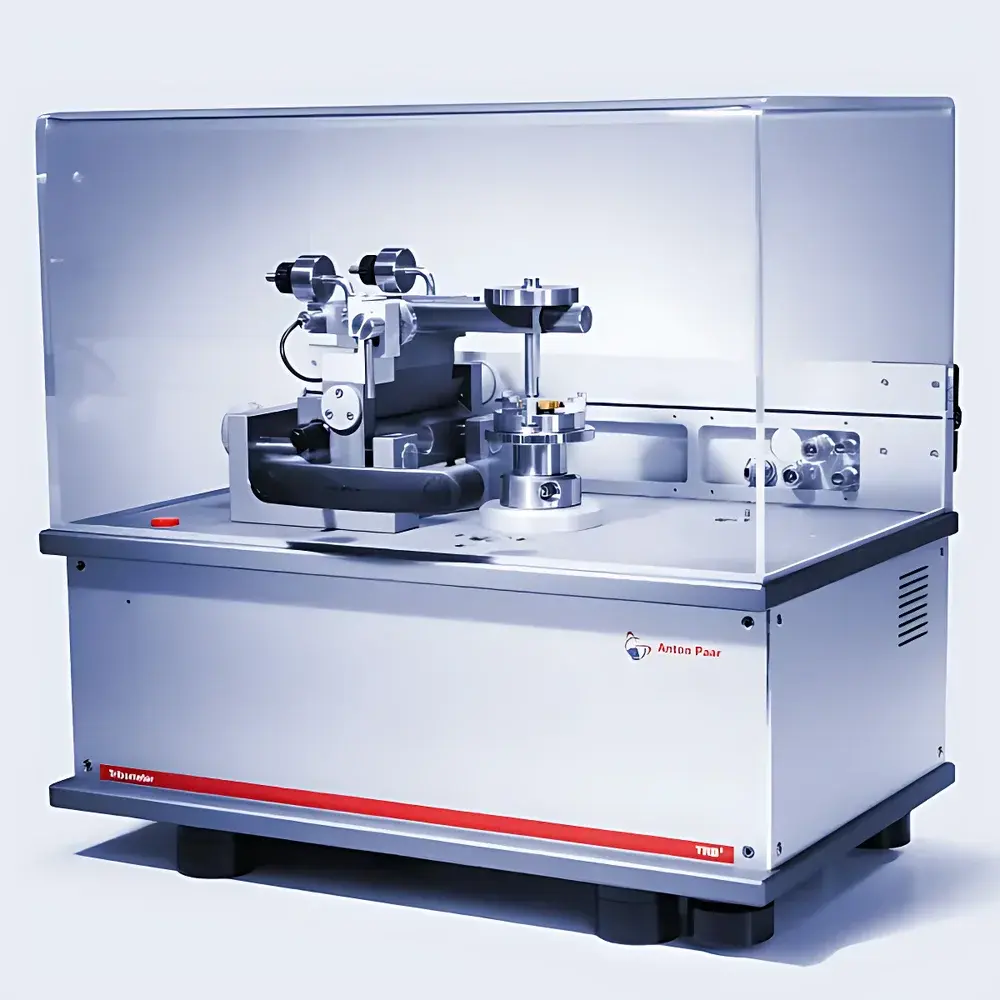
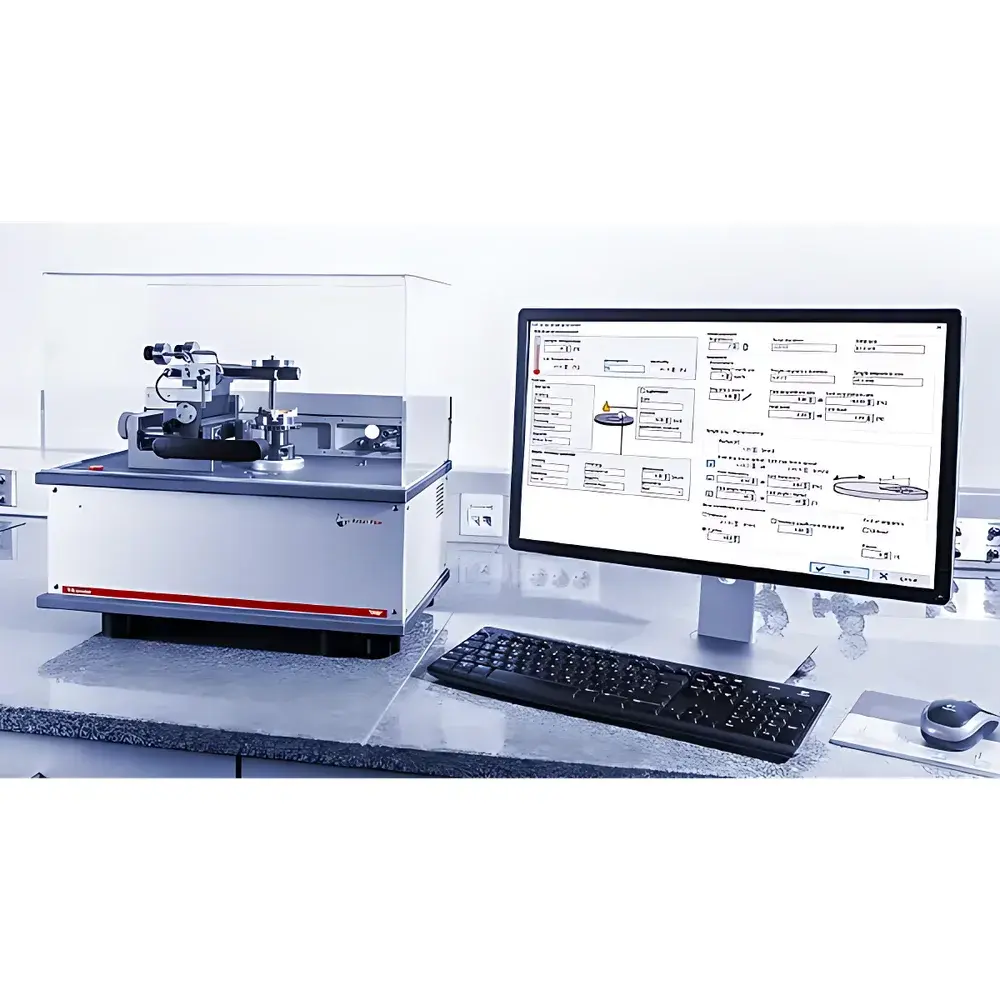
Anton Paar TRB³ Multifunctional Tribological Tester
| Brand | Anton Paar |
|---|---|
| Origin | Switzerland |
| Manufacturer | Anton Paar GmbH |
| Type | Multifunctional Tribological Tester |
| Model | TRB³ |
| Maximum Normal Force | 60 N |
| Normal Force Resolution (net weight) | Not specified |
| Maximum Friction Force | 20 N (optional 5 N) |
| Friction Force Resolution | 0.015 mN (optional 0.06 mN) |
| Rotational Speed Range | 0.2–2000 rpm (optional up to 600 rpm) |
| Linear Reciprocating Stroke | up to 60 mm |
| Linear Reciprocating Speed | up to 370 mm/s |
| Linear Frequency Range | 0.01–10 Hz |
| Oscillatory Rotational Speed | 0.2–2000 rpm |
| Oscillatory Frequency Range | 0.01–7 Hz |
| Angular Amplitude Range | ±5° to ±150° |
| Angular Resolution | 0.1° |
| Heating Capability | up to 450 °C (dry), up to 150 °C (liquid) |
| Vacuum Level | down to 10⁻⁷ mbar |
| Relative Humidity Control | 15–95% RH |
| Contact Resistance Measurement | up to 1000 Ω |
| Online Wear Depth Measurement (optional) | −2 to +2 mm |
Overview
The Anton Paar TRB³ Multifunctional Tribological Tester is a precision-engineered instrument designed for quantitative evaluation of friction, wear, and lubrication behavior under controlled and reproducible conditions. Based on the well-established ball-on-disk and pin-on-disk tribological configurations, the TRB³ implements a dual-sensor force measurement architecture grounded in Couette-type mechanical design principles. Its core operational modes include continuous rotation, linear reciprocation, and oscillatory rotation—enabling simulation of real-world contact kinematics encountered in bearings, gears, seals, biomedical implants, and surface-coated components. The system’s modular architecture supports integration of environmental control modules (temperature, humidity, vacuum, liquid immersion), making it suitable for research-grade tribological characterization across polymers, ceramics, metallic alloys, thin-film coatings, greases, and advanced lubricant additives.
Key Features
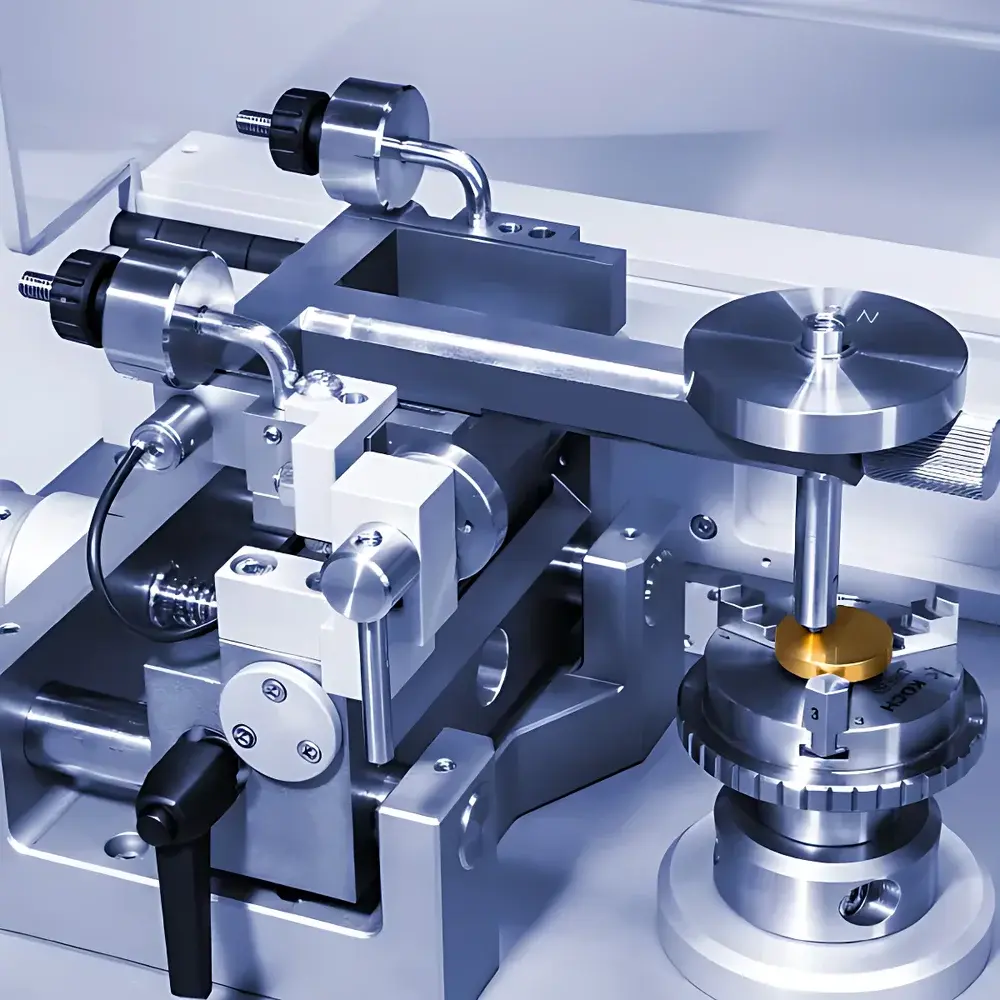
- Dual Friction Force Sensor Architecture: Two high-resolution load cells mounted on a symmetric V-shaped elastic arm eliminate thermal drift during long-duration tests or ambient temperature fluctuations—critical for accurate coefficient of friction (COF) determination over hours or days.
- Real-Time Environmental Monitoring: Integrated temperature and relative humidity sensors continuously log ambient and interfacial conditions synchronized with friction and wear data acquisition—essential for polymer tribology and hygroscopic coating studies.
- User-Executable Calibration Protocol: Operators can perform in-situ calibration of key parameters—including friction force, rotational speed, and effective radius—without external service intervention, ensuring measurement traceability and reducing instrument downtime.
- Multi-Mode Motion Control: Supports rotational (0.2–2000 rpm), linear reciprocating (0.01–10 Hz, stroke ≤60 mm), and oscillatory rotational (0.01–7 Hz, ±5°–±150°) motion profiles with programmable acceleration/deceleration ramps.
- Extended Environmental Flexibility: Optional heating stages enable testing from sub-ambient to 450 °C (in dry atmosphere) or 150 °C (under liquid lubricants); vacuum capability extends down to 10⁻⁷ mbar; humidity control spans 15–95% RH.
- Modular Sensor Expansion: Optional online wear depth measurement (±2 mm range), contact resistance monitoring (up to 1000 Ω), and triboelectric signal acquisition support advanced failure mode analysis and electrotribological investigations.
Sample Compatibility & Compliance
The TRB³ accommodates diverse sample geometries—including disks (up to 100 mm diameter), pins, balls (1–10 mm), and custom fixtures—allowing evaluation of bulk materials, thin films (<1 µm), multilayer stacks, and textured surfaces. Its mechanical design conforms to the geometric and procedural requirements of ASTM G99 (Standard Test Method for Wear Testing with a Pin-on-Disk Machine), ASTM G133 (Standard Test Method for Linearly Reciprocating Ball-on-Flat Tribometer), and DIN 50324 (Tribological Testing – Pin-on-Disk Method). All firmware and data handling routines are structured to support GLP-compliant workflows, including electronic signatures, audit trails, and raw-data immutability per FDA 21 CFR Part 11 guidelines where applicable.
Software & Data Management
The TRB³ operates via the proprietary Tribology Software Suite, offering three test configuration paradigms: Standard (predefined templates), Incremental (stepwise parameter variation), and User-Defined (fully scriptable protocols). Real-time visualization includes live COF plots, wear volume estimation, and dynamic friction maps. The integrated Stress Model module computes Hertzian contact pressure distribution, shear stress fields, and subsurface strain gradients—supporting rational selection of normal load, sliding velocity, and counterface geometry. Raw time-series data (force, displacement, temperature, humidity) are exported in ASCII/CSV format. Advanced users leverage the embedded Python 3.9 environment (with NumPy, SciPy, and Matplotlib preinstalled) for custom statistical modeling, machine learning–assisted wear prediction, or integration with finite-element solvers.
Applications
- Development and qualification of low-friction coatings (DLC, MoS₂, TiN) for aerospace and automotive components
- Screening of anti-wear additives (ZDDP, ionic liquids) and base oil formulations under boundary lubrication regimes
- Wear mechanism analysis of polymer composites (PEEK, UHMWPE) in orthopedic joint simulator environments
- Tribo-corrosion studies of stainless steels and Ni-based superalloys in saline or acidic electrolytes
- High-temperature tribology of ceramic matrix composites (CMCs) used in turbine hot-section applications
- Electro-tribological characterization of conductive coatings and battery electrode materials under sliding contact
FAQ
What standards does the TRB³ comply with?
The TRB³ meets the core mechanical, geometric, and procedural specifications of ASTM G99, ASTM G133, and DIN 50324. Its software architecture supports audit-ready documentation required for ISO/IEC 17025-accredited laboratories.
Can the TRB³ operate under vacuum or inert gas?
Yes—the chamber is compatible with vacuum levels down to 10⁻⁷ mbar and can be purged with nitrogen, argon, or other process gases using standard flange interfaces (KF40/KF50).
Is humidity control available as a factory option?
Yes—integrated RH control (15–95% ±2% accuracy) is offered with active humidification/dehumidification modules and inline dew-point monitoring.
How is wear depth measured in real time?
An optional non-contact capacitive sensor (±2 mm range, 10 nm resolution) is mounted coaxially above the test zone, enabling simultaneous recording of vertical displacement and friction force during sliding.
Does the TRB³ support automated test sequences?
Yes—through the scripting interface, users define multi-step protocols involving sequential changes in load, speed, temperature, and motion type, with conditional triggers based on real-time COF thresholds or wear accumulation.



