
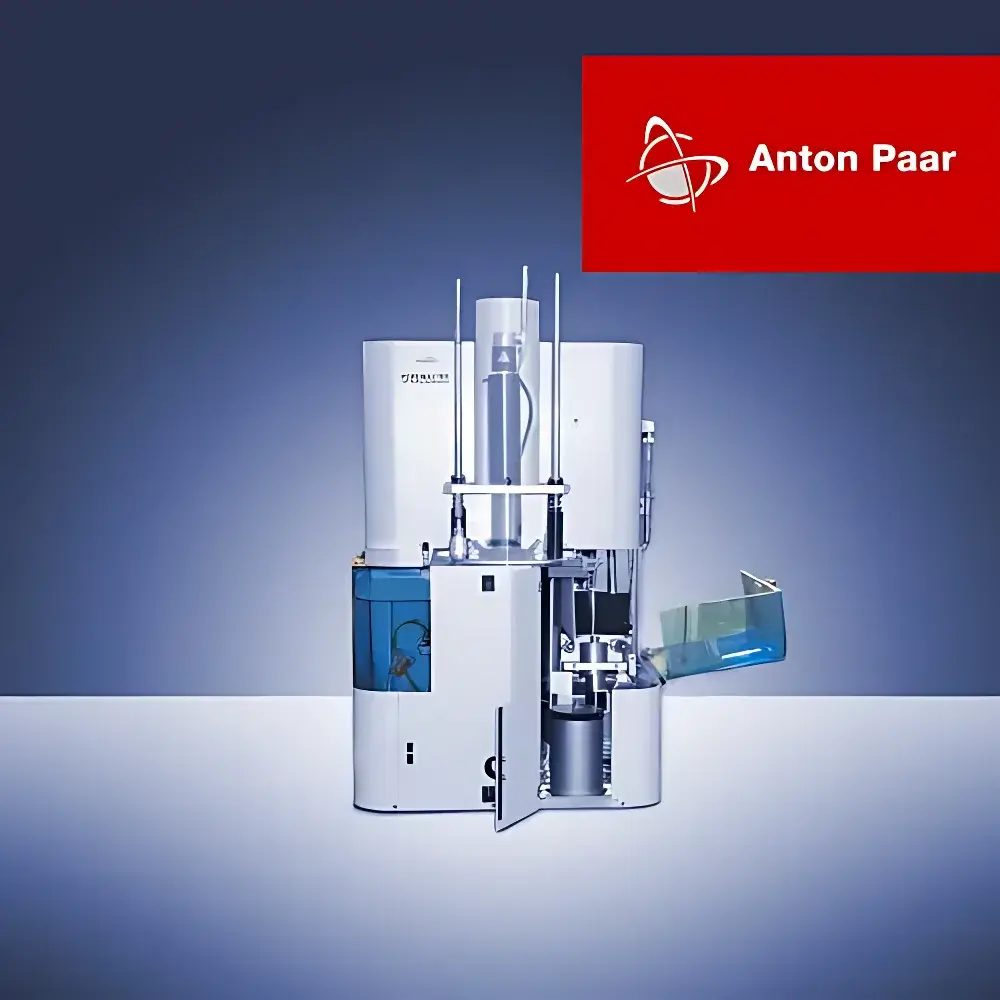
Anton Paar PoreMaster Mercury Intrusion Porosimeter
| Brand | Anton Paar |
|---|---|
| Origin | USA |
| Manufacturer Type | Manufacturer |
| Origin Category | Imported |
| Model | PoreMaster |
| Price | Upon Request |
| Pore Size Range | 30 nm – 600 µm |
| Pressure Range | 0.01 – 50 MPa |
| Measurement Accuracy | ≤ 0.5% |
Overview
The Anton Paar PoreMaster Mercury Intrusion Porosimeter is a fully automated, high-precision instrument engineered for the quantitative characterization of pore structure in solid porous materials. Based on the principle of mercury intrusion porosimetry (MIP), it measures pore size distribution, total pore volume, cumulative pore volume, differential pore volume, and intruded surface area by recording the volume of mercury forced into pores under controlled, incrementally increasing pressure. As mercury is non-wetting and has high surface tension (~485 mN/m), it only intrudes into pores when external pressure exceeds the capillary entry pressure—governed by the Washburn equation. This enables robust determination of pore diameters from ~3 nm up to >600 µm, covering macropores, mesopores, and part of the micropore regime (via extrapolation). Designed for routine QC labs and advanced R&D facilities, the PoreMaster meets ASTM D4404, ISO 15901-1, and USP requirements for pore structural analysis and supports GLP/GMP-compliant operation with audit-trail-capable software.
Key Features
- Dual-pressure architecture: Two independent low-pressure stations (up to 1500 psia / ~10.3 MPa) for rapid analysis of pores >4 µm; one or two high-pressure chambers (up to 60,000 psia / ~413.7 MPa, equivalent to 50 MPa nominal system pressure) for sub-4 µm pore resolution.
- High-fidelity pressure sensing: Dual-range transducers with ±0.11% FS accuracy, <0.000763 psi resolution at low range, and <0.916 psi resolution at full scale; nonlinearity and hysteresis each ≤±0.05% and ≤±0.10% FS respectively.
- Integrated cold trap: Captures mercury vapor before reaching the vacuum pump and exhaust stream, minimizing operator exposure and protecting lab air quality per OSHA Hg exposure limits (0.05 mg/m³ TWA).
- Sample handling safety systems: Dual mechanical interlocks prevent low-pressure station operation unless sample cell lids are fully secured; tilt-enabled sample cell design ensures complete mercury drainage and suppresses splashing during extrusion.
- Autospeed dynamic pressure control: Automatically adjusts pressure ramp rate based on real-time intrusion/extrusion kinetics—optimizing data density in critical regions while reducing total analysis time.
- Self-regulating hydraulic oil circulation: Integrated filtration and thermal management maintain consistent actuator response and long-term pressure stability across extended runs.
Sample Compatibility & Compliance
The PoreMaster accommodates standard glass or fused silica sample tubes (3.2 mL and 6.6 mL volumes), supporting sample masses from tens of milligrams to several grams depending on bulk density. It is validated for ceramics, catalysts, carbons, concrete, soils, pharmaceutical excipients, and geologic cores. All hardware and software comply with CE marking directives (2014/30/EU EMC, 2014/35/EU LVD), and the system architecture supports 21 CFR Part 11–compliant electronic records when configured with user authentication, audit trail logging, and electronic signatures. Calibration certificates traceable to NIST standards are provided for pressure transducers and volumetric displacement sensors.
Software & Data Management
PoreMaster Control Software (Windows 10/11 compatible, 64-bit) provides full instrument orchestration, real-time visualization of intrusion curves, and ISO 15901-1–aligned data reduction. It computes not only pore diameter distribution (dV/dlogD, dV/dD) but also envelope density, skeletal density, total porosity, specific surface area (via Gurvich method), and throat-to-body pore geometry metrics. Raw data (.dat) and processed reports (.pdf, .xlsx) are exportable with metadata embedding (operator ID, timestamp, calibration status, environmental conditions). Batch processing, template-based method storage, and customizable report generation streamline multi-sample workflows in regulated environments.
Applications
- Quality control of battery electrode coatings and separator membranes—validating pore connectivity and tortuosity-critical parameters.
- Characterization of zeolites and MOFs for adsorption capacity modeling and diffusion pathway analysis.
- Assessment of sintering behavior in powder metallurgy via pore closure kinetics under incremental pressure.
- Determination of crush strength in hollow glass microspheres using controlled mercury extrusion profiles.
- Water intrusion testing of hydrophobic construction materials (e.g., silane-treated concrete) to quantify ingress resistance.
- Validation of pore network models used in reservoir simulation for oil & gas exploration.
FAQ
What pore size ranges does the PoreMaster cover, and how is resolution achieved across such a broad span?
The system covers 3 nm to 600 µm via dual-pressure instrumentation: low-pressure stations resolve pores >4 µm with high volumetric sensitivity (down to 3×10⁻⁵ cm³), while high-pressure modules extend resolution below 4 µm using calibrated transducers with logarithmic pressure stepping per ASTM D4404 Annex A1.
Is mercury handling safe for routine laboratory use?
Yes—the integrated cold trap, sealed low-pressure filling manifold, tilt-assisted drainage, and mechanical interlocks collectively reduce mercury vapor exposure to well below OSHA PELs; routine wipe tests and annual vapor monitoring are recommended per institutional EH&S policy.
Can the PoreMaster be integrated into a LIMS or enterprise data system?
Yes—via OPC UA or CSV export protocols; raw data files include embedded XML metadata compliant with ISA-88/95 frameworks for traceability in automated manufacturing environments.
Does the system support compliance with pharmacopeial methods?
Yes—it fulfills USP “Porosity” and EP 2.9.32 “Mercury Intrusion Porosimetry” requirements, including documented calibration, system suitability checks, and reporting of %RSD for replicate measurements.
What maintenance is required for long-term operational reliability?
Annual transducer recalibration, quarterly cold trap cleaning, biannual hydraulic oil replacement, and routine verification of vacuum integrity (<10 mTorr base pressure) constitute the preventive maintenance schedule outlined in the service manual.



