
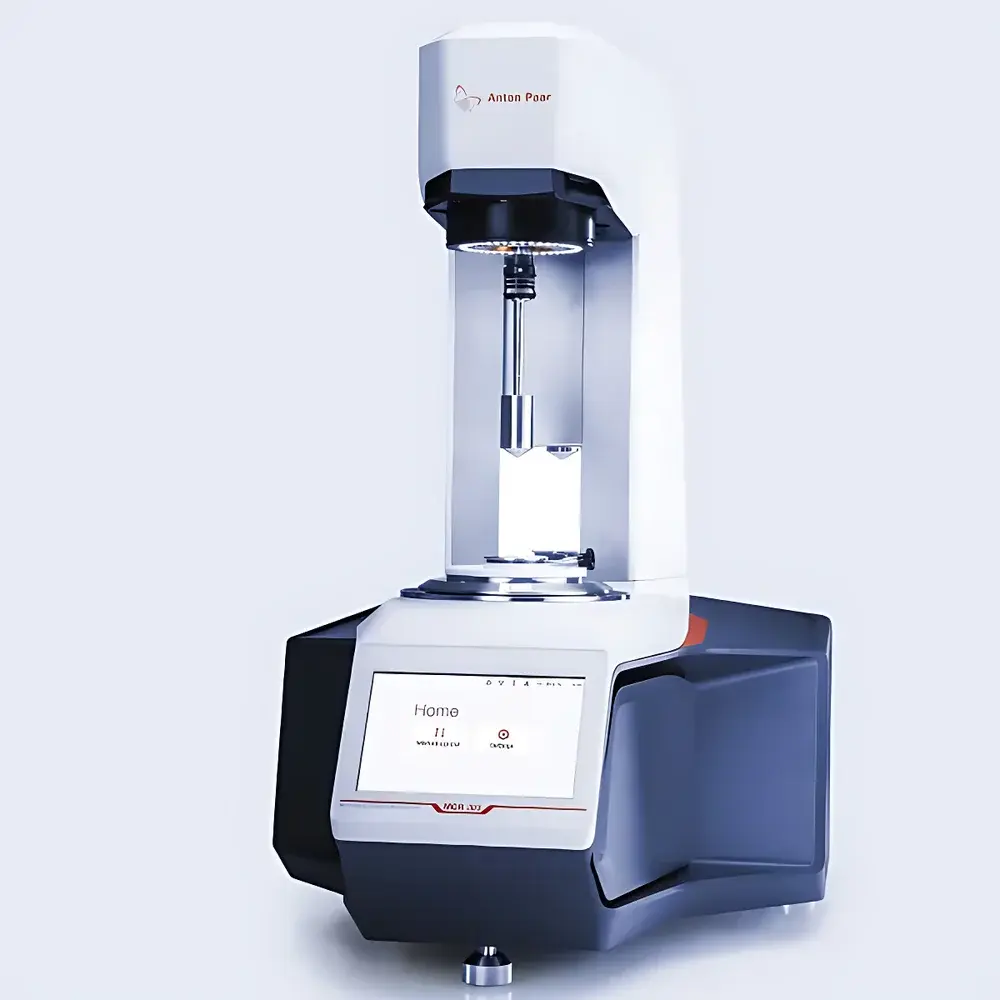
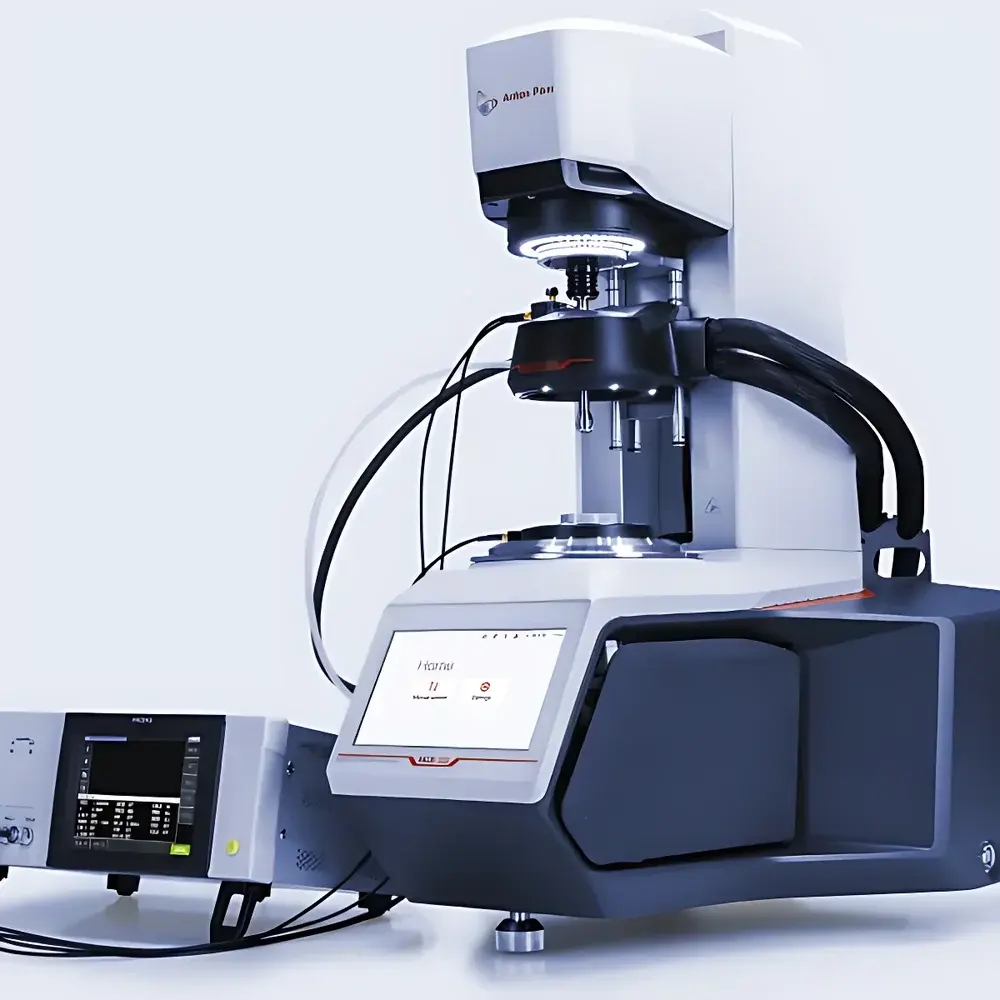
Anton Paar MCR 303 Interfacial Rheometer
| Brand | Anton Paar |
|---|---|
| Origin | Austria |
| Manufacturer Type | Original Equipment Manufacturer (OEM) |
| Product Category | Imported Instrument |
| Model | MCR 303 |
| Instrument Type | Rotational Rheometer |
| Sample Viscosity Range | High-Viscosity Liquids |
| Sample State | Liquid |
| Motor Bearing | Precision Porous Carbon Air Bearing |
| Temperature Range | –160 °C to +1000 °C |
| Minimum Rotational Speed | 0 rpm |
| Frequency Range | 2 × 10⁻⁸ Hz to 100 Hz |
| Maximum Rotational Speed | 3000 rpm |
| Maximum Torque | 215 mNm |
| Torque Resolution | 0.1 nNm |
Overview
The Anton Paar MCR 303 Interfacial Rheometer is a high-precision rotational rheometer engineered for advanced interfacial and bulk rheological characterization of complex fluids, soft solids, and structured liquids. Built upon Anton Paar’s modular TruGap™ platform, it employs controlled-strain and controlled-stress methodologies grounded in Couette and parallel-plate geometries, enabling rigorous quantification of viscoelastic moduli (G′, G″), complex viscosity (η*), yield stress, thixotropy, and time-dependent deformation behavior. Its core architecture integrates a high-stiffness, low-inertia drive system with a fully integrated 360° capacitive normal force sensor—ensuring nanoscale torque resolution (down to 0.1 nNm in oscillatory mode) and sub-micron gap control across extreme thermal gradients. Designed for laboratory environments requiring long-term stability and traceable metrology, the MCR 303 supports ISO/IEC 17025-compliant calibration workflows and meets mechanical design criteria aligned with ASTM D4402 and ISO 6721-10 for dynamic mechanical analysis.
Key Features
- Precision porous carbon air bearing motor delivering zero mechanical friction, minimal thermal drift, and continuous operation over extended durations without performance degradation.
- Ultra-low torque detection capability: 0.1 nNm resolution in oscillatory mode; enables reliable measurement of weakly structured interfaces (e.g., protein monolayers, surfactant films, polymer micelles).
- Broad dynamic frequency range from 2 × 10⁻⁸ Hz to 100 Hz—supporting both ultra-slow relaxation studies (e.g., glass transition kinetics) and rapid transient response analysis (e.g., gelation onset).
- Integrated TruStrain™ technology ensures true strain control during large-amplitude oscillatory shear (LAOS), eliminating geometric nonlinearity artifacts in nonlinear viscoelastic regime analysis.
- Toolmaster™ auto-recognition system identifies geometry type, dimensions, and calibration parameters upon attachment—reducing setup errors and enabling audit-trail–ready operation per FDA 21 CFR Part 11 requirements.
- TruRay™ optical alignment system combined with automated gap control compensates for thermal expansion across the full temperature range (–160 °C to +1000 °C), ensuring reproducible sample loading and consistent boundary conditions.
Sample Compatibility & Compliance
The MCR 303 accommodates liquid-phase samples ranging from low-viscosity solvents to highly structured pastes, emulsions, and molten polymers. Its interfacial rheology configurations support Langmuir trough coupling, pendant drop, and biconical geometry setups for surface dilatational and shear modulus determination. The instrument complies with international standards including ISO 16520 (rheology of dispersions), ASTM D7175 (dynamic shear rheometry of asphalt binders), and USP (rheological testing of pharmaceutical gels). All firmware and software modules are validated for GLP/GMP environments, with built-in electronic signatures, user access levels, and immutable audit trails meeting regulatory expectations for quality control laboratories.
Software & Data Management
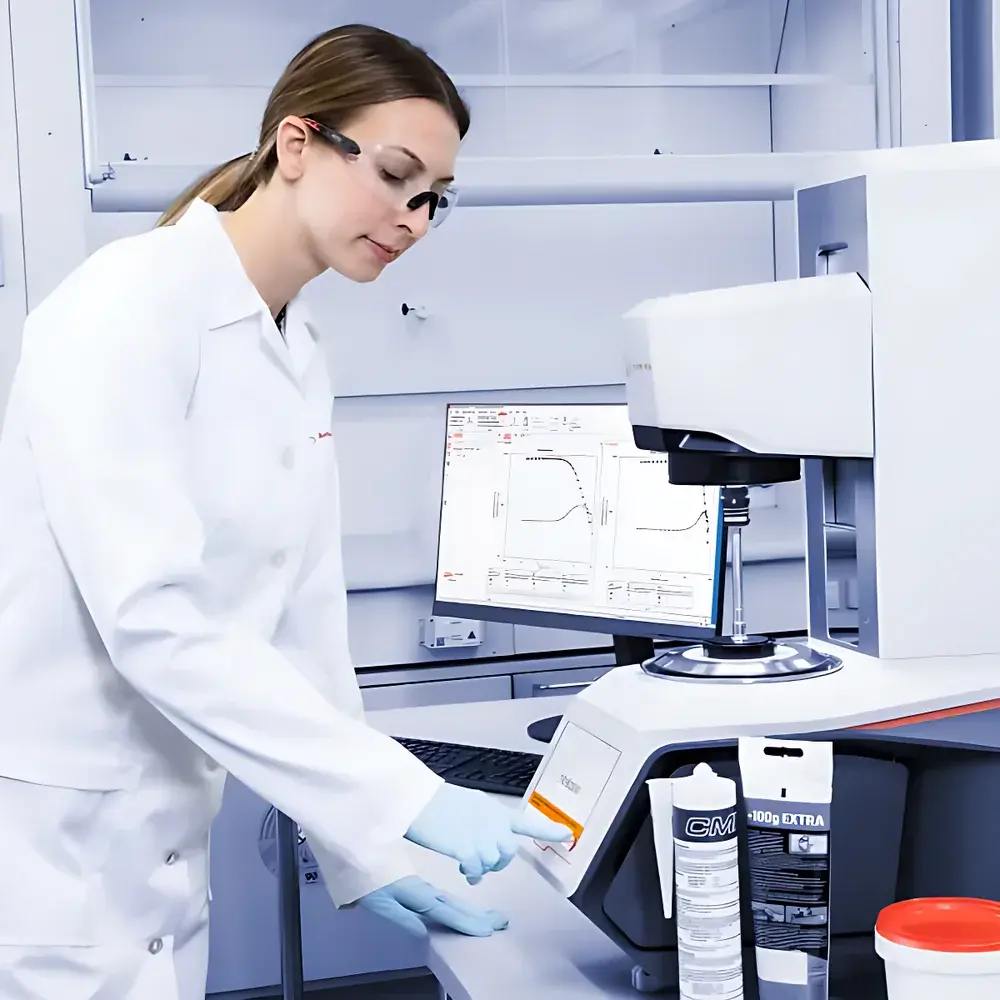
RheoCompass™ v5.x serves as the unified control and analysis environment, featuring a touchscreen-optimized interface with multilingual support (English, German, French, Japanese, Chinese). It includes over 250 preconfigured test templates—validated for QC applications such as viscosity profiling, creep recovery, and frequency sweeps—and supports custom scripting via Python API for method automation. Advanced analytics include LAOS Fourier transform decomposition, Cox-Merz superposition validation, time–temperature superposition (TTS), and interfacial elasticity modeling using the Lucassen–van den Tempel equation. Data export conforms to ASTM E1447 and ISO/IEC 17025 reporting formats, with native integration into LIMS platforms via OPC UA and CSV/XML protocols.
Applications
- Interfacial rheology of food emulsifiers, cosmetic surfactants, and pulmonary surfactant analogs under physiological temperature and humidity conditions.
- High-temperature rheology of thermosetting resins, ceramic slurries, and metal alloys during curing or sintering processes.
- Nonlinear viscoelastic fingerprinting of hydrogels, biopolymer networks, and injectable drug carriers using LAOS and step-strain protocols.
- Dynamic mechanical analysis (DMA) of thin films and coatings in tension, compression, and bending modes via optional TruStrain™ extension modules.
- Quality assurance of bituminous binders per EN 13587 and AASHTO TP 105, including multiple stress creep recovery (MSCR) and linear amplitude sweep (LAS) testing.
FAQ
What distinguishes the MCR 303 from conventional rotational rheometers?
Its fully integrated capacitive normal force sensor, air-bearing motor architecture, and TruStrain™ real-time strain control eliminate mechanical compliance and enable true small- and large-amplitude interfacial rheology with metrological traceability.
Can the MCR 303 perform measurements at cryogenic temperatures?
Yes—it supports operation down to –160 °C using liquid nitrogen-cooled Peltier stages, with active thermal gradient compensation to maintain uniform sample temperature.
Is the instrument compatible with Good Manufacturing Practice (GMP) documentation requirements?
Yes—RheoCompass™ provides full 21 CFR Part 11 compliance, including electronic signatures, role-based access control, and tamper-proof audit logs for all measurement events.
How does Toolmaster™ enhance measurement reliability?
It automatically reads embedded RFID tags on each geometry to load correct calibration coefficients, geometry dimensions, and thermal expansion data—eliminating manual entry errors and supporting ISO/IEC 17025 traceability.
What interfacial measurement techniques are supported out-of-the-box?
Surface shear rheology (using biconical or double-wall ring geometries), dilatational rheology (via Langmuir trough integration), and pendant drop interfacial tension coupling with simultaneous rheological interrogation.



