
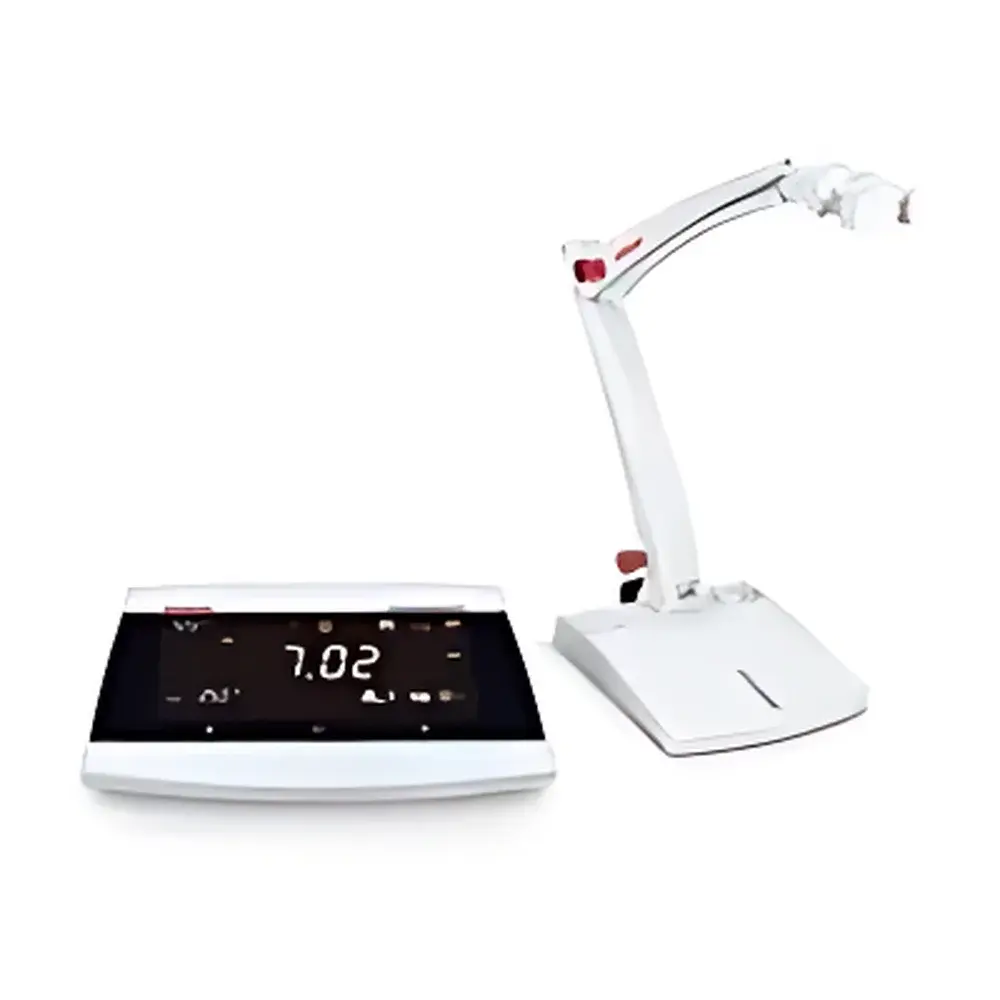
OHAUS AQUASEARCHER™ AB33PH Benchtop pH Meter
| Brand | OHAUS |
|---|---|
| Origin | Jiangsu, China |
| Manufacturer Type | Manufacturer |
| Regional Classification | Domestic (China) |
| Model | AB33PH-B |
| Instrument Type | Benchtop |
| Parameter Type | Single-Parameter (pH/mV/ORP/Temperature) |
| Measurement Range | 0.00–14.00 pH |
| Resolution | 0.01 pH |
| Accuracy | ±0.01 pH |
| Calibration Solutions | China-specific buffer set (e.g., pH 4.01, 6.86, 9.18) |
| Temperature Range | 0–100 °C |
| mV Range | −1999 to +1999 mV |
| mV Resolution | 1 mV |
| Temperature Resolution | 0.1 °C |
| Temperature Accuracy | ±0.5 °C |
| Display | 6.5-inch backlit segmented & dot-matrix LCD with capacitive touch keys |
| Data Storage | 1000 measurement records |
| Connectivity | RS232 and USB |
| Power Supply | AC adapter |
| Operating Environment | 5–40 °C, ≤80% RH (non-condensing) |
| Dimensions (H×L×W) | 51 × 210 × 142 mm |
| Net Weight | 0.5 kg |
| Housing Material | ABS |
Overview
The OHAUS AQUASEARCHER™ AB33PH is a precision benchtop pH meter engineered for routine laboratory applications requiring high repeatability, intuitive operation, and regulatory-compliant data handling. Based on potentiometric measurement principles, the instrument determines hydrogen ion activity in aqueous solutions using a glass pH electrode coupled with a reference electrode—generating a voltage differential proportional to pH according to the Nernst equation. In addition to pH, it supports direct millivolt (mV) measurements for oxidation-reduction potential (ORP) analysis and integrated temperature compensation via an internal or external Pt1000 sensor. Designed as part of the OHAUS STARTER series’ next-generation platform, the AB33PH emphasizes metrological integrity through i-Steward intelligent calibration management—a firmware-driven system that monitors electrode performance, logs calibration events, and issues proactive alerts when calibration validity expires. Its architecture aligns with fundamental quality requirements for GLP environments, supporting traceable documentation and consistent measurement outcomes across shifts and operators.
Key Features
- 6.5-inch capacitive touch-enabled LCD display combining segmented indicators with dot-matrix text for simultaneous multi-parameter readout (pH, mV, °C) and menu navigation
- i-Steward calibration stewardship system providing real-time electrode diagnostics, automatic calibration date tracking, and configurable expiration warnings
- Dual connectivity options—RS232 and USB—for seamless integration with LIMS, ELN, or custom data acquisition software
- 1000-point internal memory with timestamped entries, supporting manual or auto-storage modes and export-ready formatting
- Robust ABS housing with integrated electrode stand, designed for stable placement and ergonomic access during extended use
- Comprehensive temperature compensation: automatic (ATC) or manual (MTC), compatible with standard Pt1000 sensors meeting IEC 60751 Class B tolerances
Sample Compatibility & Compliance
The AB33PH is validated for aqueous and low-ionic-strength samples typical in academic research, environmental monitoring, food & beverage QA, and pharmaceutical water testing. It complies with core electrical safety standards including IEC 61010-1 (measurement category II, pollution degree 2) and electromagnetic compatibility per IEC 61326-1. While not pre-certified for FDA 21 CFR Part 11, its audit-trail-capable data logging, user-access controls (via optional password protection), and immutable calibration history support implementation within Part 11–aligned workflows. The instrument accepts standard BNC-input pH/ORP electrodes and supports two-point or three-point calibration per ISO 7888 and ASTM D1293 protocols. Calibration buffers conform to Chinese national standards (JJG 119–2018), ensuring metrological traceability within domestic regulatory frameworks.
Software & Data Management
Data export is supported via ASCII-formatted CSV files over USB mass storage mode or RS232 serial transmission (9600 baud, 8N1). No proprietary software is required; exported files are natively readable in Excel, MATLAB, or statistical analysis platforms. Each stored record includes pH/mV value, temperature reading, date/time stamp, calibration status flag, and electrode ID (if entered manually). The i-Steward system maintains a separate calibration log containing buffer IDs, slope (%), offset (mV), and acceptance criteria compliance status—critical for internal audits and ISO/IEC 17025 documentation. Firmware updates are delivered via USB drive, preserving configuration integrity during version upgrades.
Applications
- Quality control of purified water (PW) and water-for-injection (WFI) in pharmaceutical manufacturing
- pH monitoring in wastewater treatment effluent streams per EPA Method 150.1
- Standardization of titration endpoints in analytical chemistry teaching labs
- Stability testing of buffer formulations under accelerated aging conditions
- Field-deployable lab verification of portable pH meters using certified reference materials
- Teaching Nernstian behavior and electrode response kinetics in undergraduate physical chemistry courses
FAQ
Does the AB33PH include a pH electrode?
No—the instrument is supplied without electrodes. It accepts standard BNC-connecting combination pH electrodes or separate pH and reference electrodes compliant with DIN/ISO 17025 traceable calibration practices.
Can the AB33PH be used for non-aqueous samples?
It is optimized for aqueous systems. For organic solvents or low-dielectric media, specialized electrodes with ceramic junctions and solvent-resistant membranes are required; accuracy and response time may deviate from specifications.
Is GLP-compliant data export possible?
Yes—when paired with validated procedures for user authentication, electronic signature capture (via external systems), and secure file transfer, the AB33PH’s timestamped, uneditable data logs meet foundational GLP documentation expectations.
What calibration buffers are supported?
The device is pre-configured for Chinese national buffer standards (pH 4.01, 6.86, 9.18 at 25 °C); custom buffer tables can be programmed for international standards (e.g., NIST, DIN, or JIS) via firmware update.
How is temperature compensation applied?
Automatic temperature compensation (ATC) uses real-time input from a Pt1000 sensor; manual compensation (MTC) allows fixed-temperature entry when ambient or sample temperature is stable and known.




