
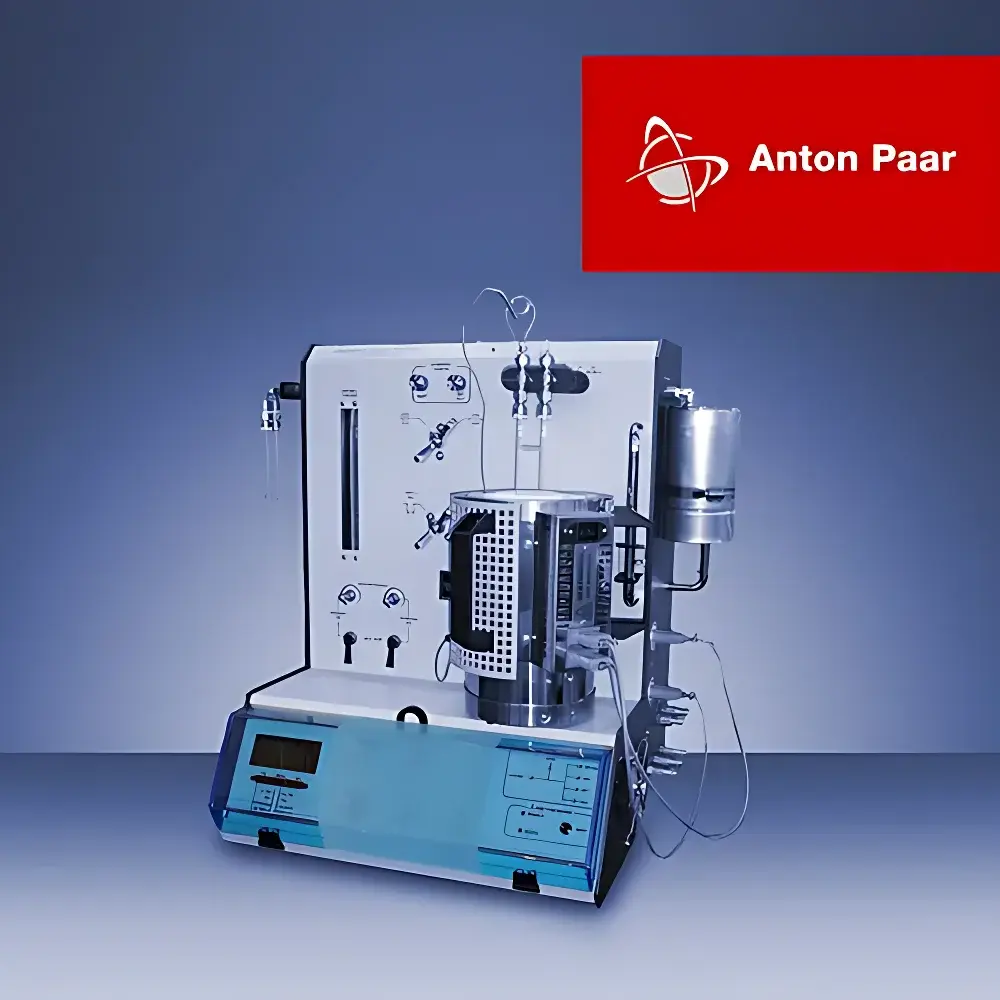
Anton Paar ChemBET Pulsar Automated Programmable Temperature-Controlled Chemisorption Analyzer
| Brand | Anton Paar |
|---|---|
| Origin | USA |
| Manufacturer Type | Manufacturer |
| Origin Category | Imported |
| Model | ChemBET Pulsar |
| Instrument Type | Chemisorption Analyzer |
| Measurement Principle | Fully Automated Flow Method |
| Gas Inlet Ports | 5 (expandable to 6 with optional gas mixer) |
| Temperature Range | Ambient to 1100 °C |
| Heating Rate | 1–50 °C/min (programmable in multiple segments) |
| Analytical Functions | TPR, TPD, TPO, Pulse Titration |
| Sample Stations | 2 (1 analysis + 1 preparation) |
| Quantitative Loop Volumes | 50, 100, 250 µL (custom volumes available) |
| Detector | High-Stability TCD with oxidation- and NH₃-resistant filament |
| Sample Tube Options | U-shaped quartz, Pyrex®, or borosilicate |
| Steam Trap | Integrated between sample tube and detector |
| GC/MS Interface Ports | 3 configurable locations (post-sample, post-trap/pre-detector, post-detector) |
| Surface Area Range | 0.01–280 m²/g |
| Total Pore Volume | 1×10⁻⁴–1.5×10⁻¹ cm³ |
| Volume Accuracy | ±1% |
| Repeatability | ±0.5% |
| Compatible Gases | H₂, O₂, CO, NO, SO₂, NH₃ (chemisorption) |
| Cooling Time (1100 °C → 100 °C) | < 30 min |
| Dimensions (W×H×D) | 45 × 63 × 42 cm |
| Weight | 24 kg |
| Operating Environment | 15–35 °C, 20–80% RH (non-condensing) |
| Power Supply | 100/120 V or 220/240 V AC, 50/60 Hz |
Overview
The Anton Paar ChemBET Pulsar is a benchtop, fully automated chemisorption analyzer engineered for precise, reproducible characterization of heterogeneous catalysts and functional materials. It operates on the flow method principle—introducing controlled pulses or continuous streams of reactive gases over a temperature-programmed catalyst bed while monitoring effluent composition via a high-stability thermal conductivity detector (TCD). Unlike static volumetric systems, the ChemBET Pulsar enables dynamic, real-time observation of surface reactions under industrially relevant conditions—including reduction (TPR), desorption (TPD), oxidation (TPO), and metal dispersion quantification via pulse titration. Its dual-station architecture separates sample preparation from analysis, eliminating cross-contamination and enabling parallel conditioning and measurement. The system integrates programmable heating profiles, automated gas switching, and quantitative loop injection—all coordinated through a unified software interface—making it suitable for routine QC labs and advanced R&D environments requiring GLP-compliant data traceability.
Key Features
- Programmable Dual-Zone Thermal Control: A high-precision furnace delivers linear heating rates from 1 °C/min up to 50 °C/min across its full 1100 °C range, with segmented ramping capability. An integrated forced-air cooling system reduces thermal soak time, achieving sub-30-minute cooldown from maximum temperature to 100 °C.
- Dual-Station Configuration: One station dedicated to in-situ pretreatment (e.g., calcination, reduction) and one reserved for analytical measurement—ensuring strict thermal and atmospheric isolation between steps.
- Modular Gas Handling Architecture: Five standard gas inlets (expandable to six with optional gas mixing module), each controlled by solenoid valves synchronized with temperature ramps and injection events. All wetted surfaces are constructed from stainless steel, PTFE, EP rubber, or inert glass—compatible with corrosive analytes including NH₃, SO₂, and NO.
- High-Fidelity TCD Detection: A robust, low-drift TCD with oxidation-resistant filament and digitally stabilized current supply ensures baseline stability over extended runs (>24 h), critical for low-concentration peak resolution in TPD and pulse titration.
- Integrated Steam Trap & GC/MS Coupling: A cryogenically cooled trap positioned between the sample tube and detector removes condensable vapors (e.g., H₂O, hydrocarbons), preserving detector integrity and signal fidelity. Three standardized GC/MS interface ports allow flexible coupling for evolved gas analysis (EGA) without hardware modification.
- Automated Quantitative Loop Injection: Motor-driven syringe-based loop actuation supports precise delivery of 50, 100, or 250 µL pulses—calibratable against certified gas standards—with automatic purging and zeroing between injections.
Sample Compatibility & Compliance
The ChemBET Pulsar accommodates powdered, pelletized, or supported catalysts (0.01–2.0 g typical mass) in standard U-shaped quartz or borosilicate sample tubes (1.5 cm³ volume, custom sizes available). Optional high-temperature quartz tubes with embedded thermocouples provide direct in-bed temperature measurement, improving accuracy in kinetic modeling. All operational sequences—including gas flow timing, temperature ramping, valve actuation, and data acquisition—are timestamped and logged with full audit trail functionality. The system supports 21 CFR Part 11–compliant user access control, electronic signatures, and immutable data archiving when configured with validated software modules. It conforms to ASTM D7209 (TPR/TPD of catalysts), ISO 18852 (surface area of porous solids), and IUPAC-recommended protocols for metal dispersion calculation.
Software & Data Management
TPRWIn software provides a unified environment for method development, instrument control, real-time visualization, and post-run analysis. Predefined templates streamline common workflows (e.g., H₂-TPR for Ni dispersion, NH₃-TPD for acidity profiling), while customizable scripting allows advanced users to define multi-step sequences with conditional logic. Peak deconvolution algorithms resolve overlapping desorption features using Gaussian/Lorentzian fitting with baseline correction and integration uncertainty estimation. Raw and processed data export to CSV, ASCII, or proprietary .tdf formats; metadata (gas composition, flow rate, calibration constants) is embedded directly into each dataset. Data backups are automated to network drives or cloud storage, and version-controlled method files ensure inter-laboratory reproducibility.
Applications
- Quantification of active metal surface area and dispersion in Pt/Al₂O₃, Ni/SiO₂, or Co/Mo sulfide catalysts via H₂ or CO pulse chemisorption.
- Acid site density and strength distribution mapping in zeolites and aluminosilicates using NH₃-TPD.
- Redox behavior assessment of transition metal oxides (e.g., CeO₂, Fe₂O₃) under reducing (H₂-TPR) or oxidizing (O₂-TPO) atmospheres.
- Thermal stability evaluation of supported catalysts during in-situ activation or deactivation studies.
- Correlation of surface properties (dispersion, acidity, reducibility) with catalytic performance metrics in reaction screening platforms.
- Support for DOE-compliant catalyst lifetime testing, where sequential TPD/TPR cycles monitor structural evolution under cyclic redox conditions.
FAQ
What types of catalysts can be analyzed on the ChemBET Pulsar?
The system is optimized for solid heterogeneous catalysts—including supported metals, metal oxides, zeolites, MOFs, and sulfided phases—across powder, extrudate, and monolith forms.
Is liquid-phase or slurry-based sample analysis possible?
No—the ChemBET Pulsar is designed exclusively for dry, solid-phase samples under controlled gas atmospheres. Slurries or liquids require prior drying or immobilization on inert supports.
Can the instrument perform both physisorption (BET) and chemisorption in one platform?
Yes—when equipped with optional cryogenic cooling (LN₂ or dry ice/acetone) and compatible gas manifolds, the system executes N₂ or Ar physisorption isotherms alongside chemisorption analyses, though not simultaneously.
How is temperature accuracy verified during operation?
Each run logs readings from both furnace thermocouple and optional sample-integrated thermocouple; deviations >±1 °C trigger automatic alerting and optional pause/resume logic.
Does the software support automated report generation for regulatory submissions?
Yes—TPRWIn includes configurable report templates compliant with GLP/GMP documentation requirements, embedding raw data plots, calibration records, operator ID, and instrument status logs.



