
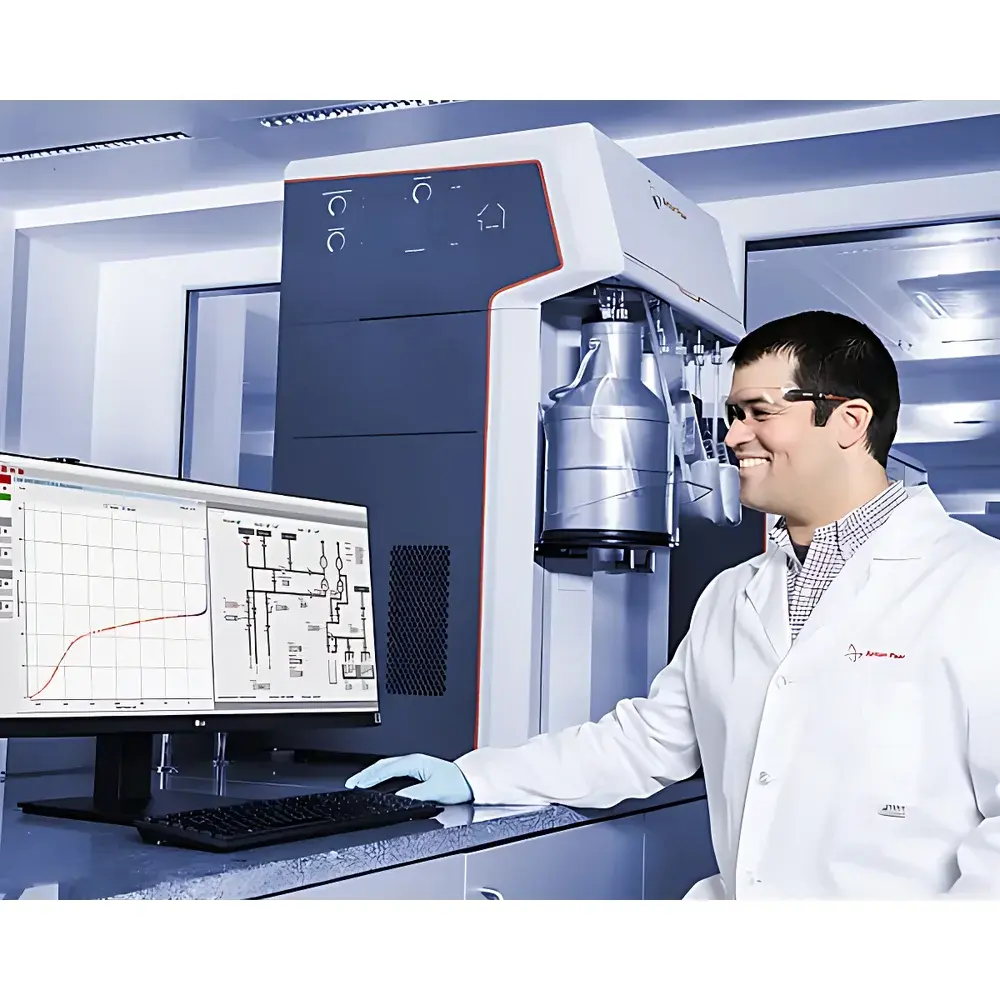
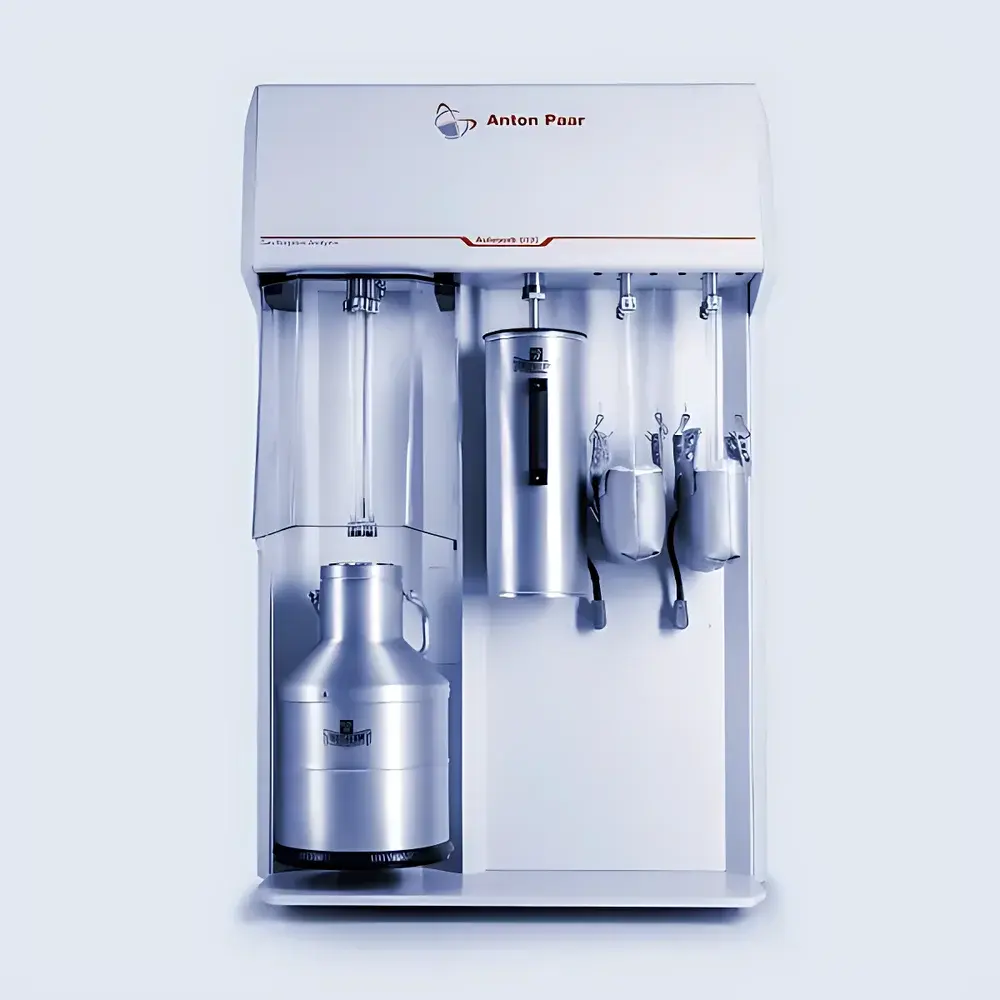
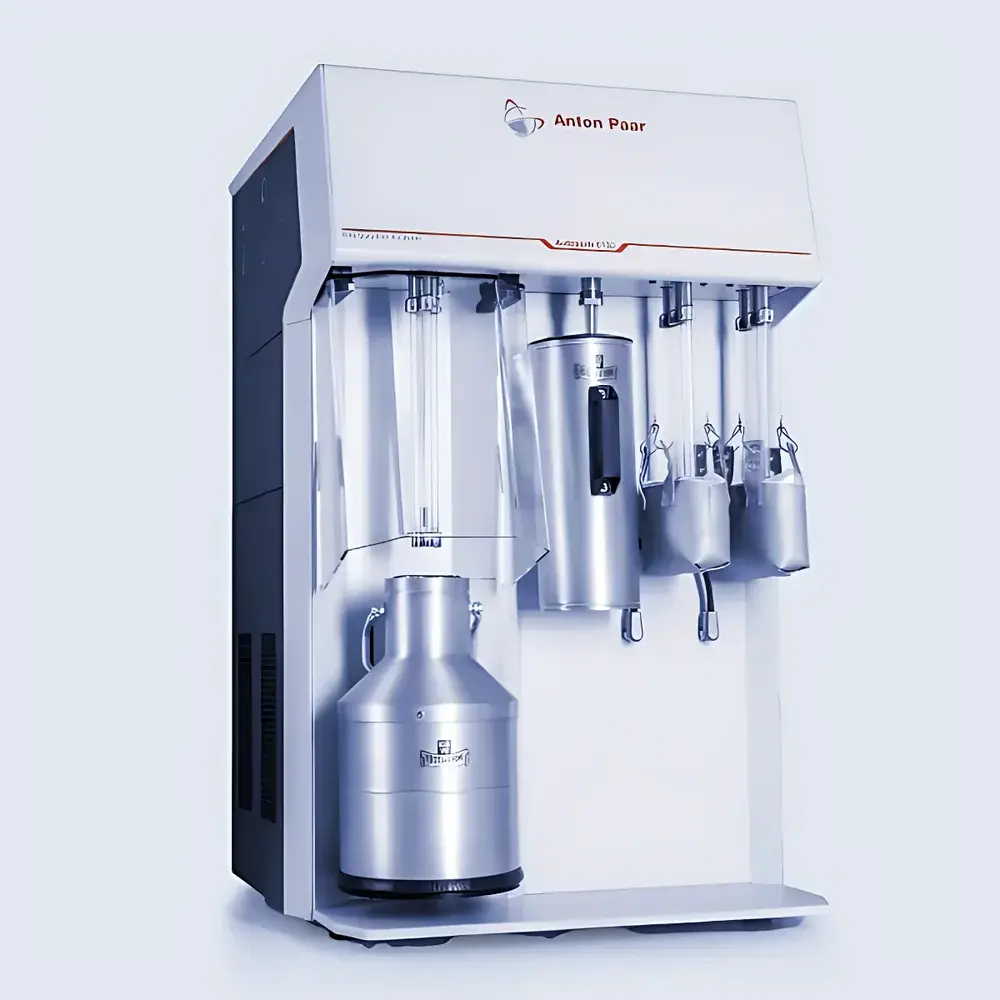
Anton Paar Autosorb 6100 Automated Gas Sorption Analyzer
| Brand | Anton Paar |
|---|---|
| Origin | USA |
| Manufacturer Type | Original Equipment Manufacturer (OEM) |
| Origin Category | Imported |
| Model | Autosorb 6100 |
| Instrument Type | Specific Surface Area and Pore Size Analyzer |
| Measurement Principle | Static Volumetric Method |
| Number of Analysis Stations | 3 |
| Specific Surface Area Range | 0.01 m²/g to unlimited |
| Pressure Range | 2×10⁻⁵ to 1100 Torr (2.6×10⁻⁸ to 0.997 p/p₀ for N₂ at 77 K) |
| Theoretical Basis | Vacuum Volumetric Method |
| Reproducibility | <1% RSD (per BAM Reference Material P115) |
| Ambient Operating Temperature | 15–35 °C |
| Temperature Control Accuracy | ±0.05 °C |
| Vacuum System | Dual-stage — Diaphragm Pump + Turbo-Molecular Pump |
Overview
The Anton Paar Autosorb 6100 is a high-precision, fully automated gas sorption analyzer engineered for rigorous physical adsorption characterization of porous and powdered materials. It operates on the static volumetric principle—quantifying gas uptake by precise pressure–volume–temperature (PVT) measurements under ultra-high vacuum conditions. Designed for metrological-grade surface area, pore size distribution (PSD), and pore volume analysis, the Autosorb 6100 delivers traceable, ISO/IEC 17025-aligned data across microporous (50 nm) regimes. Its capability to resolve relative pressures down to 2.6×10⁻⁸ p/p₀ (N₂ at 77 K) enables reliable characterization of ultramicropores and low-surface-area catalysts—critical for advanced battery electrode materials, MOFs, zeolites, and pharmaceutical excipients.
Key Features
- Triple Independent Analysis Stations: Each station operates autonomously with dedicated temperature control, pressure sensing, and gas handling—enabling concurrent BET surface area, t-plot micropore analysis, and DFT-based PSD on three distinct samples using different adsorbates (e.g., N₂, Ar, CO₂) and temperatures.
- TruZone™ Active Liquid-Level Control: Maintains constant cryogenic bath depth during extended runs (≥90 h with 3 L Dewar), eliminating thermal drift and ensuring stable cold-zone volume calibration—essential for reproducible sub-10⁻⁸ p/p₀ isotherm acquisition.
- Ultra-High Vacuum Architecture: Integrated dual-stage vacuum system (diaphragm pre-pump + turbo-molecular pump) achieves base pressure ≤2×10⁻⁵ Torr; stainless-steel monobloc manifold with high-integrity pneumatic valves improves vacuum integrity by 38% versus legacy designs.
- PowderProtect™ Sample Handling: Patented gas-flow modulation during degassing and equilibration suppresses sample fluidization and mass loss—particularly critical for fragile aerogels, nanocellulose, or low-density MOF powders.
- Integrated 6-Position Degassing Station: Two independently controlled heating zones (RT to 450 °C) support programmable multi-step degassing under dynamic or static vacuum, compliant with ASTM D3663 and ISO 9277 conditioning protocols.
Sample Compatibility & Compliance
The Autosorb 6100 supports a broad spectrum of non-corrosive adsorbates—including N₂ (77 K), Ar (87 K), Kr (77 K), CO₂ (273 K), H₂ (77 K), CH₄, C₂H₆, C₃H₈, benzene, xylene, NH₃, pyridine, and acetone—enabling both physisorption and weak chemisorption studies. All hardware and software modules conform to GLP/GMP documentation requirements, with full audit trail support per FDA 21 CFR Part 11. Data export formats (CSV, XML, PDF) are compatible with LIMS integration, and instrument validation adheres to IQ/OQ/PQ frameworks aligned with ISO/IEC 17025 and USP .
Software & Data Management
ASiQwin™ software provides complete workflow automation—from method definition and real-time isotherm visualization to model-based interpretation (BET, Langmuir, t-plot, αs-plot, DFT/NLDFT, QSDFT). Embedded uncertainty propagation algorithms calculate confidence intervals for derived parameters (e.g., surface area ±0.5%, pore width ±0.05 nm). Raw pressure–time datasets are stored with full metadata (temperature logs, valve actuation timestamps, vacuum history), supporting retrospective reprocessing without raw data loss. Optional CryoSync™ module enables synchronized cryostat control across all three stations for multi-temperature isotherms without external scripting.
Applications
- Quality control of activated carbons, silica gels, and alumina supports in catalysis and filtration
- Structure–property correlation of metal–organic frameworks (MOFs) and covalent organic frameworks (COFs)
- Pore network evolution tracking in battery cathode/anode materials during cycling
- Surface heterogeneity mapping of pharmaceutical solids via water vapor sorption isotherms
- Validation of synthetic protocols for hierarchical porous ceramics and aerogels
FAQ
What adsorption theories and models are supported for data interpretation?
BET, Langmuir, Dubinin–Radushkevich (DR), t-plot, αs-plot, BJH, DH, HK, SF, DA, DFT (NLDFT/QSDFT kernel libraries for carbon, silica, and alumina), and IAST for mixture adsorption prediction.
Is the instrument suitable for water vapor sorption analysis?
Yes—via optional integrated vapor generator module; supports gravimetric and dynamic vapor sorption (DVS) mode with humidity control from 0–90% RH at 5–50 °C.
Can the Autosorb 6100 be upgraded from a single- to triple-station configuration post-purchase?
Yes—hardware expansion kits (manifold, sensors, cryostats) and software licenses are field-installable with minimal downtime.
Does the system meet regulatory requirements for pharmaceutical development?
Fully compliant with USP , ICH Q5C, and FDA 21 CFR Part 11 when deployed with validated ASiQwin™ v5.x and enabled electronic signature/audit trail modules.
What is the minimum detectable surface area and associated uncertainty?
0.01 m²/g (N₂, 77 K); measurement uncertainty is ≤1% RSD for samples ≥2 m² total surface area (per BAM P115 reference standard verification).



