
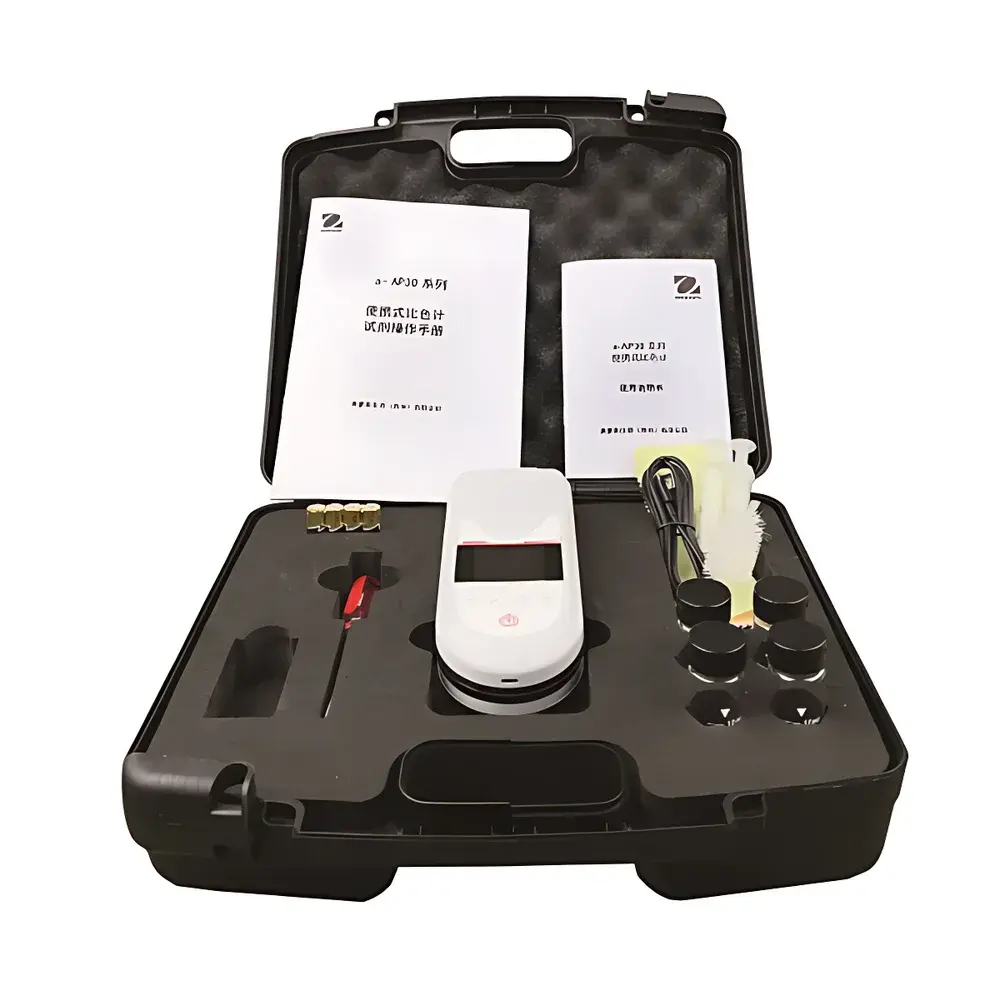
OHAUS AP30CLD Portable Photometric Water Quality Analyzer
| Brand | OHAUS |
|---|---|
| Origin | Shanghai, China |
| Manufacturer Type | Direct Manufacturer |
| Regional Classification | Domestic (China) |
| Model | AP30CLD |
| Instrument Type | Portable / Handheld Water Quality Analyzer |
| Measurable Parameters | Free Chlorine & Total Chlorine |
| Light Source | Multi-wavelength LEDs |
| Detection Principle | Absorption Photometry (Fixed-Wavelength Spectrophotometry) |
| Data Storage | 5,000 Measurement Records |
| Display | High-Brightness OLED |
| Power Supply | 4 × AAA Batteries |
| Interface | Built-in Micro-USB Port |
| Enclosure Rating | IP67 (Dust-Tight & Immersion-Resistant to 1 m for 30 min) |
| Dimensions | 162 × 78 × 42 mm |
| Weight | 220 g (without batteries) |
| Operating Temperature | 0–50 °C |
| Relative Humidity | ≤90 % RH (non-condensing) |
Overview
The OHAUS AP30CLD Portable Photometric Water Quality Analyzer is an engineered field-deployable instrument designed for rapid, on-site quantification of free chlorine and total chlorine in aqueous matrices. It operates on the principle of fixed-wavelength absorption photometry—utilizing calibrated multi-wavelength LED sources to excite colorimetric reactions between chlorine-specific reagents and analyte species. The optical path is optimized for minimal stray light and consistent beam geometry, ensuring high reproducibility across variable ambient lighting conditions. Unlike broad-spectrum spectrophotometers, the AP30CLD employs discrete, temperature-stabilized LEDs matched to the peak absorbance bands of DPD-based (N,N-diethyl-p-phenylenediamine) chemistry—enabling selective detection with reduced interferences from turbidity, nitrite, or monochloramine under standard operating protocols. Its compact architecture, low power consumption, and ruggedized enclosure make it suitable for continuous duty in municipal water distribution audits, wastewater effluent monitoring, recreational water safety verification, and industrial process control environments.
Key Features
- High-stability multi-LED optical system with factory-calibrated wavelengths at 525 nm (free chlorine) and 550 nm (total chlorine), minimizing spectral drift over time and temperature fluctuations.
- Integrated OLED display with auto-brightness adjustment—optimized for legibility under direct sunlight or low-light field conditions.
- IP67-rated housing with sealed data port and tactile membrane keypad—designed for operation in humid, dusty, or splash-prone settings including pump stations, cooling towers, and pool decks.
- Low reagent and sample volume requirement (≤10 mL per test), reducing consumable cost and enabling analysis where sample availability is constrained.
- Automatic zeroing and calibration validation routine accessible via on-device menu—supporting daily field verification without external reference standards.
- Configurable auto-power-off (1–30 min) and battery-level indicator—ensuring >12 hours of continuous operation on four AAA alkaline cells under typical usage patterns.
Sample Compatibility & Compliance
The AP30CLD is validated for use with EPA Method 334.0 and Standard Methods 4500-Cl G (DPD colorimetric method) for both free and total chlorine determination. It accepts liquid samples within pH 4.0–8.5 and turbidity ≤5 NTU without filtration—within the operational envelope defined by US EPA and ISO 7888:2019 for chlorine measurement in drinking water and treated effluents. Sample matrix compatibility includes clarified surface water, chlorinated potable water, stabilized swimming pool water, and low-organic-content industrial cooling water. The device conforms to IEC 61000-4 electromagnetic immunity standards and meets CE marking requirements for portable instrumentation. Its data integrity framework supports GLP-compliant workflows through timestamped records and non-editable storage—though full 21 CFR Part 11 compliance requires integration with validated third-party LIMS software.
Software & Data Management
All measurements are stored locally in non-volatile memory with embedded UTC timestamps, operator ID fields (configurable), and result flags (e.g., “out-of-range”, “calibration expired”). The built-in micro-USB interface enables direct connection to Windows/macOS systems without proprietary drivers; exported data is formatted as UTF-8 CSV files containing column headers: Date, Time, Parameter, Value (mg/L), Unit, Sample ID, Operator, and QC Status. Firmware updates and method configuration (e.g., unit switching between mg/L and ppm) are performed via OHAUS-provided desktop utility software—available for download from the official OHAUS global support portal. No cloud connectivity or remote telemetry is implemented, preserving data sovereignty for regulated users.
Applications
- Municipal water utilities performing routine distribution system residual chlorine checks during field patrols.
- Wastewater treatment plants verifying disinfection efficacy prior to discharge compliance reporting.
- Facility management teams monitoring HVAC cooling tower biocide residuals to prevent Legionella proliferation.
- Public health inspectors conducting unannounced pool and spa water safety assessments per CDC Model Aquatic Health Code (MAHC).
- Industrial boiler operators validating feedwater dechlorination efficiency before reverse osmosis membrane protection.
- Environmental contractors supporting Phase I/II site assessments where rapid screening for halogenated oxidants informs sampling strategy.
FAQ
What chlorine species does the AP30CLD measure independently?
It measures free chlorine (hypochlorous acid + hypochlorite ion) and total chlorine (free chlorine + combined chlorine, e.g., chloramines) as separate parameters using sequential DPD reagent additions per Standard Methods protocol.
Is calibration traceable to NIST standards?
Yes—factory calibration is performed using NIST-traceable chlorine standard solutions (SRM 2802), and users may perform field recalibration with certified secondary standards.
Can the instrument be used in seawater or brackish water?
Not recommended without dilution and matrix-matched calibration; high chloride ion concentration (>5,000 mg/L) may suppress DPD reaction kinetics and require method adaptation.
How is measurement uncertainty characterized?
At 1.0 mg/L free chlorine, typical repeatability is ±0.05 mg/L (n=6, within-run CV <2.5%), based on internal validation per ISO/IEC 17025 guidelines.
Does the AP30CLD support custom method development?
No—only pre-programmed chlorine methods are available; no user-defined wavelength or curve-fitting functionality is provided.
Related Products







