
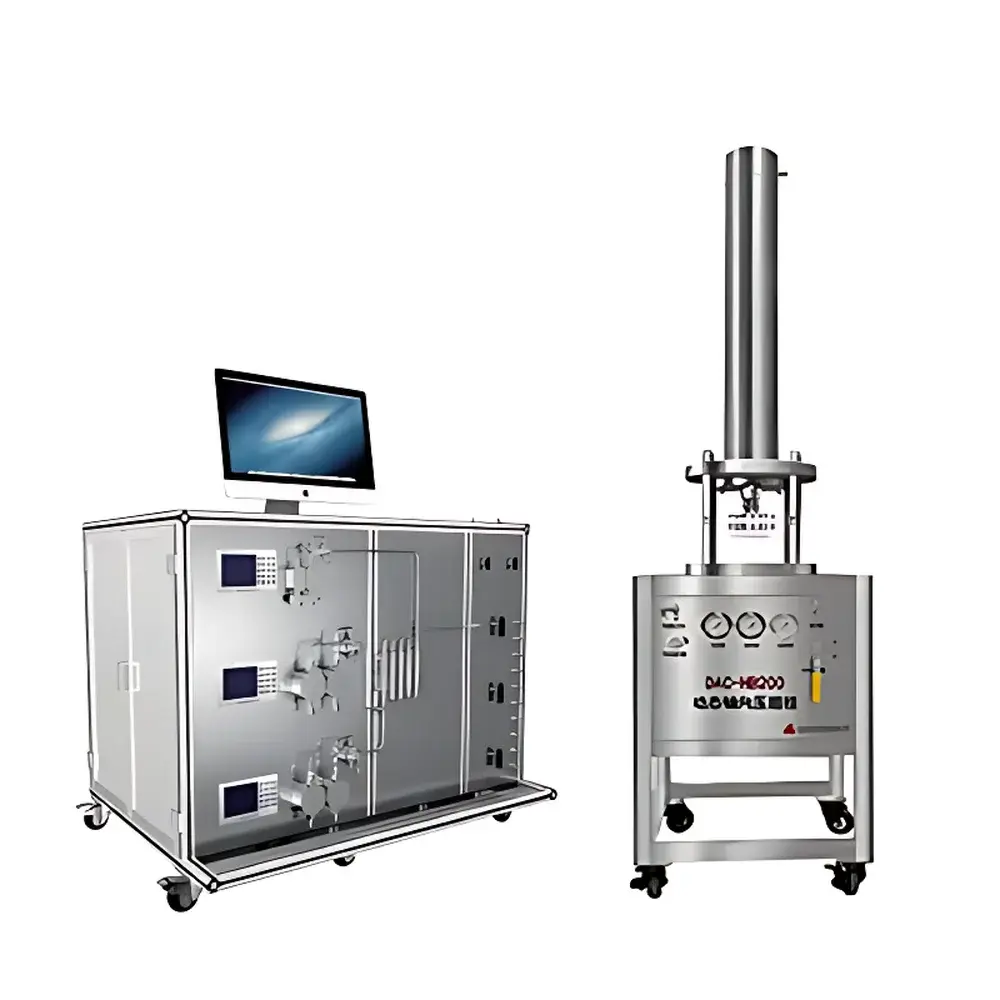
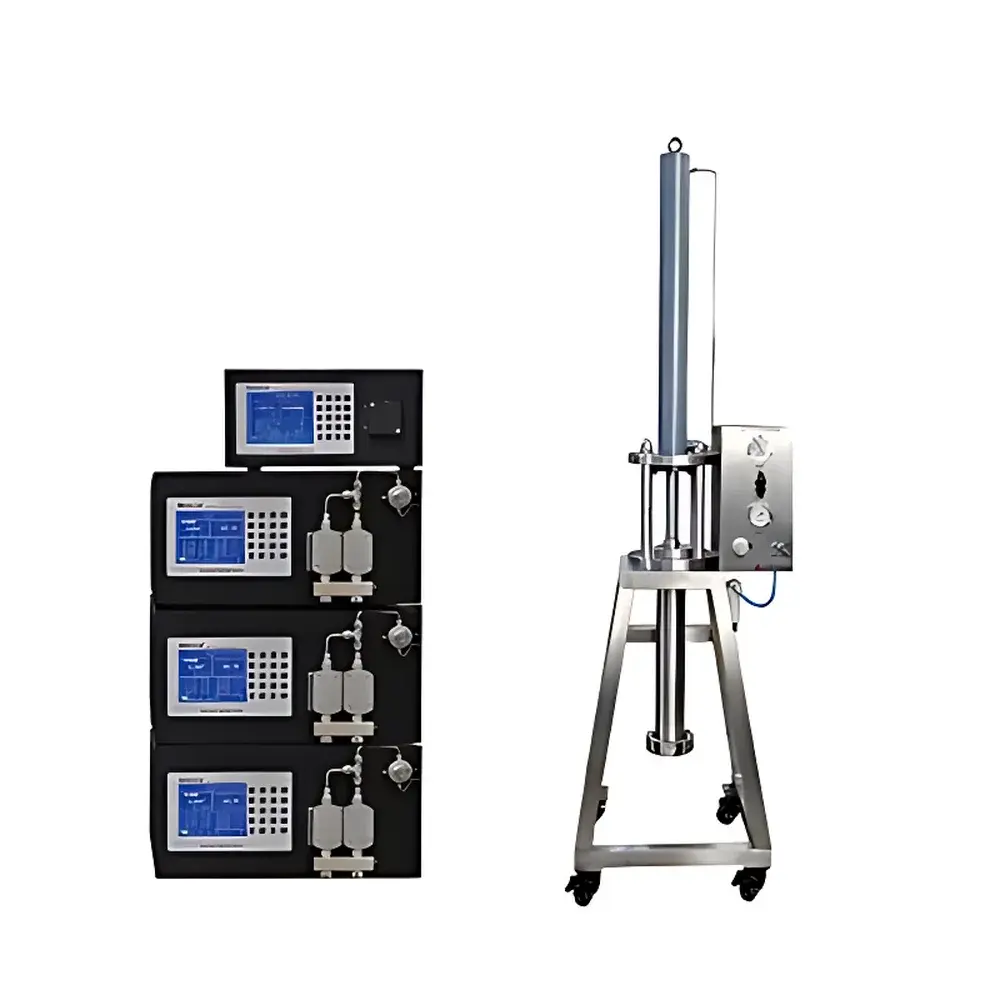
Hanbon NS43300 Laboratory-Scale High-Performance Preparative Liquid Chromatography System
| Brand | Hanbon |
|---|---|
| Origin | Jiangsu, China |
| Manufacturer Type | OEM Producer |
| Product Category | Domestic |
| Model | NS43300 |
| Application Level | Industrial Preparative |
| Instrument Type | High-Pressure Preparative HPLC |
| Flow Rate Range | 0.1–2999.9 mL/min |
| Flow Accuracy | RSD ≤ 1% |
| Flow Precision (Repeatability) | ≤ 1% |
| Maximum Operating Pressure | 10 MPa |
| Wavelength Range | ±2 nm |
| Wavelength Repeatability | 0.2 nm |
| Baseline Noise | 2 × 10⁻⁵ AU |
| Data Acquisition Frequency | 5 Hz |
Overview
The Hanbon NS43300 Laboratory-Scale High-Performance Preparative Liquid Chromatography System is an engineered solution for scalable chromatographic purification in research, process development, and pilot-scale manufacturing environments. Built upon high-pressure liquid chromatography (HPLC) principles, the system utilizes positive displacement piston pumping and UV-Vis absorbance detection to deliver robust separation performance across a wide range of compound classes—including peptides, natural products, synthetic pharmaceuticals, fermentation metabolites, and fine chemicals. Its architecture supports both analytical method transfer and linear scale-up from lab to pilot production, with pressure-rated components compliant with ISO 8573-1 (compressed air quality) and ASME B31.3 (process piping) design considerations for fluid-handling integrity.
Key Features
- High-precision dual-piston reciprocating pump with electronic damping flow control—ensures stable gradient formation and minimizes pulsation-induced baseline disturbance.
- Floating piston seal design extends seal lifetime under continuous high-pressure operation (up to 10 MPa), reducing maintenance frequency and downtime.
- UV-Vis detector with dual-wavelength simultaneous monitoring (±2 nm wavelength accuracy, 0.2 nm repeatability) enables real-time peak tracking and ratio-based identification of co-eluting species.
- Wetted-path materials configurable in SS316L stainless steel, titanium alloy, or PEEK—supporting compatibility with aggressive solvents (e.g., TFA, HFIP), acidic/basic mobile phases, and halogenated systems.
- Modular detection options including optional RID (refractive index detector) and ELSD (evaporative light scattering detector) for non-chromophoric or low-UV-absorbing analytes.
- Integrated fraction collector supporting time-based, threshold-triggered (e.g., UV peak height/area), and manual on-demand collection—each fraction logged with timestamp, retention time, and system pressure metadata.
Sample Compatibility & Compliance
The NS43300 accommodates column formats ranging from analytical-scale (4.6 mm ID) to preparative columns up to 100 mm ID—including standard HPLC columns, spring-loaded columns, dynamic axial compression (DAC) columns, and multi-functional axial compression (MAC) columns. It supports common stationary phases (C18, silica, amino, cyano, ion-exchange, and chiral media) and mobile phases spanning water/acetonitrile, water/methanol, THF, chloroform, and supercritical CO₂-based systems. The system meets key regulatory expectations for GLP/GMP-aligned workflows: audit trail functionality (with user authentication and event logging), electronic signature support per FDA 21 CFR Part 11, and data integrity compliance aligned with ALCOA+ principles. All firmware and hardware configurations are documented per ICH Q5C and USP guidelines for analytical instrument qualification.
Software & Data Management
The system operates under Hanbon ChromaControl™ v3.x software—a Windows-based platform offering method editor, real-time chromatogram visualization, peak integration with customizable baseline algorithms (tangent skim, valley-to-valley, perpendicular drop), and automated calibration reporting. Raw data files (.hcd) are stored in vendor-neutral HDF5 format with embedded metadata (instrument configuration, environmental conditions, operator ID). Export options include CSV, PDF reports, and XML-compliant outputs for LIMS integration. Software validation packages—including IQ/OQ documentation templates and cybersecurity assessment summaries—are available upon request to support internal validation protocols.
Applications
- Purification of monoclonal antibody fragments and bispecific constructs requiring high-resolution separation under denaturing or native conditions.
- Isolation of bioactive alkaloids, flavonoids, and terpenoids from plant extracts—leveraging gradient elution and dual-wavelength detection for selective fraction targeting.
- Chiral resolution of racemic APIs during early-stage development, using polysaccharide-based chiral columns and sub-2 µm particle packings.
- Process validation of fermentation-derived antibiotics (e.g., vancomycin analogs), where reproducible recovery (>92%) and endotoxin-free eluent handling are critical.
- Method scouting and robustness testing per ICH Q2(R2), including column temperature, flow rate, and gradient slope variation studies.
FAQ
What column dimensions and packing materials are supported?
The NS43300 accommodates columns from 4.6 mm to 100 mm internal diameter, with maximum bed heights up to 500 mm. Compatible packings include fully porous and superficially porous silica (sub-2 µm to 25 µm), polymeric resins, and immobilized chiral selectors.
Is the system compatible with GMP-compliant data archiving requirements?
Yes—audit trails record all method changes, injection events, calibration actions, and user logins. Data files include cryptographic hash signatures and are exportable in formats accepted by validated enterprise LIMS and eDMS platforms.
Can the UV-Vis detector be calibrated traceably to NIST standards?
Yes—wavelength calibration uses holmium oxide and didymium filters certified to NIST SRM 2034 and SRM 2035; photometric linearity is verified using neutral density filters per ASTM E275.
What solvent compatibility limitations apply to the titanium alloy fluidic path option?
Titanium alloy wetted parts resist corrosion from halogenated solvents, strong acids (e.g., >6 M HCl), and oxidizing agents (e.g., nitric acid), but are not recommended for prolonged exposure to hydrofluoric acid or hot alkaline solutions above pH 12.
How is system suitability assessed during method transfer?
Built-in system suitability tests include retention time precision (RSD ≤ 0.5%), peak asymmetry (0.8–1.5), resolution (≥2.0 between critical pairs), and tailing factor (≤2.0)—all calculated per USP and EP 2.2.46 specifications.





