
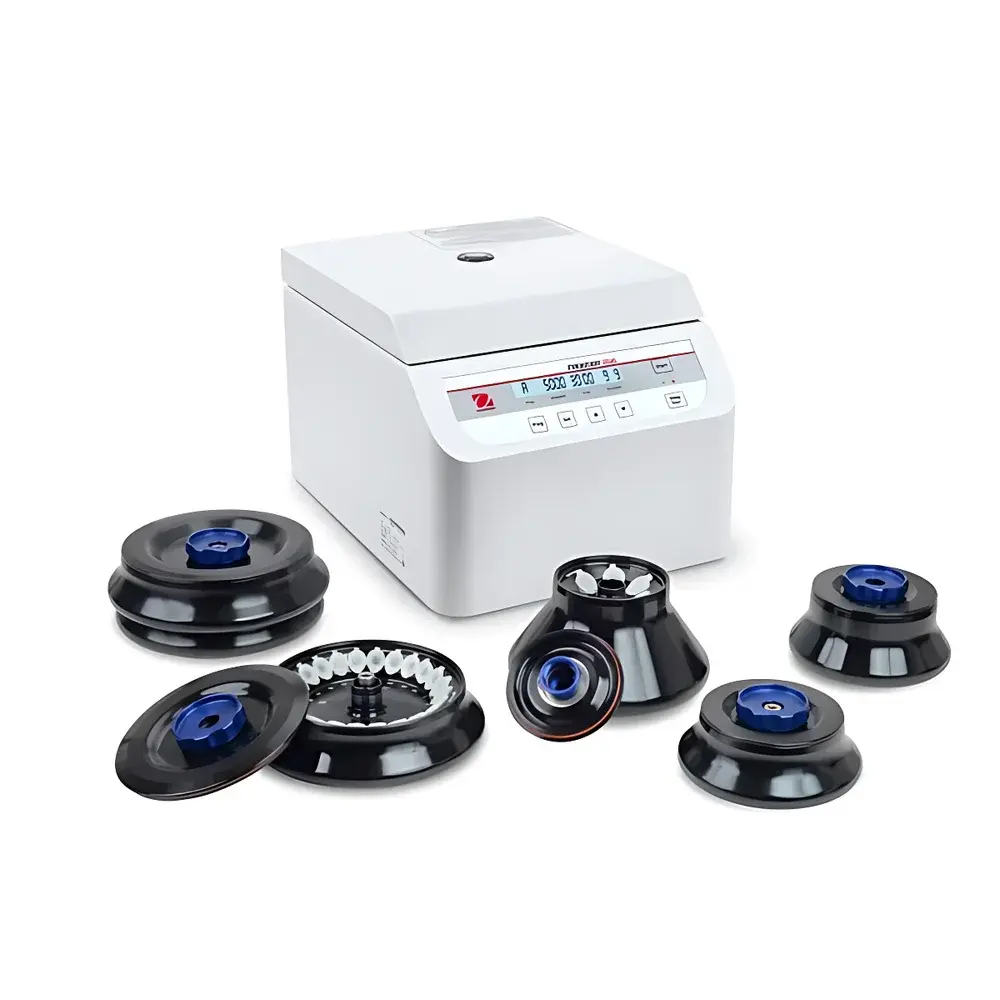
OHAUS FRONTIER™ 2000 FC2516 Microcentrifuge
| Brand | OHAUS |
|---|---|
| Origin | Jiangsu, China |
| Manufacturer Type | Original Equipment Manufacturer (OEM) |
| Product Category | Domestic |
| Model | FC2516 |
| Instrument Type | Benchtop Centrifuge |
| Speed Range | 300 – 16,500 rpm |
| Maximum RCF | 19,080 × g |
| Maximum Capacity | 48 × 1.5/2.0 mL |
| Rotor Configuration | Fixed-angle rotors only |
| Application Class | Biomolecular Separation |
| Dimensions (W × D × H) | 245 × 280 × 380 mm |
| Safety Certification | IEC 61010-1, EN 61326-1 (EMC) |
Overview
The OHAUS FRONTIER™ 2000 FC2516 is a benchtop microcentrifuge engineered for precision, safety, and operational efficiency in routine biomolecular separation workflows. It operates on the principle of sedimentation centrifugation—utilizing controlled rotational acceleration to separate particles based on size, density, and shape within viscous media. Designed for laboratories performing daily nucleic acid purification, protein pelleting, cell lysate clarification, and small-volume sample concentration, the FC2516 delivers reproducible RCF (Relative Centrifugal Force) performance across its full speed range of 300–16,500 rpm. Its compact footprint (245 × 280 × 380 mm) integrates seamlessly into biosafety cabinets or crowded benchtop environments without compromising structural rigidity or thermal stability during extended runs.
Key Features
- Robust all-metal chassis with vibration-dampening base and balanced rotor chamber, minimizing operational noise and mechanical drift during high-speed operation.
- Airtight fixed-angle rotor design featuring dual-stage silicone O-ring sealing and quick-locking lid mechanism—certified to contain aerosols generated during centrifugation of biohazardous samples (e.g., viral vectors, clinical specimens).
- Intuitive rotary dial interface with real-time rpm/RCF display, pre-set protocols for common applications (e.g., “DNA Pellet”, “Bacterial Harvest”), and automatic rotor recognition for error-free parameter validation.
- Brushless DC motor with closed-loop speed control ensures ±50 rpm accuracy at maximum load and maintains consistent rotational velocity across voltage fluctuations (100–240 VAC, 50/60 Hz).
- Integrated safety systems include imbalance detection (auto-stop at ≥5 g asymmetry), lid interlock with mechanical and electronic redundancy, and overtemperature monitoring of motor housing and rotor chamber.
Sample Compatibility & Compliance
The FC2516 supports standard microcentrifuge tubes (1.5 mL and 2.0 mL) in configurations up to 48 positions per run. Compatible rotor options include aluminum fixed-angle rotors optimized for rapid pelleting of nucleic acids, proteins, and subcellular organelles. All rotors are autoclavable (121°C, 20 min) and validated for repeated sterilization cycles without dimensional creep or fatigue. The instrument complies with IEC 61010-1 for laboratory equipment safety and EN 61326-1 for electromagnetic compatibility. While not certified for GLP/GMP production environments, its audit-ready operation log (via optional USB export) supports traceability requirements under ISO/IEC 17025-accredited testing laboratories.
Software & Data Management
The FC2516 operates as a standalone instrument with no proprietary software dependency. All run parameters—including speed, time, acceleration/deceleration profiles, and final RCF—are stored in non-volatile memory for the last 100 cycles. A USB-C port enables export of timestamped run logs (CSV format) containing start/stop times, actual vs. set rpm, detected imbalances, and thermal events. This functionality facilitates compliance with internal SOP documentation and satisfies basic data integrity expectations aligned with FDA 21 CFR Part 11 Annex 11 principles—though full electronic signature capability requires integration with third-party LIMS platforms.
Applications
- Routine DNA/RNA precipitation and column-based purification workflows requiring rapid 1.5 mL tube processing.
- Preparative isolation of exosomes, microvesicles, and ribonucleoprotein complexes via differential centrifugation steps (e.g., 10,000 × g for 15 min followed by 16,500 × g for 30 min).
- Clarification of bacterial and mammalian cell lysates prior to chromatography or electrophoresis.
- Concentration of dilute antibody solutions or enzyme preparations in low-volume formats.
- Quality control centrifugation in pharmaceutical R&D labs for filter integrity verification and particulate analysis of sterile filtrates.
FAQ
Is the FC2516 suitable for centrifuging infectious or hazardous biological materials?
Yes—the airtight rotor assembly meets containment standards for BSL-2 agents when used with certified sealed tubes and proper PPE. Dual O-rings and positive-latch lid prevent aerosol escape during deceleration.
Can I use this centrifuge for temperature-sensitive samples?
No active refrigeration is provided; however, the thermally insulated chamber and low-mass rotor minimize ambient heat transfer. For heat-sensitive applications, pre-chill rotors and tubes at 4°C prior to loading.
What rotor types are compatible with the FC2516?
Five fixed-angle aluminum rotors are available: 24 × 1.5/2.0 mL, 30 × 1.5/2.0 mL, 48 × 1.5/2.0 mL, 12 × 5 mL, and 6 × 10 mL—each individually calibrated and serialized for RCF traceability.
Does the FC2516 support programmable acceleration/deceleration ramps?
Yes—six user-selectable ramp profiles (soft, medium, fast, and three custom settings) allow optimization for fragile pellets or viscous samples.
How often does the instrument require calibration verification?
Annual verification of speed accuracy and RCF output using an NIST-traceable tachometer is recommended per ISO/IEC 17025 Clause 6.5.3; OHAUS provides calibration certificates upon request.



