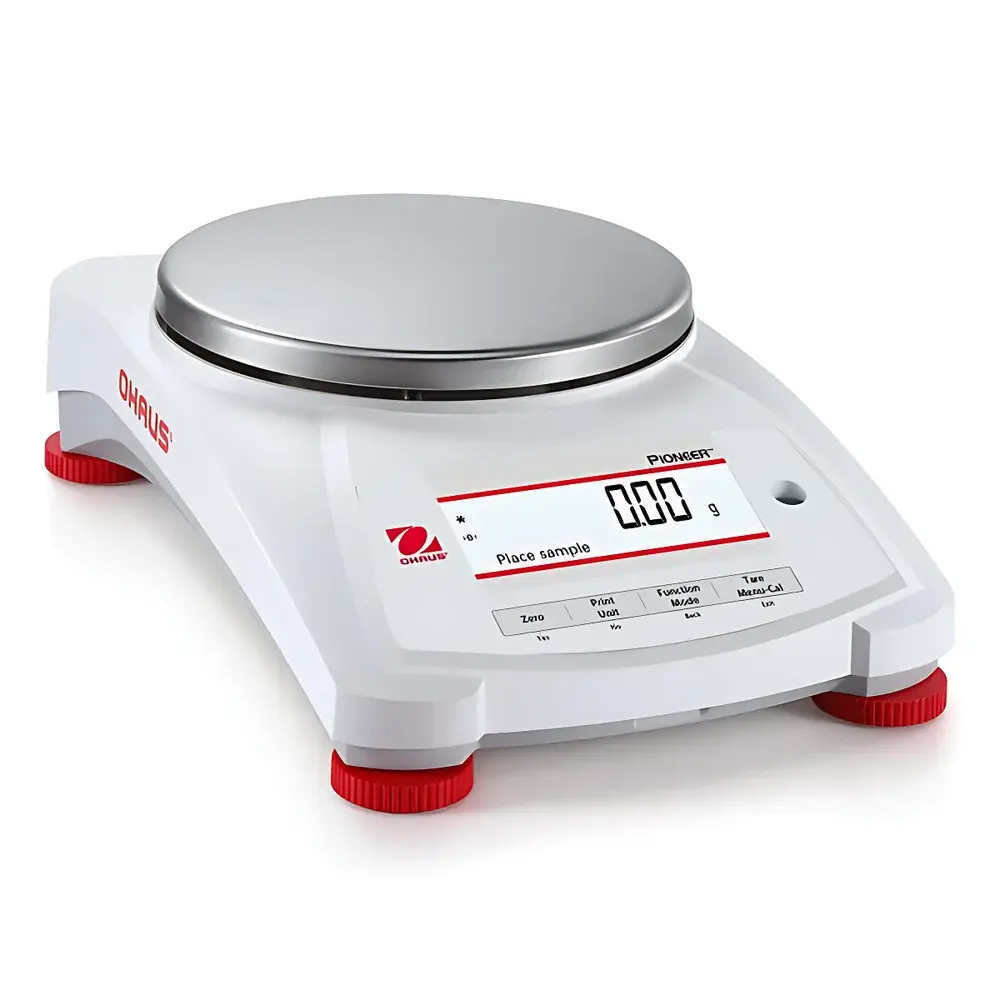
OHAUS Pioneer PX822ZH Precision Balance
| Brand | OHAUS |
|---|---|
| Origin | Jiangsu, China |
| Manufacturer Type | Direct Manufacturer |
| Product Category | Domestic |
| Model | PX822ZH |
| Instrument Type | Precision Balance |
| Maximum Capacity | 820 g |
| Readability | 0.01 g |
| Repeatability | 0.01 g |
| Calibration Modes | Internal, External, Manual, Automatic |
| Interface | USB, RS232 |
| Construction | Die-cast aluminum base, removable stainless steel pan, removable glass draft shield |
| Additional Features | ESD static elimination bar (red), GLP/GMP-compliant real-time clock, under-hook weighing, adjustable display brightness, configurable environmental filtering, auto-tare, theft-resistant lock, protective cover |
| Compliance | Designed to support GLP and GMP documentation requirements |
Overview
The OHAUS Pioneer PX822ZH Precision Balance is a rigorously engineered analytical-grade weighing instrument designed for routine quantitative mass measurement in regulated laboratory, quality control, and educational environments. Operating on electromagnetic force restoration (EMFR) principle, the PX822ZH delivers high reproducibility and long-term stability across its 820 g maximum capacity range with 0.01 g readability. Its core architecture integrates a die-cast aluminum base for mechanical damping and thermal inertia management, paired with a removable stainless steel weighing pan and modular glass draft shield—ensuring consistent performance under variable ambient conditions including minor air currents and temperature fluctuations. The built-in red ESD static elimination bar positioned above the weighing chamber actively dissipates electrostatic charge from samples and containers, mitigating drift and improving measurement fidelity—particularly critical when handling low-mass powders, polymers, or hygroscopic materials.
Key Features
- Electromagnetic force restoration sensor with 0.01 g resolution and ≤0.01 g repeatability per ASTM E898-22 and ISO 9001 calibration protocols
- Integrated ESD static elimination bar—reduces electrostatic interference without requiring external ionizers
- Dual-line LCD display: top line shows real-time mass value; bottom line provides contextual menu navigation and multilingual (including English) operational prompts—enabling intuitive operation without reference to printed manuals
- Configurable environmental filtering algorithms to suppress vibration- or airflow-induced noise during sensitive measurements
- Adjustable display brightness and contrast for optimal legibility under diverse lighting conditions (e.g., fume hood illumination or low-light QC labs)
- GLP/GMP-compliant real-time clock with date/time stamping of all weight records—supports audit-ready data traceability
- Under-hook weighing capability for density determination and suspended sample measurement
- Theft-resistant mechanical lock and transparent protective cover for secure instrument storage and transport
Sample Compatibility & Compliance
The PX822ZH accommodates a broad spectrum of sample types—from solid reagents and granular pharmaceutical intermediates to small-volume liquid containers and pre-weighed vials—within its 820 g capacity and 140 mm pan diameter. Its removable stainless steel pan and quick-release glass draft shield facilitate rapid cleaning and cross-contamination prevention between batches. While not certified for Class I/II hazardous locations, the balance meets general-purpose laboratory safety standards (IEC 61010-1) and supports compliance workflows aligned with FDA 21 CFR Part 11 (when used with validated OHAUS software), USP , and ISO/IEC 17025–accredited testing procedures. Routine calibration verification using traceable NIST-certified weights satisfies internal QA checklists and external audit requirements.
Software & Data Management
Equipped with native USB and RS232 serial interfaces, the PX822ZH enables seamless bidirectional communication with LIMS, ELN, and spreadsheet applications. Data output includes timestamped mass values, net/gross/tare identifiers, unit codes (g, mg, oz, etc.), and status flags (e.g., “stable”, “overload”, “calibrating”). When connected to OHAUS AC-300 or LabX-compatible drivers, the balance supports automated report generation with GLP headers (operator ID, location, method ID), electronic signature capture, and encrypted data export. All communication logs are time-stamped and retain immutable metadata—facilitating full traceability for regulatory inspections.
Applications
- Raw material verification and batch release testing in pharmaceutical manufacturing
- Weighing standards and reference materials in metrology labs
- Formulation development and excipient blending in R&D settings
- Student experiments and teaching demonstrations in university chemistry and biology laboratories
- In-process checks during packaging line setup and validation
- Density and specific gravity determinations via sinker method (using optional density kit)
- Calibration of pipettes and volumetric glassware through gravimetric verification
FAQ
What calibration options does the PX822ZH support?
It supports internal calibration (via motor-driven internal weight), external calibration (with user-provided standards), manual calibration, and automatic periodic calibration triggered by time or temperature thresholds.
Is the balance compliant with FDA 21 CFR Part 11?
The hardware itself is Part 11–ready; full compliance requires integration with validated software (e.g., OHAUS Logger Pro or third-party LIMS) that enforces electronic signatures, audit trails, and role-based access control.
Can the PX822ZH be used for moisture analysis?
No—it lacks integrated heating and moisture detection components. For moisture content determination, OHAUS recommends the MB series moisture analyzers.
Does it support multiple weighing units?
Yes—g, mg, oz, lb, ct, dwt, grain, and % are selectable via front-panel menu.
How is environmental filtering configured?
Through the Setup menu: users select low/medium/high filtering intensity based on local vibration sources or airflow conditions—adjusting response time versus stability trade-offs.