
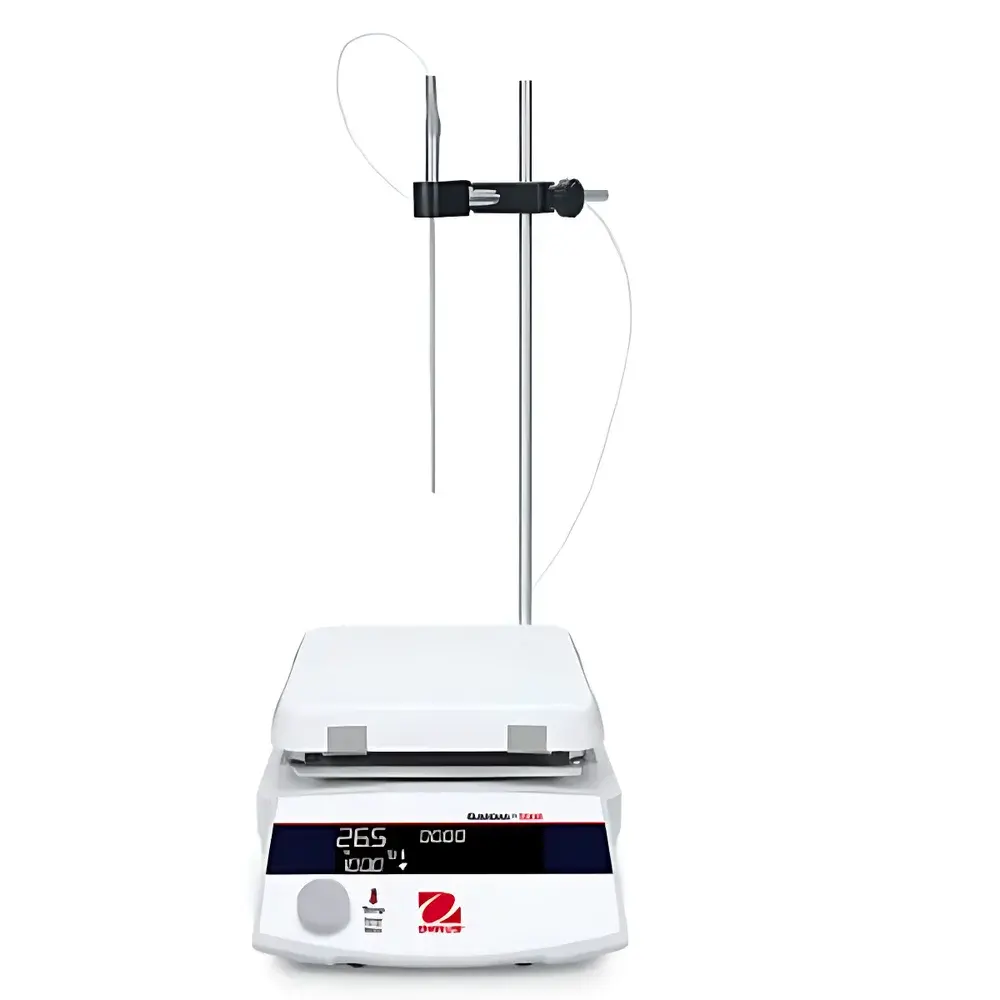
OHAUS GUARDIAN™5000 Advanced Heating Magnetic Stirrer
| Brand | OHAUS |
|---|---|
| Model | e-G52HP07C K1 |
| Heating Plate Material | Ceramic |
| Plate Dimensions | 18 cm × 18 cm |
| Temperature Range | 5 °C to 550 °C (above ambient) |
| Temperature Accuracy | ±1 °C (heating plate, <100 °C) |
| Temperature Stability | ±1 % (plate) |
| Stirring Speed Range | Not specified |
| Timer Range | 1 min – 99 h 59 min |
| Display | Backlit LCD with high contrast |
| Input Power | 220–240 V~, 50/60 Hz, 7 A |
| Dimensions (L×H×W) | 329 mm × 116 mm × 221 mm |
| Net Weight | 3.9 kg |
| Safety Certifications | CE, TÜV |
| IP Rating | IP32 |
| Communication Interface | RS232 |
| Calibration | Independent 3-point calibration for both heating plate and Pt1000 probe |
| Enclosure | Full-metal housing with ceramic square heating surface |
| Magnetic Drive | High-performance samarium-cobalt magnet |
| Operating Environment | 5–40 °C, ≤80 % RH (non-condensing) |
Overview
The OHAUS GUARDIAN™5000 Advanced Heating Magnetic Stirrer is an engineered platform for precise thermal and mechanical control in laboratory-scale liquid handling. It operates on the principle of magnetic coupling—where a rotating permanent magnet beneath the heating plate induces synchronous rotation of a magnetic stir bar immersed in the sample—combined with resistive ceramic heating for uniform, controllable thermal input. Designed for demanding applications in synthetic chemistry, bioprocessing, materials science, and quality control laboratories, the system integrates robust thermal management with digital precision, enabling reproducible reaction conditions across extended durations. Its 550 °C maximum heating capability supports high-temperature protocols such as solvent reflux, polymerization initiation, and thermal sterilization—while maintaining sub-degree temperature fidelity below 100 °C via dual-sensor feedback (ceramic plate + Pt1000 probe). The unit complies with IEC 61010-1 for electrical safety and meets EN 61326-1 for electromagnetic compatibility, ensuring operational integrity in regulated environments.
Key Features
- Full-metal chassis with IP32-rated enclosure for dust resistance and limited splash protection during routine lab use
- Ceramic square heating plate (18 cm × 18 cm) offering rapid thermal response, chemical inertness, and long-term stability under repeated thermal cycling
- Triple-mode temperature control: rapid ramp, precise hold, and overshoot-suppressed stabilization—programmable via intuitive rotary encoder interface
- Independent 3-point calibration capability for both heating surface and external Pt1000 probe, supporting traceable temperature validation per ISO/IEC 17025 requirements
- RS232 serial interface enabling integration with LIMS or custom data acquisition systems for audit-ready temperature/stirring logs
- Ergonomic front-panel tilt (25°) and high-contrast backlit LCD display for legible monitoring at bench height without repositioning
- Acoustic alert system with configurable thresholds for temperature deviation, timer expiration, or fault detection
- Optional splash guard with quick-release mounting—designed to meet GLP documentation needs for contamination-sensitive workflows
Sample Compatibility & Compliance
The GUARDIAN™5000 accommodates standard laboratory glassware including beakers (up to 4 L), Erlenmeyer flasks, and jacketed reactors when paired with appropriately sized stir bars (e.g., PTFE-coated, elliptical, or cross-shaped geometries). Its ceramic surface resists corrosion from common solvents (acids, bases, organic media) and withstands thermal shock from rapid cooling. The device conforms to key international standards applicable to laboratory instrumentation: CE marking under the EU Low Voltage Directive (2014/35/EU) and Electromagnetic Compatibility Directive (2014/30/EU); TÜV Rheinland certification verifying mechanical durability and insulation integrity; and alignment with ASTM E2913–21 for verification of thermal performance in stirred heating devices. For regulated pharmaceutical or clinical labs, its RS232 output supports 21 CFR Part 11-compliant data capture when interfaced with validated software platforms.
Software & Data Management
While the GUARDIAN™5000 operates as a standalone instrument with embedded firmware, its RS232 port enables bidirectional communication using ASCII-based command protocols. Users may log real-time temperature and timer status to external PCs or PLCs, generating time-stamped CSV files suitable for GxP-aligned record retention. Firmware supports user-defined calibration offsets and retains settings after power cycle—critical for multi-shift operations. No proprietary software installation is required; terminal emulation tools (e.g., PuTTY, Tera Term) suffice for basic remote interrogation. For automated workflows, the device responds to standardized SCPI-like commands (e.g., TEMP? , TIMER SET 3600), facilitating integration into Python- or LabVIEW-driven test sequences without middleware dependency.
Applications
- Controlled-temperature synthesis of metal-organic frameworks (MOFs) requiring prolonged heating at 200–400 °C with minimal thermal gradient
- pH adjustment and buffer equilibration in cell culture media preparation, where ±0.3 °C stability ensures consistent osmolality
- Thermal denaturation studies of recombinant proteins using stepwise ramping profiles with integrated hold phases
- Sterilization of aqueous reagents (e.g., phosphate-buffered saline) at ≥121 °C equivalent thermal dose via validated time–temperature protocols
- Dissolution testing of poorly soluble APIs under USP conditions, leveraging precise thermal ramping to simulate gastrointestinal transit
- Preparation of nanoparticle dispersions requiring simultaneous heating and shear-controlled mixing to prevent agglomeration
FAQ
Does the GUARDIAN™5000 support external temperature probes other than Pt1000?
No—the system is calibrated and validated exclusively for use with OHAUS-certified Pt1000 sensors. Substitution with non-OHAUS probes voids accuracy specifications and invalidates calibration records.
Can the heating plate temperature be controlled independently of the probe reading?
Yes. The unit offers two operational modes: “Plate Control” (regulates ceramic surface temperature only) and “Probe Control” (uses Pt1000 feedback for sample-centric regulation), selectable via front-panel menu.
Is the RS232 interface optically isolated?
No. The RS232 port uses standard single-ended signaling. For electrically noisy environments, users should employ shielded cabling and ground-loop mitigation practices per EN 61326-2-3.
What maintenance is required to sustain calibration integrity?
Annual verification against NIST-traceable reference thermometers is recommended. Cleaning must be performed with non-abrasive, alcohol-based solutions—never with halogenated solvents that may degrade ceramic surface coatings.
How does the unit handle thermal load changes during operation?
The PID algorithm dynamically adjusts power delivery based on real-time error between setpoint and measured value. Response time to 95 % of target is typically <60 s for ambient-to-100 °C transitions, verified per ASTM E2913 Annex A2.



