
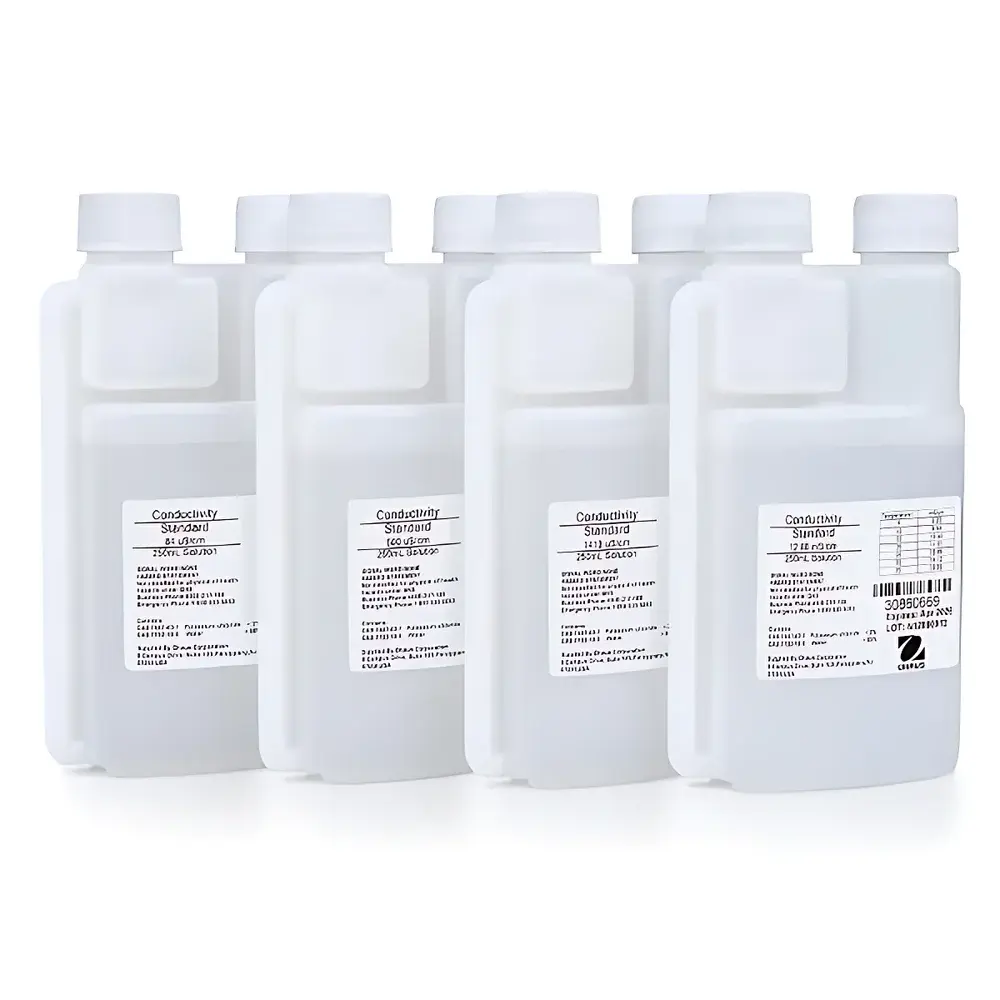
OHAUS Conductivity Standard Solutions
| Brand | OHAUS |
|---|---|
| Origin | Jiangsu, China |
| Manufacturer Type | Direct Manufacturer |
| Regional Classification | Domestic (China) |
| Model | OHAUS Water Analysis Conductivity Standard Solutions |
| Pricing | Available Upon Request |
| Concentration Options | 84 µS/cm, 500 µS/cm, 1413 µS/cm, 12.88 mS/cm |
| Volume | 250 mL per bottle |
| Format | Dual-pack (two identical vials per SKU) |
| Certifications | Traceable to NIM (National Institute of Metrology, China) |
Overview
OHAUS Conductivity Standard Solutions are high-purity, traceably certified reference materials designed for the accurate calibration and verification of laboratory and field-based conductivity meters. Engineered for precision and long-term stability, these solutions are formulated in strict accordance with international metrological practices and serve as essential tools in quality control laboratories, environmental monitoring programs, pharmaceutical water system validation, and academic research settings. Each batch is prepared under controlled cleanroom conditions using ultrapure water (resistivity ≥ 18.2 MΩ·cm at 25 °C) and high-grade reagents meeting ACS and ISO 3696 Grade 1 specifications. The conductivity values—84 µS/cm, 500 µS/cm, 1413 µS/cm, and 12.88 mS/cm—are certified at 25 °C and referenced to the International Temperature Scale (ITS-90), ensuring compatibility with all modern benchtop and portable conductivity analyzers that apply automatic temperature compensation (ATC) algorithms.
Key Features
- Traceable certification: Each lot includes a Certificate of Analysis (CoA) with uncertainty statements, measurement methodology (reference to ASTM D1125 and ISO 7888), and traceability to the National Institute of Metrology (NIM), China.
- Dual-pack configuration: Two identical 250 mL HDPE bottles per SKU enhance operational continuity—enabling simultaneous use and backup storage without cross-contamination risk.
- Stability-optimized formulation: Buffered KCl-based matrices minimize CO₂ absorption and pH drift, ensuring shelf life of ≥24 months when unopened and stored at 15–25 °C.
- Temperature-controlled labeling: Conductivity values are explicitly stated at 25 °C; temperature coefficients (β-values) are provided on CoA to support manual correction in non-ATC systems.
- Batch-specific documentation: Includes lot number, manufacturing date, expiration date, and certified conductivity value with expanded uncertainty (k = 2).
Sample Compatibility & Compliance
These standards are compatible with all conductivity sensors employing two-electrode, four-electrode, or toroidal (inductive) detection principles—including those from Mettler Toledo, Thermo Scientific Orion, Hach, Hanna Instruments, and OHAUS EC series meters. They meet the metrological requirements for routine calibration under ISO/IEC 17025-accredited testing laboratories and satisfy critical regulatory expectations for conductivity verification in USP , EP 2.2.38, and JP 2.05 water quality testing protocols. When used in GMP environments, the dual-pack format supports ALCOA+ data integrity principles by enabling independent calibration verification and reducing handling-related variability.
Software & Data Management
While the standards themselves are physical reference materials, their use integrates seamlessly into digital quality management workflows. OHAUS provides optional QR-coded labels enabling direct import of CoA metadata into LIMS platforms (e.g., LabWare, STARLIMS) via mobile scanning. All CoAs include machine-readable fields compliant with ASTM E1482 and ISO/IEC 17025 Clause 7.7 requirements for record retention. For laboratories operating under FDA 21 CFR Part 11, the dual-pack structure facilitates audit-ready documentation—each bottle’s unique lot identifier permits full traceability across calibration logs, instrument verification records, and electronic lab notebooks.
Applications
- Calibration of benchtop and portable conductivity meters prior to analysis of purified water (PW), water for injection (WFI), and clean steam condensate.
- Verification of sensor performance during preventive maintenance or after electrode cleaning/reconditioning.
- Establishment of intermediate check standards in multi-point calibration routines per ISO 17025 Clause 6.4.10.
- Support of environmental compliance testing for surface water, wastewater effluent, and drinking water distribution systems (aligned with EPA Method 120.1 and ISO 7888).
- Validation of inline conductivity sensors in biopharmaceutical process skids where real-time water quality monitoring is required per Annex 1 and EU GMP Chapter 5.
FAQ
Are these standards certified to ISO Guide 34 or ISO/IEC 17034?
No—these are certified reference materials (CRMs) issued by an ISO/IEC 17025-accredited manufacturer, not a ISO/IEC 17034-certified reference material producer. Certification follows NIM-traceable protocols aligned with ISO Guide 35 principles.
Can I use the 1413 µS/cm standard for both low- and mid-range calibration?
Yes—1413 µS/cm is the most widely adopted primary standard for general-purpose calibration; however, best practice recommends using at least two points spanning the expected measurement range (e.g., 84 µS/cm + 1413 µS/cm for freshwater, or 1413 µS/cm + 12.88 mS/cm for saline applications).
What is the recommended storage condition after opening?
Store opened bottles at 15–25 °C, tightly capped, and use within 30 days. Avoid exposure to direct sunlight or high-humidity environments to prevent evaporation or contamination.
Do you provide custom concentrations or bulk packaging?
Yes—OHAUS offers custom-formulated conductivity standards (±0.5% tolerance) and bulk packaging (1 L, 5 L carboys) upon request for OEM integration or centralized lab distribution. Contact technical support for feasibility assessment and lead time.
Related Products





