
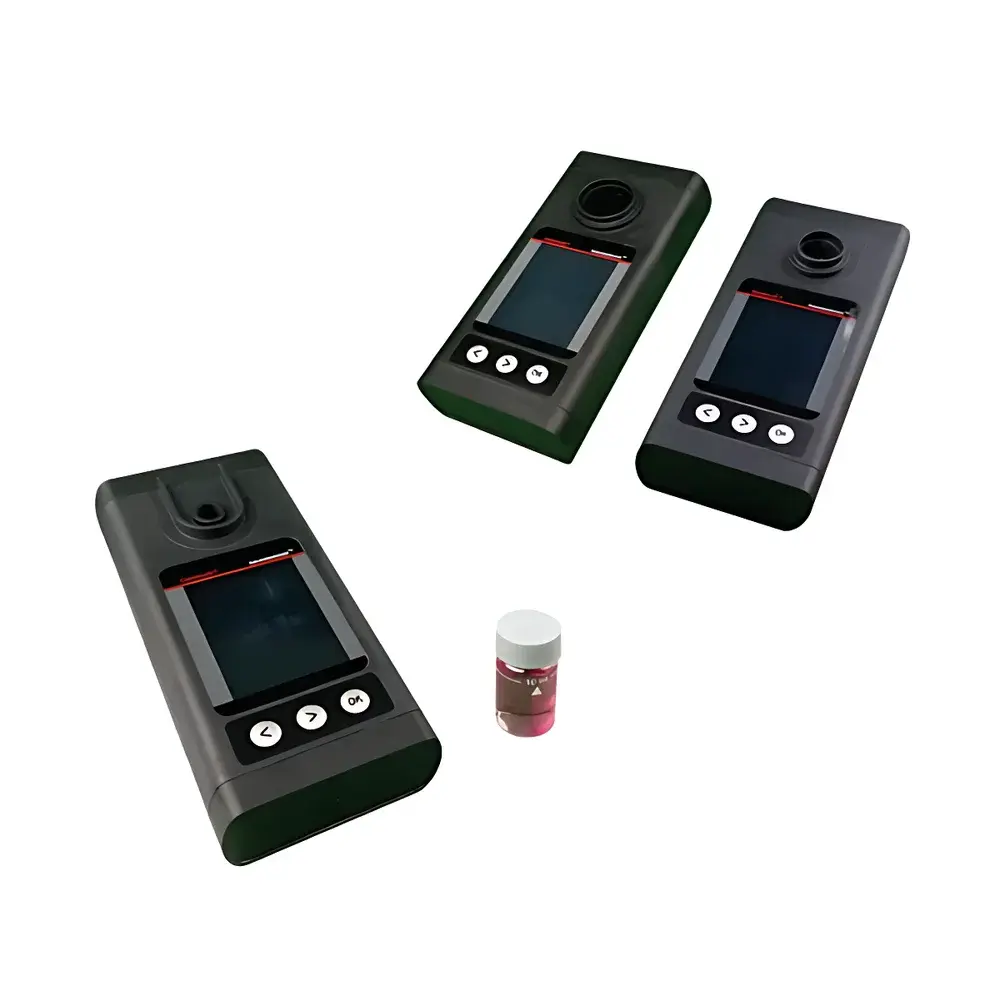
OHAUS AP40DW Aquasearcher™ Portable Industrial-Grade Colorimetric Water Quality Analyzer
| Brand | OHAUS |
|---|---|
| Origin | Shanghai, China |
| Manufacturer Type | Direct Manufacturer |
| Regional Classification | Domestic (China) |
| Model | AP40DW |
| Instrument Type | Portable / Handheld Water Quality Analyzer |
| Measurable Parameters | Free Chlorine, Total Chlorine, Chlorine Dioxide, Total Bromine |
| Battery Life | Up to 10,000 measurements per charge |
| Data Storage Capacity | 30,000 test records with timestamp (date & time) |
| Enclosure | Ruggedized IP67-rated housing |
| Optional Accessories | Pre-filled reagent vials and field-ready reagent kits |
Overview
The OHAUS AP40DW Aquasearcher™ Portable Industrial-Grade Colorimetric Water Quality Analyzer is a purpose-engineered field instrument designed for reliable, on-site quantification of critical disinfectant residuals in water distribution systems, wastewater effluents, cooling towers, swimming pools, and emergency response environments. It operates on standardized colorimetric principles—specifically N,N-diethyl-p-phenylenediamine (DPD) chemistry for free and total chlorine, chlorophenol red for chlorine dioxide, and DPD-based methodology for total bromine—ensuring compatibility with widely accepted EPA, ASTM D1253, ISO 7393-2, and Standard Methods 4500-Cl G protocols. Unlike benchtop spectrophotometers, the AP40DW integrates optical path stability, temperature-compensated photodiode detection, and factory-calibrated LED light sources (525 nm, 580 nm, 620 nm) to deliver repeatable absorbance readings under variable ambient lighting, humidity, and vibration conditions typical of industrial field use.
Key Features
- Rugged IP67-rated polycarbonate housing with shock-absorbing rubber overmold—tested to MIL-STD-810G for drop resistance from 1.2 m onto concrete.
- Dual-mode operation: direct readout (mg/L as Cl₂) and concentration conversion via built-in algorithm library compliant with US EPA Method 334.0 and APHA Standard Methods 4500-Cl.
- Integrated rechargeable lithium-ion battery supporting ≥10,000 consecutive measurements per full charge; low-power sleep mode extends idle runtime to 18 months.
- High-contrast backlit LCD display with anti-glare coating—optimized for readability under direct sunlight or low-light tunnel/underground conditions.
- On-device data management: stores 30,000 measurement records with embedded UTC timestamp, operator ID field, and location tag (via optional Bluetooth GPS module).
- Modular reagent compatibility: accepts both OHAUS-certified pre-filled single-use vials (AP40-CLF, AP40-CLT, AP40-CLO₂, AP40-BR) and user-loaded liquid reagents following AOAC-approved preparation guidelines.
Sample Compatibility & Compliance
The AP40DW is validated for aqueous samples with turbidity ≤5 NTU and temperature range 5–40 °C. It supports raw water, filtered potable water, chlorinated secondary effluent, and saline pool water (up to 5,000 ppm TDS). All measurement protocols adhere to regulatory frameworks governing public water systems (US EPA 40 CFR Part 141), occupational safety (OSHA 29 CFR 1910.120), and pharmaceutical water monitoring (USP , EP 2.2.43). The device firmware includes audit-trail logging enabled by default—meeting FDA 21 CFR Part 11 requirements for electronic records when paired with OHAUS AquaLink™ Cloud (optional subscription). Calibration verification is traceable to NIST-traceable DPD standard solutions (SRM 2820a), and routine performance checks align with ISO/IEC 17025 clause 7.7 for field instrumentation.
Software & Data Management
Data export is supported via micro-USB 2.0 (device-to-PC) and Bluetooth 5.0 (to Android/iOS mobile devices). The included AquaLink™ Desktop Suite (v3.2+) enables batch report generation in PDF/CSV formats, customizable QA/QC flagging (e.g., out-of-range absorbance, expired reagent lot alerts), and integration with LIMS platforms via HL7 or ASTM E1384-compliant XML export. All stored measurements include metadata: instrument serial number, calibration date, reagent lot code, environmental temperature at time of reading, and user-defined sample ID. Firmware updates are delivered through digitally signed OTA packages, preserving cryptographic integrity per IEC 62443-3-3 SL2 requirements.
Applications
- Real-time verification of chlorine residual decay across municipal water distribution networks during routine patrols.
- Rapid assessment of disinfection efficacy post-decontamination in fire department hazmat response scenarios.
- Continuous compliance monitoring for HVAC cooling tower biocide dosing per ASHRAE Guideline 12-2020.
- Field validation of membrane filtration system integrity via chlorine breakthrough detection.
- Regulatory sampling support for NPDES permit holders requiring daily chlorine/bromine reporting to state environmental agencies.
- Academic and NGO-led water quality surveys in remote or off-grid communities lacking laboratory infrastructure.
FAQ
Is the AP40DW suitable for seawater or high-salinity brine applications?
Yes—its optical system compensates for ionic strength effects up to 5,000 ppm TDS; however, for samples >10,000 ppm, dilution with deionized water and correction factor application is recommended per ASTM D5117.
Does it support GLP/GMP-compliant audit trails?
Yes—the internal log captures operator login/logout, calibration events, measurement edits, and firmware changes with immutable timestamps; exportable logs meet ALCOA+ data integrity criteria.
Can third-party reagents be used without voiding warranty?
OHAUS validates performance only with AP40-series certified reagents; use of non-OHAUS reagents may affect accuracy and invalidate regulatory compliance claims.
What is the recalibration interval under continuous field use?
Factory calibration remains stable for 12 months; however, field verification using NIST-traceable standards is required before each shift per ISO/IEC 17025 Section 7.7.3.
Is Bluetooth connectivity compatible with enterprise MDM systems?
Yes—AquaLink™ Mobile supports Microsoft Intune and VMware Workspace ONE enrollment for secure credential provisioning and policy enforcement.
Related Products







