
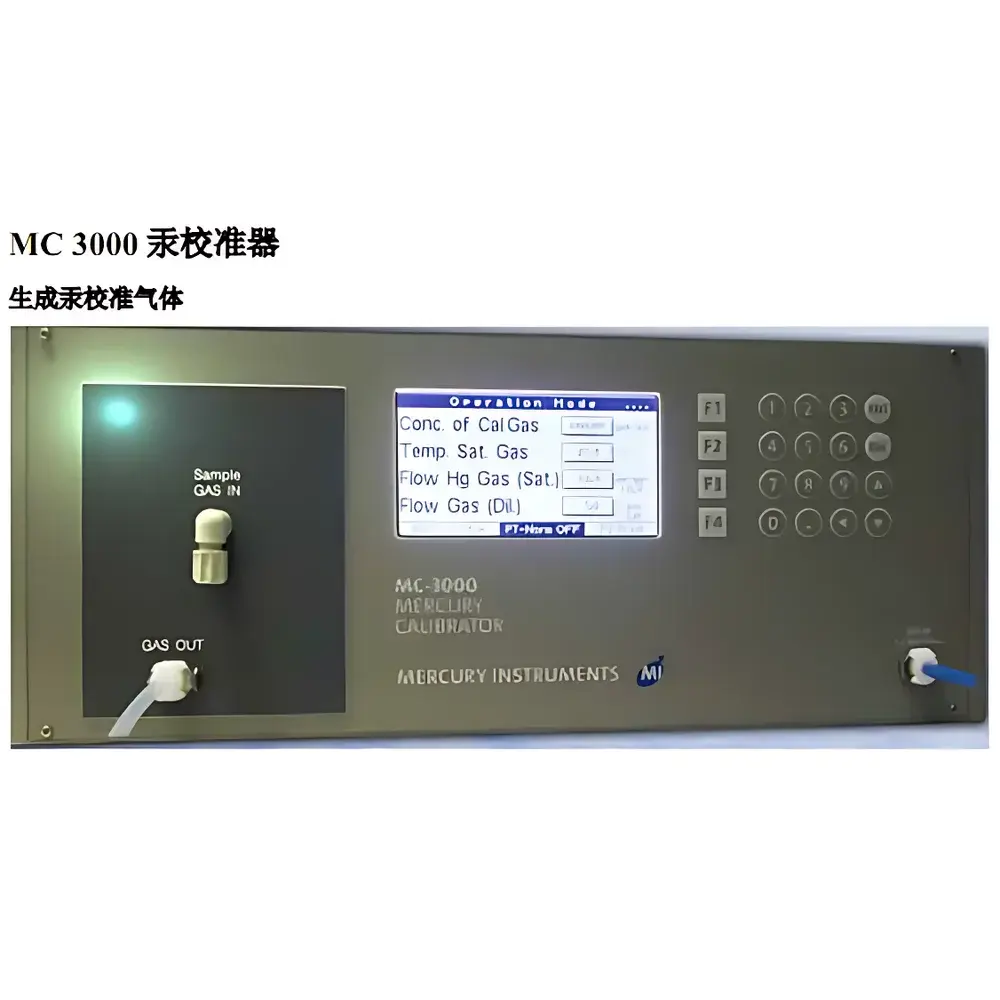
Mercury Instruments MC3000 Mercury Vapor Calibrator
| Brand | Mercury Instruments |
|---|---|
| Origin | Germany |
| Model | MC3000 |
| Instrument Type | Portable |
| Principle | Cold Vapor Atomic Absorption (CVAA) |
| Detection Limit | ≤1 ng/mL |
| Repeatability | ≤3% (CVAA method) |
| Linearity Error | 5% |
| Mercury Vapor Output Range | 15–500 µg/m³ Hg⁰ |
| Calibration Method | NIST-Recommended Mercury Saturated Vapor Pressure Technique |
| Stabilization Time | 30 min |
Overview
The Mercury Instruments MC3000 is a precision-engineered, portable mercury vapor calibrator designed for trace-level calibration and verification of mercury analyzers used in environmental monitoring, industrial hygiene, laboratory QA/QC, and regulatory compliance settings. It operates on the fundamental physical principle of mercury’s well-characterized saturated vapor pressure at controlled temperatures—a method formally endorsed by the National Institute of Standards and Technology (NIST) for primary-standard traceable calibration. Unlike dynamic dilution systems relying on permeation tubes or mass flow controllers alone, the MC3000 employs a dual-stage thermodynamic saturation process: first, carrier gas (e.g., compressed air or nitrogen) is humidified with elemental mercury vapor via temperature-stabilized saturator; second, excess mercury is removed through selective condensation in a cooled trap, ensuring only equilibrium-saturated vapor proceeds to the dilution stage. This architecture delivers highly reproducible, gravimetrically traceable mercury concentrations—critical for validating instruments subject to EPA Method 1631, ISO 6978-2, EN 13256, and ASTM D6784-22.
Key Features
- Portable, battery-operable design with integrated microprocessor control—enabling field-deployable calibration without external power or lab infrastructure.
- NIST-traceable output range of 15–500 µg/m³ Hg⁰, covering typical ambient air, stack emission, and occupational exposure limit (OEL) verification requirements.
- Thermally stabilized mercury saturator and condensation trap ensure long-term stability and minimal drift (<0.5% over 8 h).
- Intuitive front-panel keypad interface with real-time concentration display and status indicators for flow, temperature, and saturation readiness.
- Compatible with standard 50 mL mercury reservoirs; includes optional portable air pump for zero-air generation in remote locations.
- Rugged aluminum housing rated IP54 for dust and splash resistance—suitable for mobile labs, fenceline monitoring, and plant floor deployment.
Sample Compatibility & Compliance
The MC3000 generates certified elemental mercury (Hg⁰) vapor only—making it inherently compatible with cold vapor atomic absorption (CVAA), cold vapor atomic fluorescence (CVAFS), and direct-reading mercury analyzers requiring Hg⁰ reference standards. It does not produce oxidized mercury species (e.g., Hg²⁺), nor is it intended for calibration of speciation systems. All output concentrations are traceable to NIST Standard Reference Materials (SRMs) 2798 and 2799 via documented vapor pressure equations (e.g., Clausius–Clapeyron-derived Hg⁰ saturation curves). The device complies with ISO/IEC 17025:2017 requirements for calibration equipment used in accredited testing laboratories and supports GLP/GMP audit trails when operated with logged calibration records.
Software & Data Management
While the MC3000 operates as a standalone hardware calibrator, its configuration parameters—including setpoint concentration, carrier gas flow rate (0.5–5 L/min), and stabilization timestamp—are stored in non-volatile memory and can be exported via optional RS-232 or USB-C interface (firmware v2.1+). Exported logs include UTC timestamps, internal temperature readings (±0.1 °C), and flow sensor diagnostics—facilitating integration into LIMS environments and supporting FDA 21 CFR Part 11 compliance when paired with validated electronic record systems. No proprietary software installation is required; data files conform to CSV/UTF-8 format for direct import into Excel, LabArchives, or Empower.
Applications
- Field validation and routine calibration of portable and fixed-site mercury analyzers deployed in coal-fired power plants, waste incinerators, and chlor-alkali facilities.
- Performance qualification (PQ) of continuous emission monitoring systems (CEMS) per EPA Performance Specification 12A and EU BREF guidelines.
- Method verification for ASTM D6784-22 (Ontario Hydro Method) and ISO 6978-2 (natural gas mercury analysis).
- Generation of stable, low-concentration Hg⁰ standards for instrument detection limit verification and linearity assessment across 1–500 µg/m³.
- Supporting ISO 17025 accreditation audits by providing documented, repeatable calibration evidence with uncertainty budgets derived from NIST vapor pressure models.
FAQ
What carrier gases are compatible with the MC3000?
Compressed air, nitrogen, and argon are fully supported. Oxygen and reactive gases (e.g., chlorine, ozone) must be avoided due to mercury oxidation risk.
Does the MC3000 require annual recalibration?
No—its calibration is physics-based (mercury vapor pressure), not sensor-dependent. However, annual verification of flow sensors and temperature stability against NIST-traceable references is recommended per ISO/IEC 17025 Clause 6.5.
Can the MC3000 generate concentrations below 15 µg/m³?
Not natively. For sub-15 µg/m³ applications, downstream dilution using certified zero-air and mass flow controllers is required—and must be validated separately.
Is the MC3000 suitable for calibrating mercury speciation instruments?
No. It produces only elemental mercury vapor (Hg⁰). Speciation calibrators require independent Hg²⁺ or methylmercury standards.
How is traceability documented for audit purposes?
Each unit ships with a Certificate of Conformance referencing NIST SP 260-179 and includes a traceability matrix linking operating temperature, flow rate, and calculated saturation concentration to published vapor pressure data (e.g., M. W. G. de Vries et al., J. Chem. Eng. Data, 2010).
Related Products




