
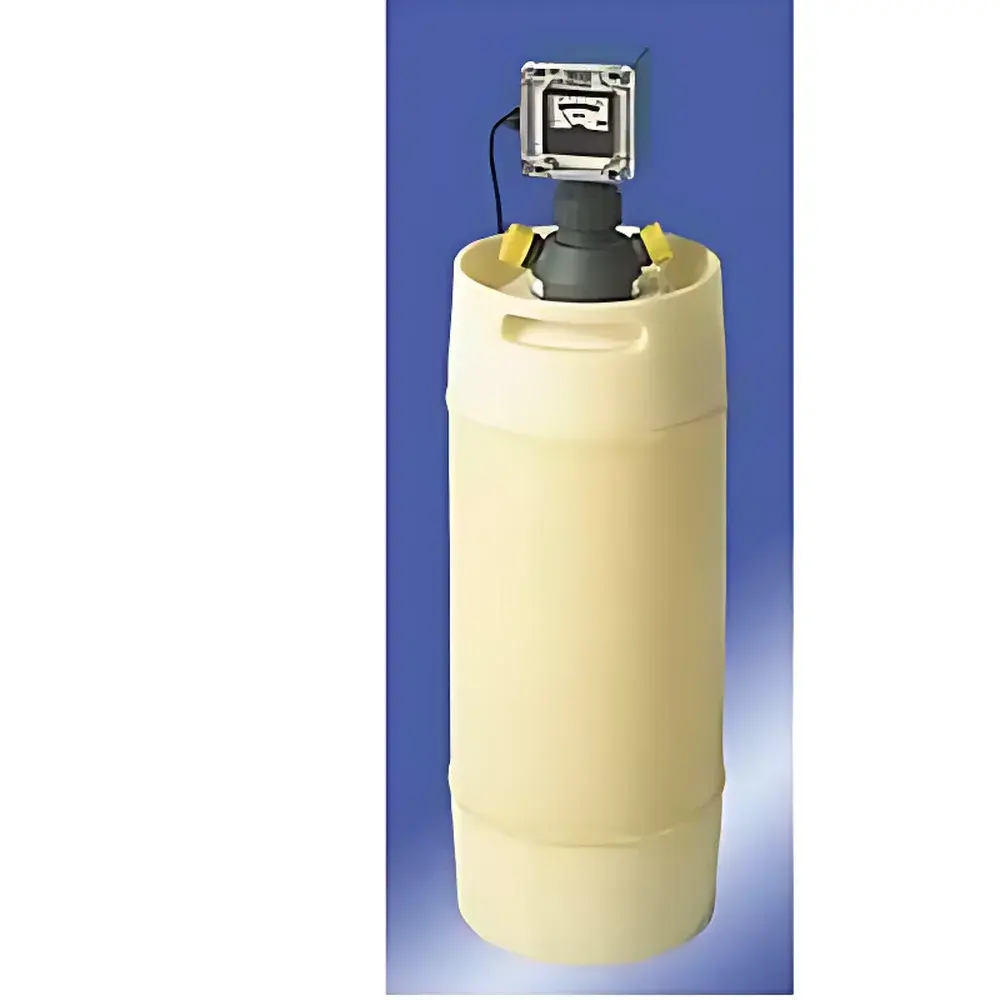
Behr B10dN / B22dN / B45dN Pressure-Resistant Mixed-Bed Deionizer
| Origin | Germany |
|---|---|
| Manufacturer Type | Authorized Distributor |
| Origin Category | Imported |
| Model | Behr B10dN / B22dN / B45dN |
| Pure Water Grade | ASTM Type I / ISO 3696 Grade 1 |
| Resistivity | 18.2 MΩ·cm @ 25°C |
| Heavy Metals & Soluble Silica | < 0.1 ppb |
| Total Organic Carbon (TOC) | < 3 ppb |
| Microbial Count / Endotoxins | < 0.001 EU/mL |
| Particles (>0.1 µm) | < 1 particle/mL |
| Max. Operating Pressure | 8 bar |
| Housing Material | Polyamide (PA66-GF30) |
| Exchange Capacity (B10dN/B22dN/B45dN) | 1.2 / 2.4 / 5.5 kL @ 10 °dH hardness removal |
| Max. Flow Rate (L/h) | 300 / 500 / 800 |
| Overall Height (cm) | 68 / 112 / 125 |
| Housing Height (cm) | 55 / 98 / 110 |
Overview
The Behr B10dN, B22dN, and B45dN series are pressure-resistant, mixed-bed deionizers engineered for continuous, high-reliability production of ultra-pure water in laboratory and light industrial settings. Designed to operate directly on municipal or pre-treated feed water networks—without external pressure regulation—the units leverage a robust polyamide (PA66-GF30) housing rated for sustained operation at up to 8 bar, eliminating the need for pressure-reducing valves and reducing system complexity. These deionizers utilize high-capacity, low-leach mixed-bed ion exchange resins optimized for deep removal of cations and anions, delivering consistent ASTM Type I / ISO 3696 Grade 1 water quality with resistivity ≥18.2 MΩ·cm, TOC <3 ppb, and endotoxin levels below 0.001 EU/mL. Their uniform internal flow distribution ensures full resin utilization and maximized service life per regeneration cycle.
Key Features
- Pressure-rated polyamide housing (PA66-GF30) certified for continuous operation at 8 bar—compatible with fluctuating municipal supply pressures
- Integrated conductivity monitoring with real-time display and programmable alarm thresholds; optional remote analog (4–20 mA) or digital (Modbus RTU) output for centralized control systems
- Automatic power cutoff upon reaching user-defined conductivity limit—ensuring strict adherence to purity specifications and preventing off-spec water generation
- Three scalable models (B10dN, B22dN, B45dN) supporting feed water hardness up to 10 °dH, with total exchange capacities of 1.2, 2.4, and 5.5 kL respectively
- Modular configuration options: standard unit (BxNdN), spare housing variant (BxNdNZ), and advanced version with limit switch box + electronically actuated solenoid valve (BxNdNA) for automated bypass and maintenance sequencing
- Optimized hydraulic design ensuring laminar, uniform flow across the entire resin bed—minimizing channeling and maximizing ion exchange efficiency and reproducibility
Sample Compatibility & Compliance
The Behr B-series deionizers are validated for use with reverse osmosis (RO) permeate, softened municipal water, or other low-silica, low-organics feed sources. They comply with key international standards governing analytical-grade water production, including ASTM D1193 (Type I), ISO 3696 (Grade 1), and CLSI EP23-A guidelines for reagent water in clinical laboratories. Units configured with the BxNdNA option support GLP/GMP-aligned operational protocols through hardware-enforced interlocks and audit-ready event logging (e.g., conductivity excursions, valve actuation, power interruption). While not standalone FDA 21 CFR Part 11-compliant, the system’s analog/digital outputs integrate seamlessly with validated LIMS or SCADA platforms that maintain electronic records and signature controls.
Software & Data Management
These are hardware-integrated, microprocessor-controlled instruments—not PC-dependent systems. All critical parameters—including real-time conductivity, cumulative volume processed, and alarm history—are stored in non-volatile memory and accessible via front-panel interface. For integration into larger facility infrastructure, the optional analog (4–20 mA) or Modbus RTU interface enables direct connection to PLCs, building management systems (BMS), or centralized water quality dashboards. Event logs include timestamps for conductivity threshold breaches, automatic shutdowns, and manual reset actions—supporting traceability requirements under ISO/IEC 17025 and CAP-accredited laboratory quality systems.
Applications
- Routine rinsing of volumetric glassware, pipettes, and HPLC vials where residual ions or organics compromise assay accuracy
- Feed water polishing for ultratrace elemental analysis (ICP-MS, GF-AAS), electrophoresis, and cell culture media preparation
- Final-stage deionization downstream of RO systems in research labs, QC/QA facilities, and pilot-scale pharmaceutical manufacturing
- Water supply for low-flow, high-purity applications such as buffer preparation, calibration standard dilution, and spectroscopic blanking
- Backup or primary deionization for small-to-midsize industrial users requiring consistent Type I water without full EDI or distillation infrastructure
FAQ
Can the B10dN/B22dN/B45dN be installed directly on unregulated city water lines?
Yes—each model is rated for continuous operation at up to 8 bar inlet pressure and includes internal flow conditioning to accommodate typical municipal pressure fluctuations (2–6 bar).
What feed water quality is required for optimal performance?
RO permeate or softened water with silica <50 ppb, TOC <500 ppb, and free chlorine <0.1 ppm is recommended. Pre-filtration (5 µm) and activated carbon polishing are advised if feed contains oxidants or particulates.
How is resin exhaustion detected and managed?
Conductivity rise above the user-set threshold triggers audible/visual alarms and automatic power cutoff. Exhaustion is confirmed by measuring outlet conductivity; resin replacement intervals depend on feed water quality and daily throughput.
Are spare parts and certified resins available globally?
Original Behr polyamide housings, calibrated conductivity cells, and OEM-mixed-bed resins (tested for ≤0.1 ppb metal leaching) are distributed through authorized partners in EMEA, North America, and APAC regions.



