
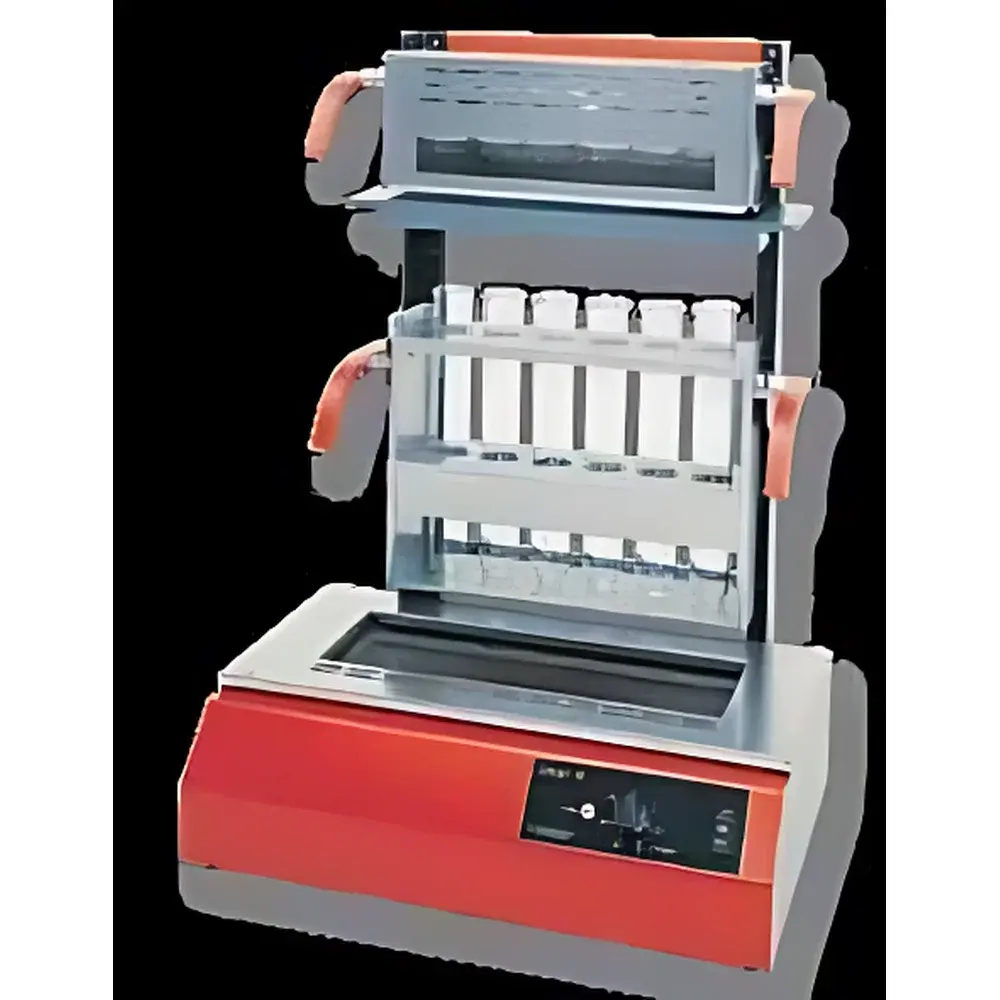
Behr InKjel Series Rapid Infrared Digestion Unit for Kjeldahl Nitrogen Determination
| Origin | Germany |
|---|---|
| Manufacturer Type | Authorized Distributor |
| Origin Category | Imported |
| Model | Behr InKjel Series (InKjel1210M, InKjel625P, InKjel1225M, InKjel450P, InKjel475M) |
| Digestion Time Range | 1–199 min |
| Repeatability | ±0.5% RSD |
| Nitrogen Recovery Rate | >99.5% |
| Power Input | 750–1500 W (adjustable 0–100% in 1% increments) |
| Voltage | 230 VAC / 115 VAC, 50/60 Hz |
| Dimensions (W × D × H) | ≈54 × 44 × 75 cm |
| Weight (incl. reaction tubes) | ≈20 kg |
Overview
The Behr InKjel Series Rapid Infrared Digestion Unit is a precision-engineered thermal digestion system designed exclusively for Kjeldahl nitrogen determination and other high-temperature acid digestion applications. Unlike conventional block-heated digesters that rely on conductive heat transfer through metal surfaces, the InKjel platform employs high-intensity quartz infrared emitters to deliver direct, radiant energy to sample vessels. This method ensures rapid thermal ramp-up, precise temperature control at the sample level (targeting sulfuric acid boiling point ≈337 °C), and elimination of thermal lag or cold spots common in aluminum heating blocks. The system operates on the principle of selective infrared absorption by the digestion mixture—primarily by concentrated H2SO4 and organic matrices—enabling uniform energy coupling across all positions. Its architecture supports full compliance with ISO 8585, AOAC 984.27, and EPA Method 351.2 for total Kjeldahl nitrogen (TKN) analysis, serving as a critical upstream module in certified laboratory workflows for food, feed, environmental, and agricultural testing.
Key Features
- Quartz infrared heating elements delivering uniform radiant energy distribution—no hot/cold zones across sample positions
- Dual-row 12-position configuration (configurable via interchangeable tube holders) with independent thermal symmetry verification per position
- Suspended glass digestion tube design: tubes hang freely in ceramic-coated stainless steel cradles, minimizing mechanical stress and thermal shock-induced breakage versus bottom-contact block systems
- Digitally adjustable power (0–100% in 1% increments) and time (0–199 min in 1-min steps), supporting method-specific optimization for diverse matrices (e.g., high-fat dairy, fibrous plant tissue, wastewater sludge)
- Integrated safety interlocks including overtemperature cutoff (>400 °C), cooling fan auto-activation post-cycle, and door-open inhibition
- Multi-language UI (English, German, French, Spanish, Chinese) with intuitive single-button start and programmable memory for up to 10 user-defined digestion protocols
Sample Compatibility & Compliance
The InKjel system accommodates standardized Kjeldahl digestion tubes in five configurations: 12 × 100 mL (InKjel1210), 6 × 250 mL (InKjel625), 12 × 250 mL (InKjel1225), 4 × 500 mL (InKjel450), and 4 × 750 mL (InKjel475). All variants maintain identical thermal performance profiles, validated per DIN EN ISO/IEC 17025:2017 clause 7.2.2 for equipment suitability. The system meets CE marking requirements under the Low Voltage Directive (2014/35/EU) and Electromagnetic Compatibility Directive (2014/30/EU). For regulated environments, it supports GLP-compliant operation when paired with traceable calibration records and audit-ready log export (via optional RS232/USB interface). While not intrinsically compliant with FDA 21 CFR Part 11, its deterministic timer and fixed power settings enable full procedural traceability required for GMP-aligned validation protocols.
Software & Data Management
The InKjel M and P models feature embedded firmware with non-volatile memory for storing run parameters and timestamps. No proprietary software is required for basic operation; however, optional PC connectivity enables CSV-formatted export of cycle logs—including start time, set power %, duration, end time, and error codes—for integration into LIMS or electronic lab notebooks (ELN). Firmware updates are performed via USB stick using signed binaries, ensuring integrity verification. All parameter changes are logged with operator ID (if enabled via external authentication) and timestamp, satisfying minimum ALCOA+ data integrity principles for raw instrument data.
Applications
- Routine TKN quantification in cereals, meat products, dairy powders, and infant formula per ISO 5983-1 and AOAC 992.15
- Environmental analysis of total nitrogen in soil extracts, sewage sludge, and municipal wastewater per EPA 351.2 and ISO 11261
- Feedstuff certification for crude protein content (×6.25 conversion factor) under EU Regulation (EC) No 152/2009
- Method development for alternative catalysts (e.g., selenium-free digestion) requiring precise thermal profiling
- High-throughput preprocessing for automated distillation units (e.g., Behr DistiLine or Büchi K-425), reducing overall assay turnaround time by ≥40% vs. conventional heating blocks
FAQ
What is the maximum operating temperature of the InKjel infrared emitters?
The quartz emitters are rated for continuous operation at surface temperatures exceeding 900 °C, but process temperature at the sample level is thermodynamically limited by the boiling point of concentrated sulfuric acid (~337 °C at atmospheric pressure).
Can the InKjel be used for non-Kjeldahl digestion methods such as microwave-assisted or aqua regia digestion?
No—the InKjel is engineered specifically for open-vessel, reflux-style Kjeldahl digestion. It lacks pressure containment, fume scrubbing, or inert atmosphere capabilities required for alternative digestion chemistries.
Is calibration traceable to national standards?
Yes. Behr provides optional NIST-traceable calibration certificates for temperature uniformity mapping (per ASTM E220) and timer accuracy verification (per ISO/IEC 17025 Annex A.3), conducted annually or after major maintenance.
How does the suspended tube design improve reproducibility?
By eliminating direct contact between glassware and heated metal surfaces, thermal gradients across the tube wall are minimized, reducing localized overheating, charring, and inconsistent digestion kinetics—key contributors to RSD >1% in block-based systems.
What maintenance is required for long-term reliability?
Quarterly inspection of quartz emitter alignment and reflector cleanliness; annual replacement of thermal fuses and fan filters; biannual verification of power output stability using calibrated wattmeter and reference load.





