
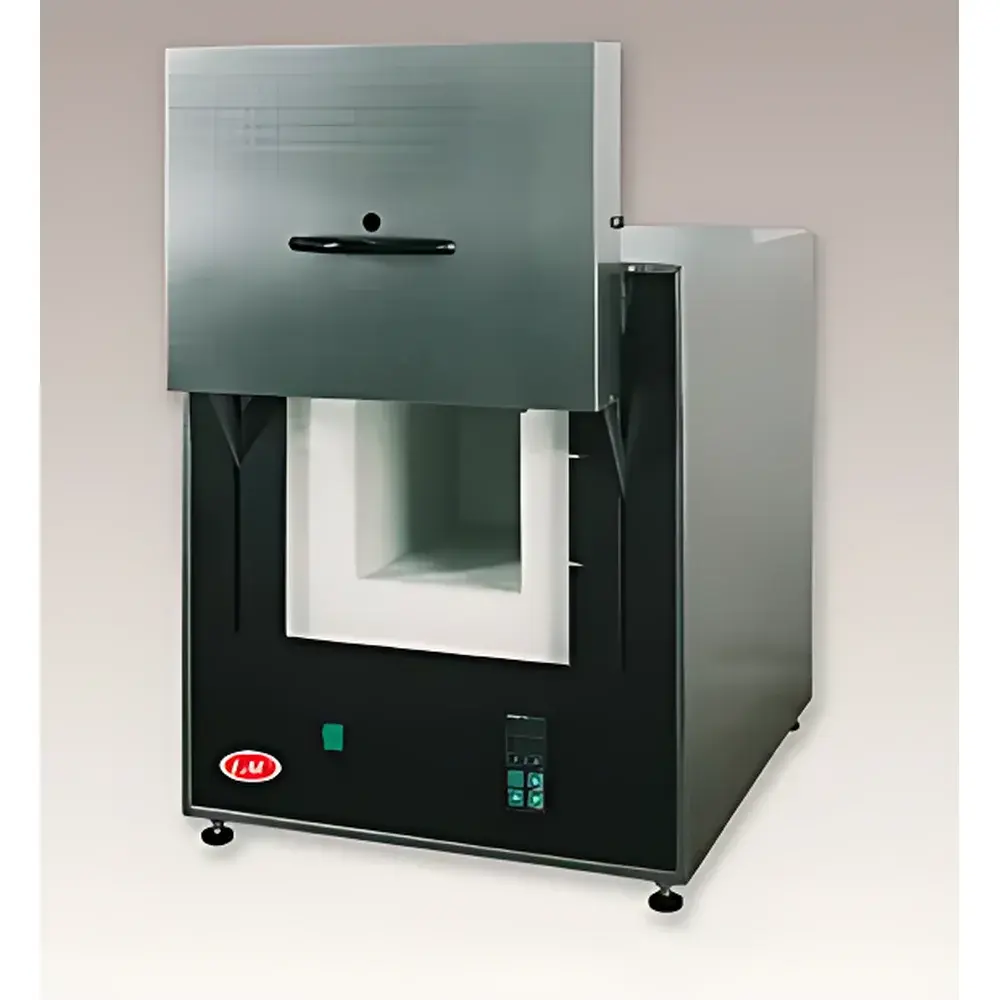
LAC LMH Series Laboratory Muffle Furnace
| Brand | LAC |
|---|---|
| Origin | Czech Republic |
| Model | LMH Series |
| Max Temperature | 1200 °C |
| Chamber Volume | 4–11 L |
| External Dimensions (W×H×D) | 490×540×720 mm to 570×540×720 mm |
| Internal Dimensions (W×H×D) | 170×90×275 mm to 255×165×255 mm |
| Power Rating | 3–3.5 kW |
| Weight | 43–53 kg |
| Voltage | 230 V AC |
| Temperature Control | HT40 Programmable Controller with S-type Thermocouple |
| Heating Element | Kanthal A1 wire wound on mullite tubes |
| Insulation | Mullite fiber + mineral granulate fill |
| Safety Features | Interlocked door switch, tempered blue safety viewing window, spring-assisted counterbalanced door |
| Cooling | Integrated axial cooling fan |
| Compliance | Designed for GLP-compliant thermal processing in analytical and materials labs |
Overview
The LAC LMH Series is a line of high-reliability laboratory muffle furnaces engineered for precise, repeatable thermal treatment of diverse samples—including those containing halides, sulfates, or other corrosive volatiles that degrade conventional heating elements. Unlike standard box furnaces, the LMH employs a frameless structural design with continuous circumferential stainless-steel cladding, eliminating dust-trapping joints and facilitating ISO Class 5 cleanroom-compatible operation. Its core thermal architecture relies on Kanthal A1 resistance wire wound around high-purity mullite ceramic tubes—providing exceptional oxidation resistance up to 1200 °C and long-term stability under cyclic loading. The chamber is insulated with layered mullite fiber board backed by dense mineral granulate fill, achieving low thermal mass and rapid ramp rates (typically <15 min to 1000 °C) while maintaining uniformity ≤±3 °C across the full working volume (per ASTM E220 calibration methodology). All models operate on single-phase 230 V AC supply and integrate an internal axial cooling fan to accelerate cooldown cycles and reduce thermal stress on insulation.
Key Features
- Frameless monocoque construction with seamless stainless-steel outer shell for contamination control and mechanical robustness
- Tempered blue safety viewing window (EN 171 compliant) enabling real-time visual monitoring without thermal leakage or UV exposure
- Spring-loaded, counterbalanced upward-lifting door with positive-action safety interlock—de-energizes heating circuit upon opening
- Reinforced insulated door frame with integrated ceramic fiber gasketing ensures zero air infiltration during hold phases
- Programmable HT40 temperature controller (standard) featuring 16-segment ramp-soak profiles, ±0.5 °C setpoint accuracy, and auto-tuning PID algorithm
- Optional INDUSTRY controller upgrade supporting Modbus RTU (RS-485), Ethernet/IP, and FDA 21 CFR Part 11–compliant audit trail logging
- Low-noise solid-state relay (SSR) switching eliminates electromagnetic interference—critical when operating adjacent to sensitive instrumentation (e.g., balances, spectrometers)
- Top-mounted insulation layer minimizes heat loss and improves energy efficiency (typical standby power <12 W at ambient)
Sample Compatibility & Compliance
The LMH series accommodates crucibles, boats, and trays made from alumina, silicon carbide, quartz, or platinum—validated for use with aggressive chemistries including NaOH fusion, ashing of polymer composites, and calcination of catalyst precursors. Its corrosion-resistant heating element configuration permits extended operation with chloride- or fluoride-bearing samples without premature element failure. The furnace meets CE marking requirements per EN 61000-6-3 (EMC) and EN 61000-6-4 (immunity), and its thermal performance adheres to ISO 9001–certified manufacturing protocols. For regulated environments, optional RS-232/485 interfaces enable integration into LIMS or MES platforms; temperature recording software provides timestamped, tamper-evident cycle reports compliant with GLP and GMP Annex 11 documentation standards.
Software & Data Management
When equipped with the INDUSTRY controller and optional R232/485 interface, the LMH supports bidirectional communication with third-party SCADA systems or custom Python-based lab automation frameworks. The included temperature monitoring and logging software (Windows-compatible) records all thermocouple readings at user-defined intervals (1–60 s), generates PDF/PNG reports with digital signatures, and enforces electronic signature workflows per 21 CFR Part 11. Audit trails capture operator ID, parameter changes, alarm events, and system boot/shutdown timestamps—all stored locally with SHA-256 hash integrity verification. No cloud dependency: all data remains on-premise unless explicitly exported via encrypted USB transfer.
Applications
- Gravimetric analysis: ash content determination per AOAC 923.03, ASTM D3174, and ISO 1171
- Thermal decomposition studies of battery cathode materials (e.g., LiCoO₂, NMC) under inert or controlled-atmosphere conditions
- Preparation of reference standards via high-temperature homogenization and annealing
- Residue-on-ignition testing for pharmaceutical excipients (USP <281>)
- Sintering of ceramic green bodies and metal oxide powders prior to XRD or BET surface area analysis
- Calibration of thermocouples and RTDs using fixed-point cells (e.g., Al, Zn, Sn) within defined soak stability windows
FAQ
What maximum temperature uniformity can be expected across the working zone?
Typical radial and axial uniformity is ±2.5 °C at 1000 °C and ±3 °C at 1200 °C, verified per ASTM E220 Annex A4 using a 5-point sensor array.
Is inert atmosphere purging supported as standard equipment?
No—gas inlet/outlet ports and gas-tight sealing are optional accessories; standard models operate in ambient air only.
Can the furnace be validated for IQ/OQ/PQ protocols?
Yes—LAC provides factory-issued as-built drawings, material certifications (RoHS/REACH), and traceable calibration certificates (NIST-traceable S-type thermocouple); full validation support packages available upon request.
What maintenance is required for long-term reliability?
Annual inspection of door gasket compression, thermocouple drift check (recommended every 6 months), and visual verification of heating element integrity—no lubrication or consumable replacement needed under normal use.
Does the HT40 controller support remote access or network connectivity?
No—the HT40 is a standalone analog/digital hybrid unit with front-panel interface only; network capability requires upgrading to the INDUSTRY controller with RS-485/Ethernet module.



