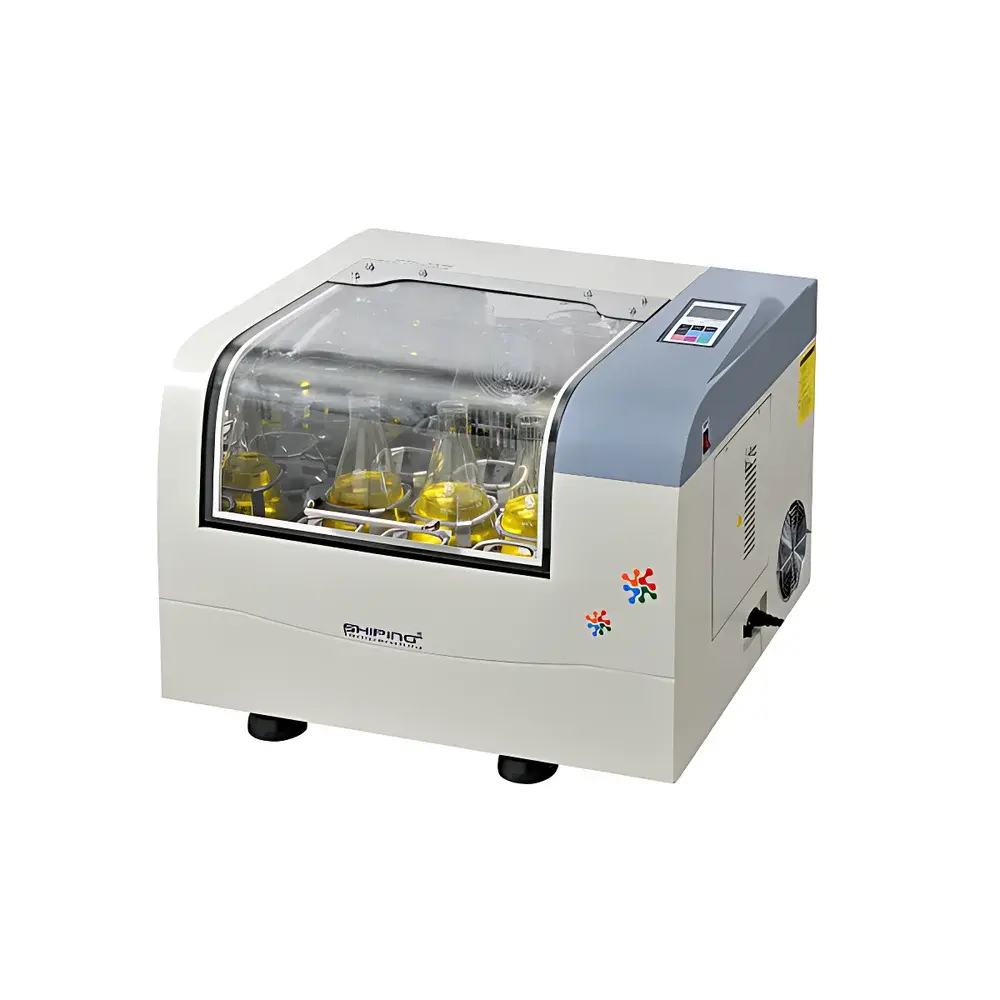
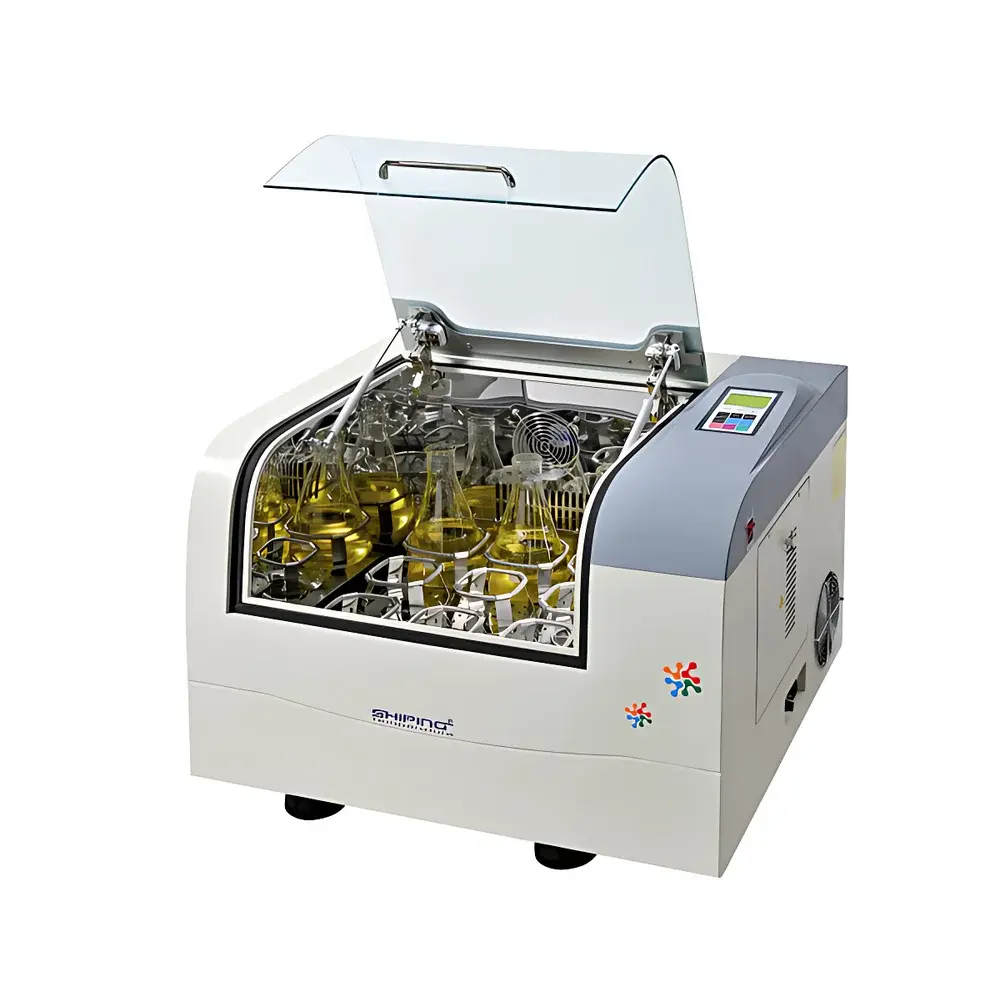
Shanghai Shiping SPH-200D Benchtop Incubated Orbital Shaker
| Brand | Shanghai Shiping |
|---|---|
| Origin | Shanghai, China |
| Manufacturer Type | Direct Manufacturer |
| Product Category | Domestic |
| Model | SPH-200D |
| Price Range | USD 2,800–7,000 (est.) |
| Instrument Type | Incubated Orbital Shaker |
| Timer Range | 0–99.59 h |
| Oscillation Frequency | 30–600 rpm |
| Amplitude Adjustment | 0–50 mm, continuously variable |
| Temperature Control Range | 4–60 °C |
| Platform Quantity | 1 |
| Display | LCD with backlight |
| Control System | PID microprocessor-based environmental scanning controller |
| Air Circulation | Forced convection |
| Oscillation Mode | Orbital only (note: “reciprocating/orbital switch” is not supported per technical spec) |
| Temperature Resolution | 0.1 °C |
| Temperature Uniformity | ≤ ±1.0 °C at 37 °C |
| Temperature Stability | ≤ ±0.2 °C |
| Speed Accuracy | ±1 rpm |
| Platform Dimensions | 420 × 400 mm |
| Chamber Volume | 69 L |
| Internal Dimensions | 460 × 500 × 350 mm |
| External Dimensions | 778 × 685 × 600 mm |
| Net Weight | 88 kg |
| Gross Weight | 122 kg |
| Cooling System | R134a refrigerant, air-cooled, 130 W compressor |
| Heating Power | 400 W |
| Total Power Consumption | 704 W |
| Voltage/Frequency | AC 200–240 V, 50–60 Hz |
| Bearing | NSK double-row precision bearings |
| Shaft Material | 45# carbon steel, quenched & tempered (220–250 HBW) |
| Interior Material | Full 304 stainless steel mirror finish |
| Exterior Housing | ABS engineering polymer, corrosion-resistant and anti-static coating |
| Safety Features | Dual-limit overtemperature/overspeed audible & visual alarm |
| Additional Functions | Parameter memory & encryption |
Overview
The Shanghai Shiping SPH-200D Benchtop Incubated Orbital Shaker is a precision-engineered platform for controlled microbial, mammalian, and suspension cell culture under simultaneous temperature regulation and orbital agitation. It operates on the principle of orbital motion—generating uniform shear forces ideal for oxygen transfer in aerobic bioprocesses—while maintaining stable thermal conditions across the chamber via a dual-mode Peltier-assisted heating/cooling system (R134a refrigerant + resistive heating). Designed for laboratories requiring reproducible growth kinetics, the unit integrates a PID-controlled microprocessor that continuously scans ambient and internal conditions to dynamically adjust power delivery, minimizing thermal overshoot and ensuring ≤ ±0.2 °C stability and ≤ ±1.0 °C uniformity at 37 °C—a critical benchmark for ISO/IEC 17025-compliant biological incubation workflows.
Key Features
- Single-axis balanced drive mechanism delivering low-vibration, high-efficiency operation with <15 dB(A) acoustic emission at 300 rpm—optimized for long-duration cultures without mechanical stress on sensitive cells or reagents.
- Continuously variable amplitude control (Φ0–50 mm) enables precise tuning of mixing intensity to match oxygen demand profiles across diverse culture volumes—from 50 mL microtiter-compatible tubes to 2000 mL baffled flasks.
- LCD backlit display with dual-parameter readout (setpoint vs. real-time temperature/speed) supports GLP-compliant documentation; all operational parameters are password-encrypted to prevent unauthorized modification.
- Comprehensive safety architecture includes redundant thermal protection (independent cut-off relay + software limiter), motor overheat detection, electrical leakage sensing, and automatic power resumption following grid interruption—meeting IEC 61010-1 requirements for laboratory equipment safety.
- Eight-segment programmable curve functionality allows sequential ramping of temperature and speed, supporting complex protocols such as cold-shock induction, synchronized fermentation phases, or gradient-based enzyme expression studies.
- Chamber constructed entirely from electropolished 304 stainless steel with seamless welding minimizes microbial retention points; ABS polymer exterior provides chemical resistance against ethanol, isopropanol, and diluted acids used in routine decontamination.
Sample Compatibility & Compliance
The SPH-200D accommodates standard laboratory vessels up to 2000 mL capacity (e.g., five 2000 mL Erlenmeyer flasks, nine 1000 mL, or thirty-six 50 mL tubes) on its 420 × 400 mm platform. Its forced-convection airflow design ensures homogeneous heat distribution even during high-speed operation (600 rpm), validated per ASTM E2500-13 guidelines for equipment qualification. The unit complies with electromagnetic compatibility standards EN 61326-1 and carries CE marking for use within EU-regulated research environments. While not FDA 21 CFR Part 11–certified out-of-the-box, audit-ready features—including parameter logging, user access control, and electronic signature support via optional RS485/Modbus integration—facilitate GxP-aligned validation in QC microbiology and biopharmaceutical process development labs.
Software & Data Management
Data acquisition is managed locally via the embedded microcontroller, which records timestamped temperature and speed values at 10-second intervals. All logs are stored in non-volatile memory with overwrite protection and exportable via USB interface (optional firmware upgrade). The system supports manual calibration offsets for both temperature (±5.0 °C range) and rotational speed (±50 rpm), traceable to NIST-traceable reference instruments. For networked deployment, Modbus RTU protocol enables integration into LabVantage, STARLIMS, or custom SCADA platforms—supporting automated report generation compliant with ISO 15197 and USP analytical instrument qualification frameworks.
Applications
- Microbial cultivation (E. coli, yeast, Bacillus spp.) under defined dissolved oxygen regimes.
- Mammalian cell expansion in serum-free or low-serum media where shear sensitivity necessitates amplitude modulation.
- Enzyme production and purification workflows requiring temperature-synchronized agitation (e.g., His-tagged protein expression at 18 °C).
- Environmental microbiology assays including BOD5 incubation, coliform enumeration, and antibiotic susceptibility testing per CLSI M07-A10.
- Biopolymer synthesis (e.g., alginate, chitosan) where gelation kinetics depend on thermal history and mixing homogeneity.
- Phytochemical extraction optimization using aqueous-organic solvent systems under controlled thermal agitation.
FAQ
Does the SPH-200D support reciprocating motion?
No—the device is engineered exclusively for orbital shaking; reciprocating functionality is not implemented in this model.
Is remote monitoring possible without additional hardware?
Local data logging is built-in; Ethernet or Wi-Fi connectivity requires optional communication module installation.
What is the minimum operating temperature with refrigeration active?
The unit achieves and maintains 4 °C ambient-equivalent chamber temperature under standard lab conditions (25 °C, 50% RH).
Can the shaker accommodate stacked multi-tier platforms?
No—only a single 420 × 400 mm platform is installed; vertical stacking is not supported due to structural and thermal uniformity constraints.
How frequently should temperature and speed calibration be performed?
Per ISO/IEC 17025 recommendations, quarterly verification is advised using accredited reference probes; full recalibration annually or after major maintenance.