
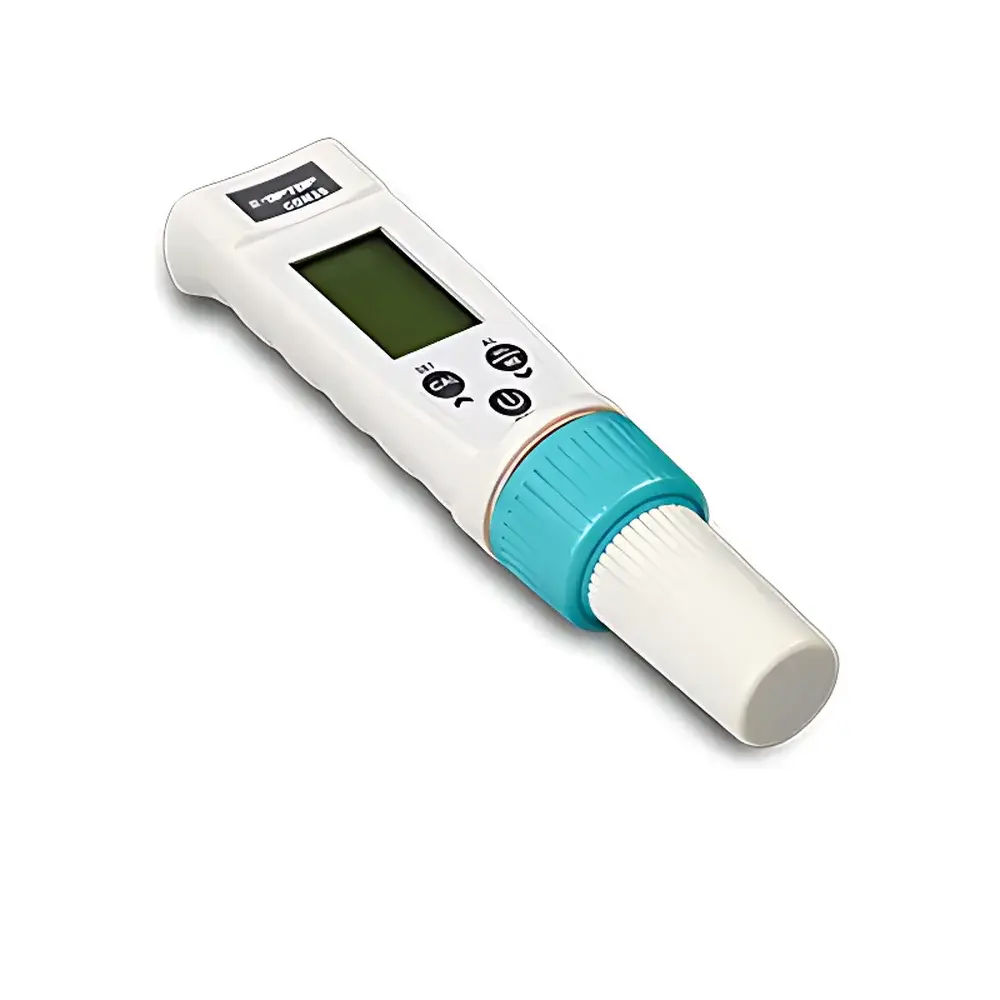
SOPTOP ORP35 Handheld Oxidation-Reduction Potential Meter
| Brand | SOPTOP |
|---|---|
| Model | ORP35 |
| Measurement Range | −900 to +900 mV |
| Temperature Range | 0.0–60.0 °C (32.0–140.0 °F) |
| Temperature Compensation | Automatic or Manual |
| Resolution | 1 mV, 0.1 °C, 0.1 °F |
| Accuracy | ±1 mV |
| Calibration | Auto-recognition of standard buffer solutions |
| Electrode Type | Flat-surface platinum ORP electrode |
| Data Storage | 10 measurement records |
| Display | Multi-line LED, 22 × 32 mm active area with energy-efficient backlight |
| Ingress Protection | IP67 |
| Power Supply | 1 × AA alkaline battery (1.5 V) |
| Auto-power-off | After 6 minutes of inactivity with data retention |
| Hold Function | Manual reading freeze |
Overview
The SOPTOP ORP35 Handheld Oxidation-Reduction Potential Meter is a precision-engineered electrochemical instrument designed for field-deployable and routine laboratory assessment of redox activity in aqueous systems. Operating on the fundamental principle of potentiometric measurement, the ORP35 detects the electrical potential difference between a noble metal (platinum) sensing element and a stable reference electrode—typically Ag/AgCl—immersed in solution. This voltage, expressed in millivolts (mV), reflects the net tendency of a system to gain electrons (reduction) or lose electrons (oxidation), independent of concentration but highly sensitive to chemical speciation, dissolved oxygen, disinfectant residuals (e.g., chlorine, ozone), and microbial metabolic activity. Unlike pH meters, which require two-point calibration against defined H⁺ activity standards, ORP instruments rely on single-point verification using standardized redox buffers (e.g., Zobell’s or Light’s solutions at known mV values), enabling rapid, non-quantitative yet highly diagnostic process monitoring across water treatment, aquaculture, swimming pool management, and industrial cooling circuits.
Key Features
- High-stability flat-surface platinum ORP electrode optimized for reproducible surface interaction and minimal polarization drift during continuous immersion or spot-check measurements.
- True dual-scale temperature display (°C and °F) with selectable automatic or manual temperature compensation—critical for maintaining measurement fidelity across seasonal or process-induced thermal gradients.
- IP67-rated housing ensures dust-tight integrity and resistance to temporary submersion (up to 1 m for 30 min), supporting reliable operation in humid, splash-prone, or outdoor environments without protective enclosures.
- Multi-line LED display with energy-efficient backlighting provides legible readouts under low-light conditions common in underground utility vaults, pump stations, or nighttime sampling campaigns.
- Intelligent power management includes auto-hold activation, programmable auto-shutdown (6-minute timeout), persistent data retention upon power loss, and visual low-battery warning—extending operational readiness without compromising data continuity.
- Onboard memory stores up to 10 timestamped measurements, facilitating preliminary trend logging without external software or connectivity hardware.
Sample Compatibility & Compliance
The ORP35 is validated for use with clean to moderately turbid aqueous samples exhibiting conductivity ≥50 µS/cm, including municipal drinking water, wastewater effluent, recirculating aquaculture systems, chlorinated recreational water, and industrial process streams. It is not intended for non-aqueous solvents, high-viscosity slurries, or strongly reducing media containing sulfides or ferrous ions without prior sample conditioning. While the device itself does not carry CE, UKCA, or FDA 510(k) certification, its measurement methodology aligns with ASTM D1293 (Standard Test Method for pH of Water) and ISO 5814 (Water quality — Determination of dissolved oxygen — Electrochemical probe method), both of which reference ORP as a correlative parameter for oxidation state validation. The platinum electrode conforms to ISO 7888 for electrode material purity and surface geometry specifications.
Software & Data Management
The ORP35 operates as a standalone, embedded-system instrument with no Bluetooth, USB, or cloud connectivity. All data handling occurs locally: measurements are displayed in real time, frozen via Hold mode for recording, and retained in non-volatile memory across battery changes. No proprietary software, drivers, or operating system dependencies are required. For regulatory traceability, users must manually transcribe readings into lab notebooks or LIMS-compatible spreadsheets. Though lacking 21 CFR Part 11-compliant audit trails or electronic signatures, the device supports GLP-aligned workflows when paired with documented SOPs covering electrode maintenance, calibration frequency (recommended daily for critical applications), and environmental condition logging.
Applications
- Verification of residual oxidant efficacy in municipal water distribution networks and point-of-use disinfection systems.
- Monitoring redox potential shifts during biological nutrient removal (BNR) in activated sludge basins to optimize anoxic/anaerobic zone control.
- Assessing pond health and dissolved oxygen dynamics in intensive aquaculture operations through correlation of ORP with nitrification rates.
- Quality assurance of rinse water in pharmaceutical equipment cleaning cycles where oxidative sanitizers (e.g., peracetic acid) are employed.
- Routine checks of electroplating bath stability and passivation efficiency in metal finishing facilities.
FAQ
Does the ORP35 require calibration with multiple standard solutions?
No. ORP calibration uses a single certified redox standard (e.g., +228 mV at 25 °C in Zobell’s solution). Multi-point calibration is neither supported nor scientifically appropriate for ORP instrumentation.
Can the included platinum electrode be used for long-term immersion in seawater?
Yes—the flat-surface design resists biofouling better than conventional rod-type electrodes, though weekly cleaning with dilute HCl (0.1 M) and rinsing with deionized water is recommended for sustained accuracy in saline matrices.
Is temperature compensation mandatory for accurate ORP readings?
While ORP is intrinsically temperature-dependent, the ORP35’s ±1 mV accuracy specification assumes compensation is enabled. Manual input is acceptable only if ambient temperature remains stable within ±0.5 °C during measurement.
What does IP67 rating mean for field deployment?
It certifies complete protection against dust ingress and transient immersion in water up to 1 meter depth for 30 minutes—making the unit suitable for rain-exposed sampling, wet well inspections, and transport in unsealed instrument cases.
How often should the electrode be replaced under normal use?
Platinum sensing elements typically exceed 24 months of service life when stored dry and cleaned regularly; performance degradation is indicated by sluggish response (>15 s to stabilize) or deviation >±5 mV from verified standards after recalibration.




