
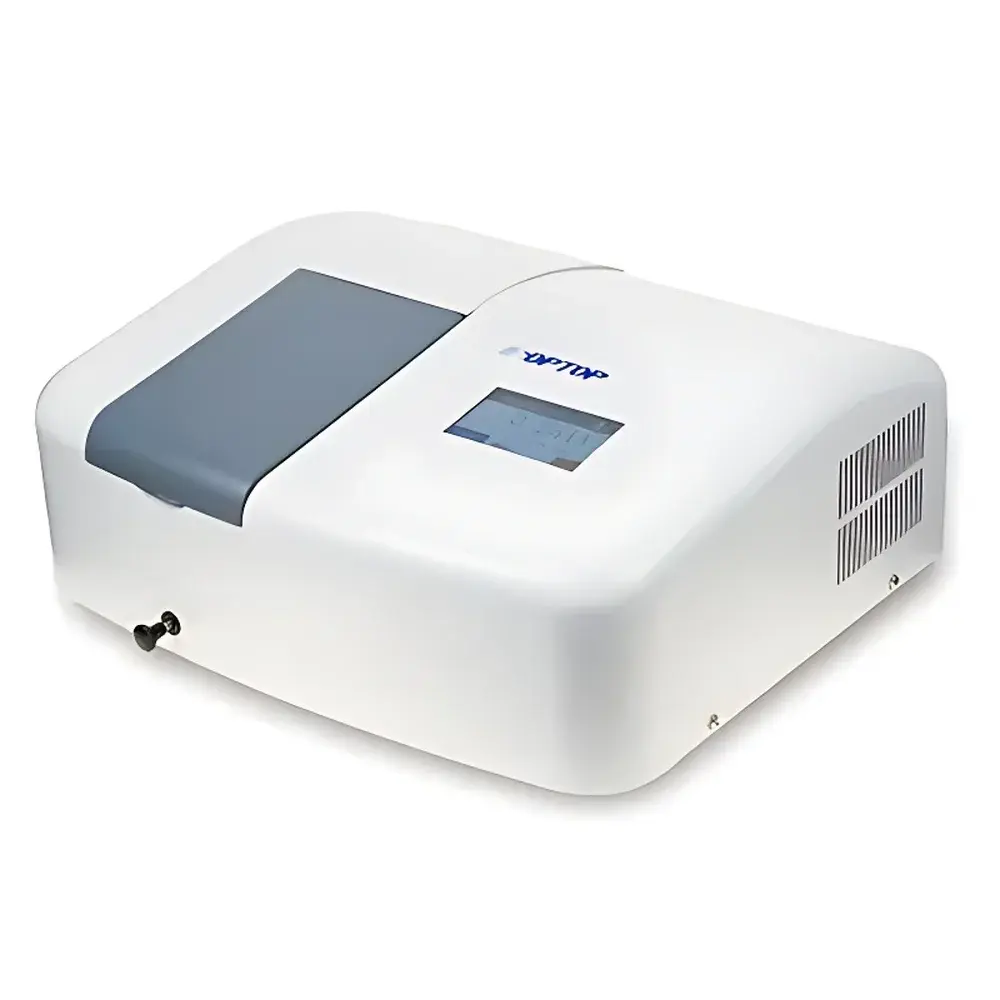
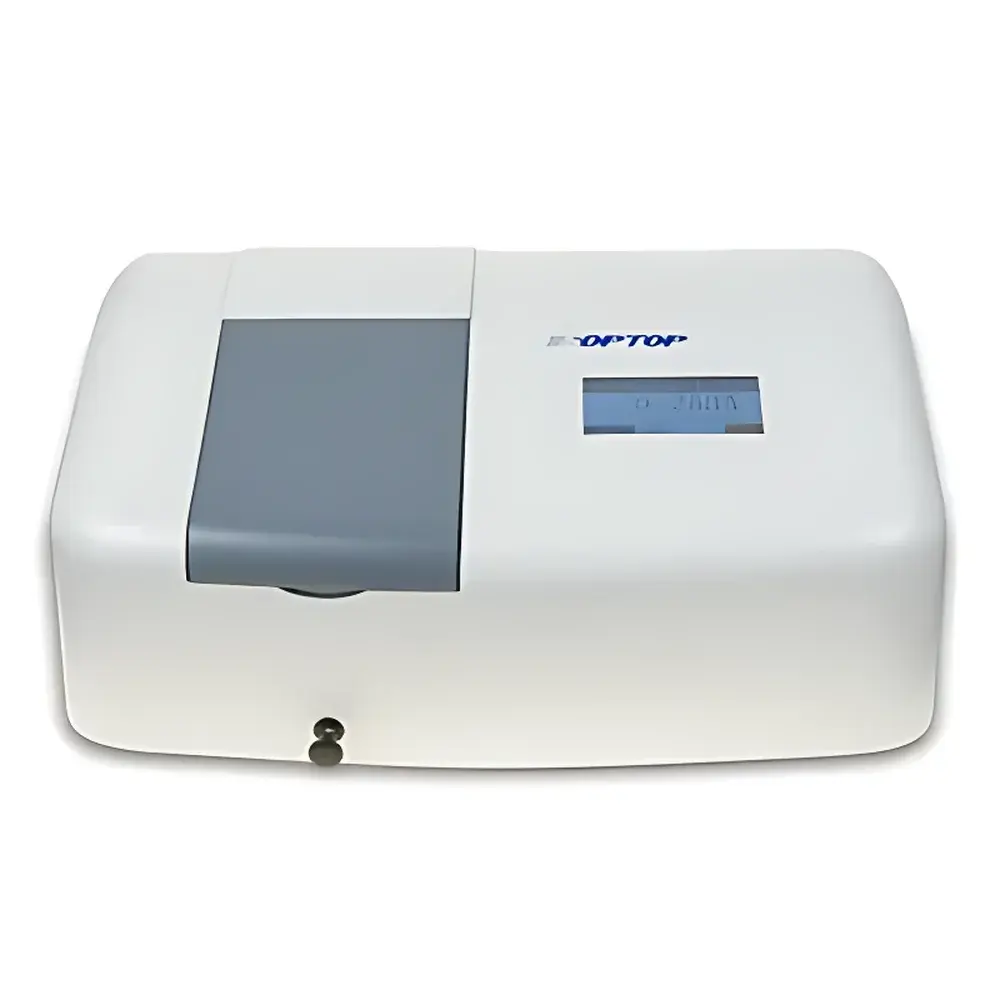
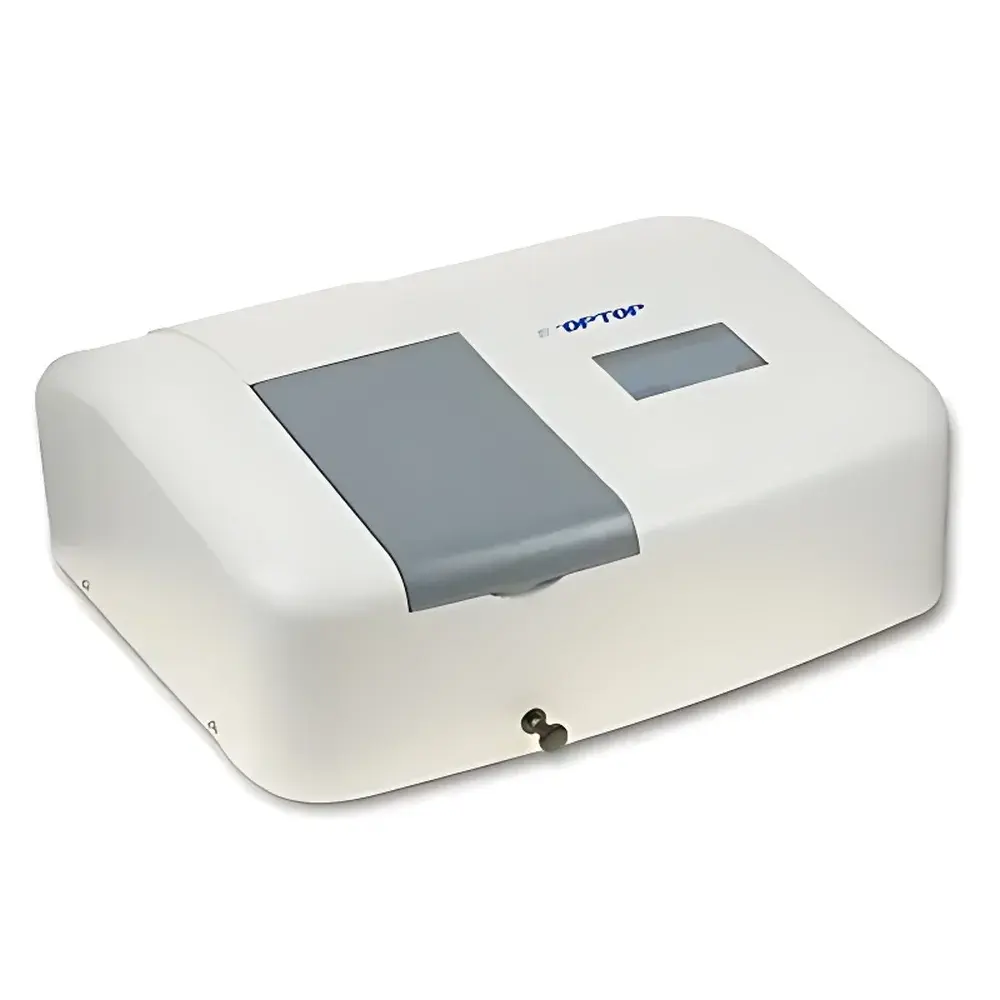
SOPOTOP 752 UV-Vis Spectrophotometer
| Brand | SOPOTOP |
|---|---|
| Origin | Shanghai, China |
| Model | 752 |
| Optical System | Single-beam |
| Detector Type | Silicon Photocell |
| Wavelength Range | 200–1000 nm (0.1 nm step resolution) |
| Spectral Bandwidth | 4 nm |
| Wavelength Accuracy | ±1.0 nm |
| Wavelength Repeatability | ±0.5 nm |
| Photometric Accuracy | ±0.5% T (at 0–100% T) |
| Photometric Repeatability | ±0.3% T |
| Stray Light | ≤0.3% T at 220 nm and 360 nm |
| Display | 4.3-inch color TFT touchscreen (480 × 272 pixels) |
| Data Interface | USB 2.0 |
| Power Supply | 220 V ±10%, 50 Hz / 110 V ±10%, 60 Hz, 90 W |
| Dimensions (W × D × H) | 470 × 380 × 225 mm |
| Net Weight | 10.5 kg |
| Compliance | CE, ISO/IEC 17025 compatible operation environment |
Overview
The SOPOTOP 752 UV-Vis Spectrophotometer is a single-beam optical instrument engineered for routine quantitative and qualitative analysis in academic laboratories, quality control environments, and industrial R&D settings. It operates on the principle of Beer–Lambert law-based absorbance measurement, utilizing a Czerny–Turner monochromator with a 1200-line/mm holographic grating to deliver precise wavelength selection across a broad spectral range from 200 nm to 1000 nm. With a fixed spectral bandwidth of 4 nm and 0.1 nm wavelength stepping capability, the instrument provides sufficient resolution for standard applications including concentration determination, purity assessment, and kinetic monitoring of chemical reactions. Its robust mechanical architecture, integrated silicon photocell detector, and thermally stabilized optical path ensure high photometric reproducibility and long-term baseline stability under ambient laboratory conditions.
Key Features
- 4.3-inch full-color TFT touchscreen interface (480 × 272 resolution) enabling intuitive navigation, real-time spectrum visualization, and direct parameter input without external peripherals
- Automated wavelength scanning and positioning with ±1.0 nm accuracy and ±0.5 nm repeatability, reducing operator-induced variability
- Direct concentration readout functionality with user-definable calibration factors and multi-point standard curve fitting (linear, quadratic, cubic, and piecewise)
- Comprehensive photometric measurement modes: fixed-wavelength absorbance/transmittance, wavelength scanning (A/T/E), time-based kinetics, multi-wavelength analysis, and 3D spectral mapping
- USB 2.0 host interface supporting plug-and-play data export to external storage devices; no proprietary drivers required
- Optimized thermal management and vibration-damped optical bench design to minimize drift during extended measurements
Sample Compatibility & Compliance
The SOPOTOP 752 accommodates standard 10 mm pathlength cuvettes (glass, quartz, or plastic), supporting liquid, colloidal, and dissolved solid samples across pharmaceutical, environmental, food science, and biochemical workflows. It meets essential electromagnetic compatibility (EMC) and safety requirements aligned with CE marking directives. While not certified for GMP production environments out-of-the-box, its optional audit trail module—when enabled—supports ALCOA+ principles by recording user actions, method parameters, and timestamped measurement events in an immutable log file, facilitating alignment with GLP documentation practices and preliminary FDA 21 CFR Part 11 readiness assessments. The instrument’s operational performance adheres to foundational metrological expectations outlined in ISO/IEC 17025:2017 for testing laboratories, particularly regarding traceability of wavelength and photometric scale verification.
Software & Data Management
The UV-Solution workstation software (optional but recommended for full functionality) provides a Windows-compatible platform for advanced spectral processing and regulatory-compliant reporting. It supports raw data export in native .csv and Excel (.xlsx) formats, bitmap (.bmp) image capture of spectra, and customizable report templates compliant with internal QA documentation standards. Analytical capabilities include spectral smoothing (Savitzky–Golay), derivative spectroscopy (up to third order), peak/valley detection with threshold-based identification, overlay comparison of up to eight spectra, and coordinate transformation (logarithmic, inverse, etc.). For life science applications, dedicated DNA/protein modules implement A260/A280 ratio calculations using user-adjustable extinction coefficients and pathlength correction factors. All software-generated records retain embedded metadata (instrument ID, date/time stamp, operator login, method name), ensuring data integrity throughout the analytical lifecycle.
Applications
This spectrophotometer serves as a core tool in diverse analytical contexts: quantification of nucleic acids and proteins in molecular biology labs; determination of active pharmaceutical ingredient (API) concentration in QC release testing; evaluation of dye degradation kinetics in textile chemistry; measurement of nitrate/nitrite levels in water quality analysis per EPA Method 353.2; verification of catalyst loading in heterogeneous reaction studies; and validation of cleaning efficacy via residual contaminant absorbance in medical device manufacturing. Its 200–1000 nm coverage enables characterization of organic chromophores, transition metal complexes, and semiconductor nanomaterials where π→π*, n→π*, and d–d transitions fall within this range.
FAQ
What is the minimum detectable absorbance for the SOPOTOP 752?
The instrument achieves a photometric noise level of ≤0.002 A at 500 nm (1 sec response time), corresponding to a practical lower limit of quantitation near 0.01 A under optimized conditions.
Can quartz cuvettes be used below 220 nm?
No—standard quartz cuvettes transmit effectively down to ~190 nm, but the 752 model’s specified lower limit is 200 nm due to optical throughput constraints and stray light management at shorter wavelengths.
Is UV-Solution software included or optional?
UV-Solution is an optional software package; basic instrument control and data logging are available via the onboard touchscreen interface.
Does the 752 support method validation protocols per ICH Q2(R2)?
While the hardware supports key validation parameters (wavelength accuracy, photometric linearity, repeatability), full ICH Q2(R2) method validation requires user-performed system suitability tests and documented procedures—not built-in automated validation routines.
How is wavelength calibration verified?
Calibration is performed using holmium oxide or didymium glass filters traceable to NIST SRM standards; the instrument includes a dedicated filter alignment routine accessible via service mode.






