
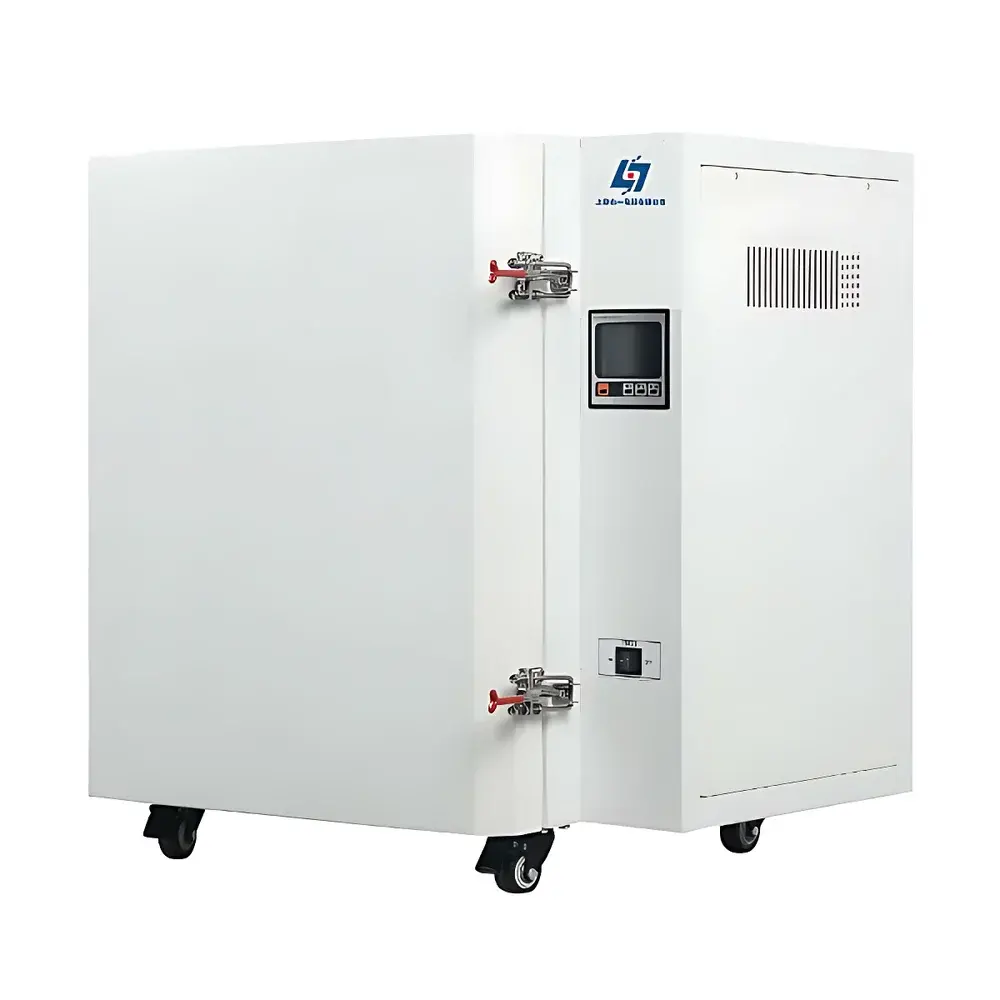
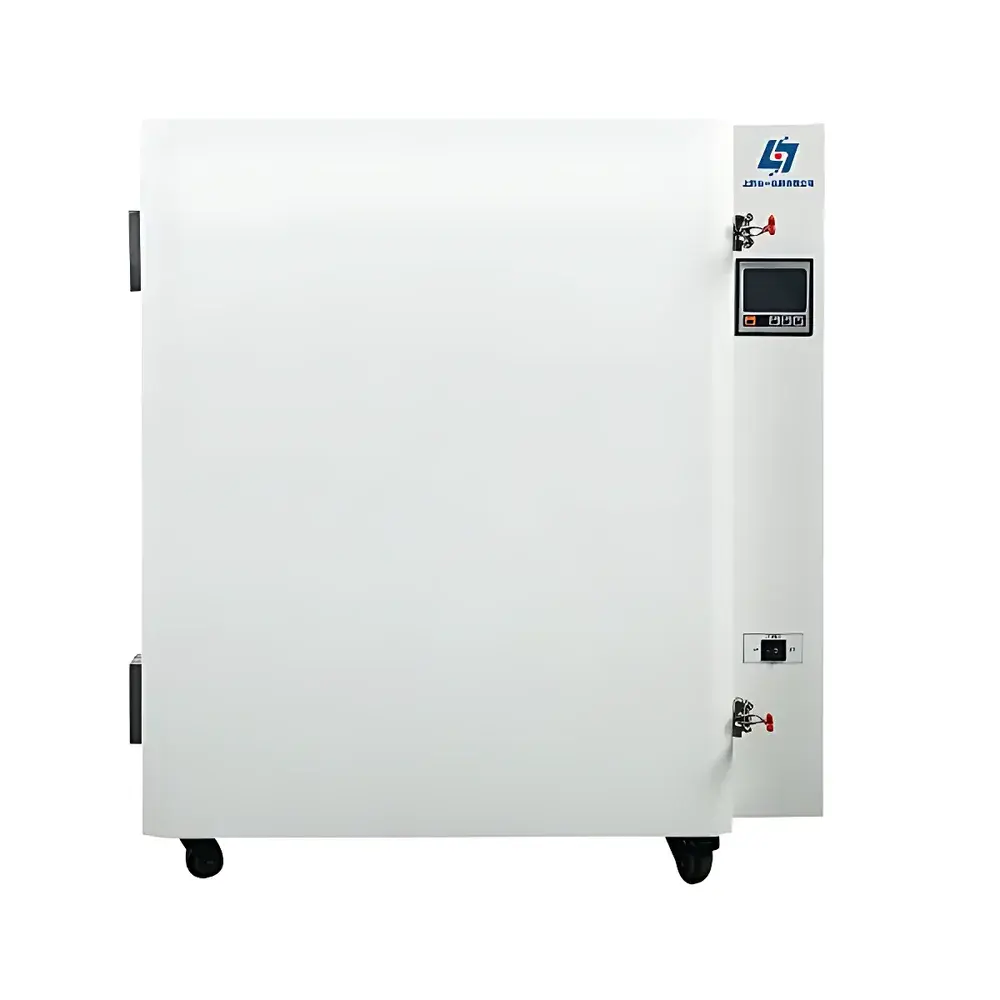
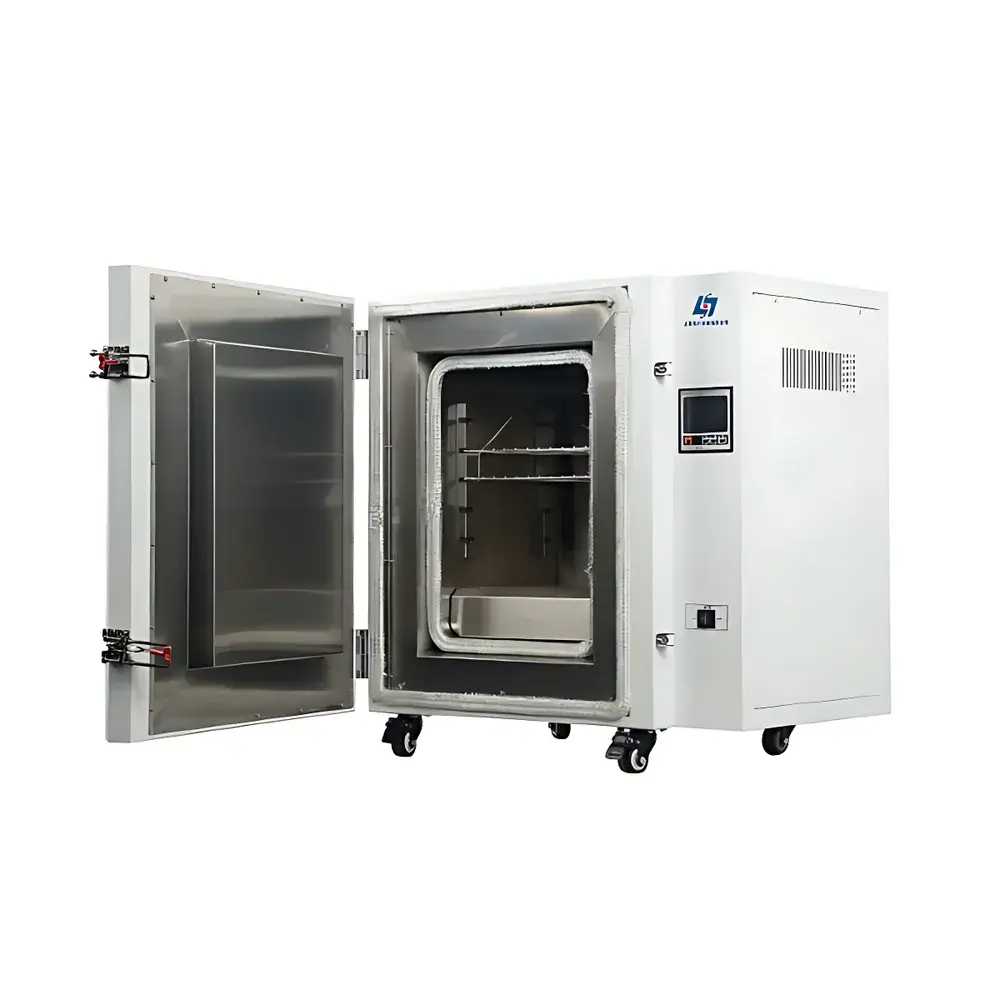
Yoyi DGG-309 High-Temperature Forced-Air Drying Oven (500 °C, Multi-Stage Programmable)
| Brand | Yoyi |
|---|---|
| Origin | Shanghai, China |
| Manufacturer Type | Direct Manufacturer |
| Product Category | Domestic |
| Model | DGG-309 |
| Instrument Type | High-Temperature Drying Oven |
| Temperature Range | RT+20 °C to 500 °C |
| Temperature Uniformity | ±2.5 % (at 100 °C) |
| Temperature Fluctuation | ±2.0 °C |
| Temperature Resolution | 1 °C |
| External Dimensions (W×D×H) | 840×995×1390 mm |
| Internal Chamber Dimensions (W×D×H) | 500×600×1000 mm |
| Chamber Volume | 300 L |
| Chamber Material | Mirror-Finish Stainless Steel |
| Power Supply | AC 380 V, 50 Hz |
| Input Power | 6000 W |
| Working Environment Temperature | +5 °C to +40 °C |
| Timer Range | 1–9999 min |
Overview
The Yoyi DGG-309 is a high-temperature forced-air drying oven engineered for precision thermal processing in industrial quality control laboratories and R&D environments. Operating across a calibrated temperature range of RT+20 °C to 500 °C, it employs a robust convection-based heating architecture with multi-blade centrifugal circulation fans and pre-heated air injection via a dedicated thermal mixing chamber. This design ensures rapid thermal ramping and minimizes axial and radial temperature gradients—critical for applications demanding strict thermal homogeneity, such as polymer curing, ceramic sintering pre-treatment, catalyst activation, and metal oxide stabilization. The oven conforms to fundamental thermal equipment design principles outlined in ISO 17025:2017 (clause 6.4.2 on environmental condition control) and supports GLP-compliant workflows through programmable logic and audit-ready operational features.
Key Features
- Microprocessor-based multi-stage programmable temperature controller with 4.3-inch LCD interface, supporting up to 30 segments per program cycle—including ramp/soak profiles, power modulation, and auto-tuning PID algorithms
- Pre-heating cavity design that thermally conditions incoming air prior to chamber entry, reducing cold-spot formation and improving thermal response time by ≥35% versus conventional ducted systems
- Mirror-finish SUS304 stainless steel inner chamber (500×600×1000 mm) with adjustable chrome-plated wire shelving (2 standard trays included); all internal welds polished to Ra ≤0.8 µm for cleanability and corrosion resistance
- Dual-layer ceramic fiber door gasket rated for continuous operation at 500 °C; achieves <0.8 W/m²·K thermal transmittance (U-value) when combined with 100 mm thick glass fiber insulation between chamber and outer casing
- Cold-rolled steel exterior with electrostatic epoxy-polyester powder coating (film thickness ≥75 µm), meeting ISO 20567-1 salt-spray resistance requirements (≥500 h neutral salt fog)
- Independent over-temperature cut-off system (optional) compliant with IEC 61000-4-2/ESD and IEC 61000-4-4/EFT immunity standards, triggering mechanical relay interruption at user-defined thresholds
Sample Compatibility & Compliance
The DGG-309 accommodates a wide range of sample formats—including crucibles (up to Φ120 mm), Petri dishes, ceramic boats, aluminum trays, and standardized ASTM E1137 test specimens—within its 300 L working volume. Chamber geometry enables uniform airflow distribution validated per ASTM E2205-22 Annex A1 (thermal mapping protocol), with typical uniformity of ±2.5% at 100 °C and ±3.0% at 450 °C (n=9-point sensor grid). The unit meets CE marking requirements under the EU Machinery Directive 2006/42/EC and Low Voltage Directive 2014/35/EU. Optional RS485 Modbus RTU interface supports integration into centralized lab monitoring systems compliant with FDA 21 CFR Part 11 for electronic records and signatures when paired with validated software.
Software & Data Management
The embedded controller logs timestamped temperature data at user-selectable intervals (1–600 s) with non-volatile memory retention (≥10,000 cycles). Optional RS485 communication module enables bidirectional data exchange with SCADA or LIMS platforms using standard Modbus RTU protocol. An optional embedded thermal printer (IEEE 1188 compliant) provides hard-copy output of real-time curves, setpoints, and alarm events—fully traceable with batch ID, operator code, and UTC timestamps. All firmware updates are performed via secure USB interface with SHA-256 signature verification to maintain integrity during GLP/GMP audits.
Applications
- Thermal gravimetric analysis (TGA) sample pre-conditioning and residue ashing (per ASTM E1131 and ISO 11358)
- Curing of epoxy, silicone, and polyimide coatings on aerospace substrates (MIL-STD-883 Method 2015)
- Moisture content determination in pharmaceutical excipients (USP <921> Loss on Drying)
- Heat treatment of calibration standards (e.g., NIST SRM 1978, alumina reference materials)
- Accelerated aging studies for battery cathode materials (LiCoO₂, NMC) per IEC 62660-1
- Pre-baking of semiconductor wafers and MEMS packaging substrates prior to thin-film deposition
FAQ
What is the maximum recommended continuous operating temperature?
The DGG-309 is rated for continuous operation at 500 °C. Prolonged use above this limit may compromise heater element lifespan and insulation integrity.
Is the temperature controller validated to meet ISO/IEC 17025 traceability requirements?
Yes—the controller’s internal Pt100 sensor input channel is factory-calibrated against NIST-traceable references; full calibration certificate (including uncertainty budget) is available upon request.
Can inert gas purging be integrated for oxygen-sensitive processes?
Yes—an optional inert gas inlet port (with integrated needle valve and digital flowmeter, 0–10 L/min range) is available to maintain O₂ levels below 100 ppm during thermal treatment.
Does the oven support remote monitoring via Ethernet or Wi-Fi?
No native Ethernet/Wi-Fi module is included; however, third-party RS485-to-Ethernet gateways (e.g., Moxa EDS-205A) can be deployed to enable TCP/IP-based supervision within existing lab networks.
What maintenance intervals are recommended for optimal performance?
Fan motor lubrication every 12 months; door gasket inspection every 6 months; thermal insulation integrity check (via surface thermography) annually—per manufacturer-recommended PM schedule aligned with ISO 55001 asset management principles.



