
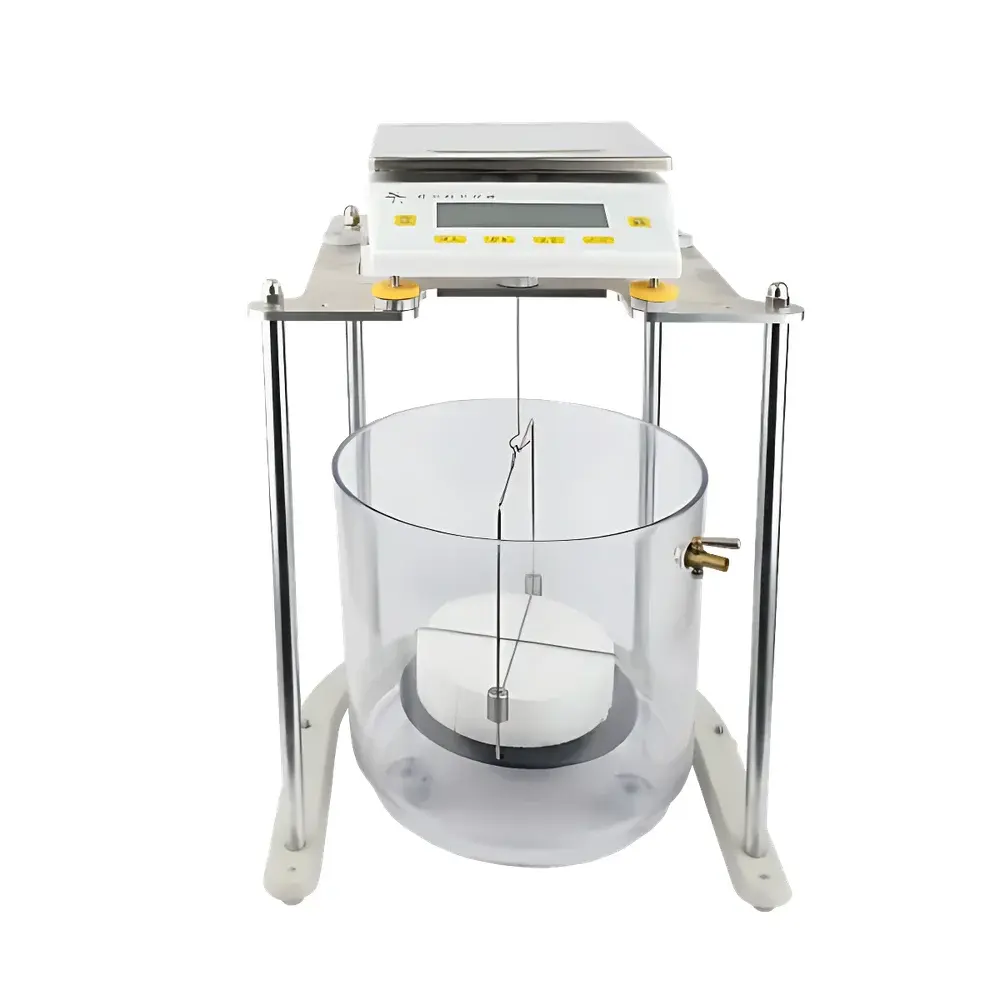
SOP TOP JA Series Rigid Foam Water Absorption Tester
| Brand | SOP TOP |
|---|---|
| Model | JA Series |
| Origin | Shanghai, China |
| Instrument Type | Rigid Foam Water Absorption Testing System |
| Core Components | Integrated Precision Electronic Balance + Dedicated Foam Immersion & Drying Fixture |
| Balance Models Compatible | JA21002P (2100 g / 0.01 g readability), JA50002P (5000 g / 0.01 g readability) |
| Repeatability | ±0.01 g (JA21002P), ±0.02 g (JA50002P) |
| Linearity Error | ±0.02 g |
| Pan Diameter | Φ158 mm |
| Interface | RS232 |
| Operating Temperature | 5–40 °C |
| Relative Humidity | ≤85% RH (non-condensing) |
| Compliance | Designed to support ASTM D2842, ISO 2896, GB/T 8810–2005 test protocols |
Overview
The SOP TOP JA Series Rigid Foam Water Absorption Tester is a purpose-built, integrated physical property testing system engineered for the precise and repeatable determination of water absorption in rigid polymeric foams—primarily expanded polystyrene (EPS), extruded polystyrene (XPS), polyisocyanurate (PIR), and phenolic foams. The instrument operates on the gravimetric immersion principle defined in ASTM D2842 (“Standard Test Method for Water Absorption of Rigid Cellular Plastics”) and ISO 2896 (“Plastics — Rigid cellular materials — Determination of water absorption”). It combines a high-stability analytical balance with a dedicated mechanical fixture that ensures standardized sample suspension, controlled immersion depth, consistent drip-off timing, and safe post-immersion handling—all critical variables affecting measurement reproducibility. Unlike generic moisture analyzers or standalone balances, the JA Series integrates mechanical constraints and procedural guidance directly into its architecture, minimizing operator-induced variability and supporting GLP-aligned documentation workflows.
Key Features
- Modular dual-component design: Separately serviceable electronic balance (JA21002P or JA50002P) and foam-specific immersion/drainage assembly—enabling independent calibration and maintenance.
- Operator-centric ergonomics: Integrated swivel casters allow smooth repositioning during multi-step testing sequences; non-slip rubber feet and anti-drop perimeter guards prevent accidental displacement or pan impact during sample transfer.
- Standardized immersion geometry: Fixture maintains fixed submersion depth (±1 mm tolerance) and vertical alignment per ASTM D2842 Clause 7.2, eliminating manual height adjustment errors.
- Controlled drip-off station: Built-in timed drainage platform with calibrated tilt angle (15° ± 0.5°) and standardized dwell time (10 min ± 15 s), ensuring uniform surface water removal prior to final weighing.
- RS232 serial interface compliant with industry-standard data logging software; supports direct export of timestamped mass readings (pre-immersion, post-immersion, post-drip) for audit-ready reporting.
Sample Compatibility & Compliance
The JA Series accommodates standard test specimens per ASTM D2842 (50 mm × 50 mm × 25 mm or 100 mm × 100 mm × 25 mm) and ISO 2896 (100 mm × 100 mm × 50 mm), with maximum specimen weight up to 4.5 kg (JA50002P configuration). Specimen surfaces are verified for dimensional stability under immersion via pre-test conditioning at 23 ± 2 °C and 50 ± 5% RH for ≥24 h, as required by both standards. The system supports full traceability through balance internal calibration (using certified Class M2 weights) and optional external verification per ISO/IEC 17025. While not a regulated medical device, its measurement uncertainty budget aligns with ISO/IEC 17025:2017 Annex A.2 requirements for mass measurement in materials testing laboratories.
Software & Data Management
No proprietary software is bundled; the RS232 interface enables seamless integration with laboratory information management systems (LIMS), Excel-based QA templates, or validated third-party data acquisition platforms (e.g., LabVIEW, MATLAB, or custom Python scripts using pySerial). Each measurement cycle outputs three ASCII-formatted mass values with UTC timestamps and instrument ID, satisfying minimum ALCOA+ (Attributable, Legible, Contemporaneous, Original, Accurate, Complete, Consistent, Enduring, Available) data integrity criteria. When deployed in regulated environments (e.g., building material certification labs), users may configure audit trails, electronic signatures, and 21 CFR Part 11-compliant user access controls via their host software—provided such functionality is validated by the end-user’s QA department.
Applications
- Quality control of insulation foams in construction material manufacturing (XPS/EPS board production lines).
- R&D evaluation of hydrophobic additives or surface treatments on rigid cellular plastics.
- Third-party certification testing per EN 13163 (thermal insulating products for buildings) and ASTM C578 (rigid, cellular PVC thermal insulation).
- Failure analysis of moisture-related degradation in sandwich panel cores or cold-chain packaging.
- Validation of closed-cell content estimation via comparative absorption vs. density measurements (per ISO 845).
FAQ
Does the JA Series include automated temperature or humidity control for conditioning chambers?
No—the instrument itself does not incorporate environmental conditioning. Per ASTM D2842 and ISO 2896, specimen conditioning must be performed externally in a certified climate-controlled room or chamber meeting specified tolerances (23 ± 2 °C / 50 ± 5% RH).
Can the system be used for flexible foams or elastomeric materials?
Not recommended. The fixture geometry, drip-off protocol, and mass range are optimized for dimensionally stable rigid foams. Flexible or compressible samples may yield non-reproducible drainage behavior and violate standard-defined immersion conditions.
Is balance calibration traceable to national metrology institutes?
Yes—both JA21002P and JA50002P models support internal calibration with external weights. Traceability requires user-provided Class M2 or better certified masses, calibrated by an ISO/IEC 17025-accredited provider.
What maintenance intervals are recommended for long-term accuracy?
Daily zero-check; weekly span verification using certified weights; annual full recalibration including linearity and repeatability assessment per ISO 9001 clause 7.1.5.2.
Related Products



