
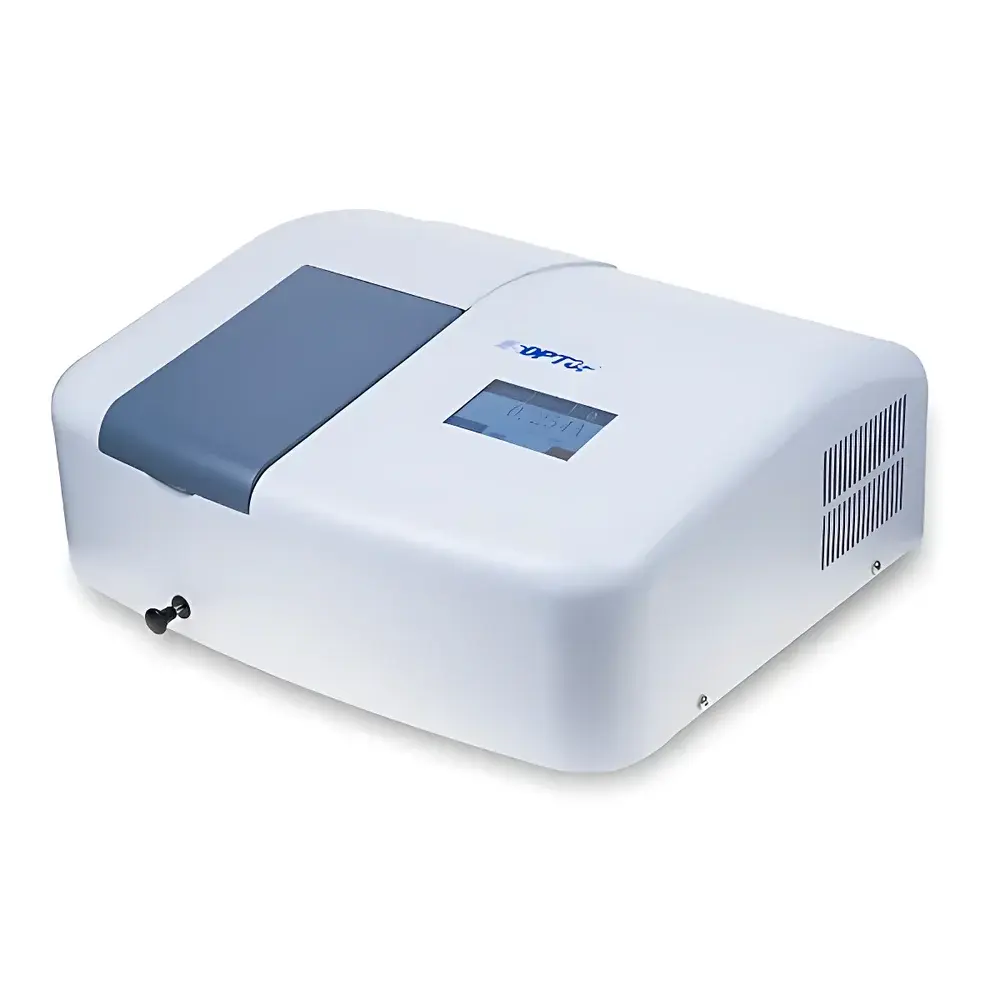
SUNNY HENGPING V2200 Visible Spectrophotometer
| Brand | SUNNY HENGPING INSTRUMENT |
|---|---|
| Origin | Shanghai, China |
| Manufacturer Type | Manufacturer |
| Model | V2200 Visible Spectrophotometer |
| Optical Design | Single-beam |
| Detector Type | Silicon photodiode |
| Wavelength Range | 325–1100 nm (0.1 nm step increment) |
| Spectral Bandwidth | 2 nm |
| Wavelength Accuracy | Auto-wavelength positioning |
| Display | 4.3-inch color TFT touchscreen (480 × 272 pixels) |
| Data Interface | USB |
| Light Source | Imported 20 W / 12 V halogen lamp |
| Power Supply | 220 V ±10%, 50 Hz / 110 V ±10%, 60 Hz |
| Net Weight | 10.0 kg |
| Dimensions (W × D × H) | 470 × 380 × 225 mm |
Overview
The SUNNY HENGPING V2200 Visible Spectrophotometer is a precision single-beam optical instrument engineered for quantitative and qualitative analysis in the visible to near-infrared spectral region. Operating on the principle of Beer–Lambert law-based absorbance measurement, it delivers reliable photometric data across a continuous wavelength range from 325 nm to 1100 nm with 0.1 nm resolution. Its Czerny–Turner (C-T) monochromator design incorporates a 1200-line/mm holographic grating and an imported silicon photodiode detector, ensuring high signal-to-noise ratio and long-term photometric stability. The instrument is optimized for routine laboratory applications—including concentration determination, kinetic assays, spectral scanning, and biomolecular quantification—where robustness, ease of operation, and regulatory-compliant data handling are essential.
Key Features
- 4.3-inch high-resolution color TFT touchscreen (480 × 272 pixels) with intuitive graphical user interface for direct instrument control without external PC dependency.
- Single-beam optical architecture with auto-wavelength positioning and automatic zero-absorbance/100% transmittance calibration at user-selected wavelengths.
- Integrated photometric modes: fixed-wavelength measurement (A/T), wavelength scanning (absorbance, transmittance, or energy), time-based kinetics (time scan), and multi-point quantitative analysis.
- Onboard standard curve generation supporting linear, quadratic, cubic, and piecewise (broken-line) regression models—enabling immediate concentration calculation for unknown samples.
- Preconfigured DNA/protein analysis module with built-in extinction coefficients and ratio calculations (e.g., A260/A280), supporting customizable wavelength pairs and correction factors.
- USB interface for seamless data export to external storage devices; all measurement results—including spectra, kinetic traces, and calibration tables—exportable as Excel (.xlsx) files or bitmap (.bmp) images.
- Modular accessory compatibility—including variable-pathlength cuvette holders, fiber-optic probes, and solid-sample reflectance kits—to extend application flexibility beyond liquid-phase analysis.
Sample Compatibility & Compliance
The V2200 accommodates standard 10 mm square quartz or glass cuvettes (pathlengths from 1 mm to 50 mm via optional holders), as well as microvolume and flow-cell configurations. It supports both transmission and reflectance measurements for homogeneous liquid solutions, suspensions, and thin-film samples. While not classified as a GMP-certified instrument by default, the optional audit trail module enables compliance with FDA 21 CFR Part 11 requirements for electronic records and signatures—supporting user-defined roles, session logging, parameter change tracking, and immutable data archiving. All firmware and UV-Solution software operations adhere to ISO/IEC 17025 principles for testing and calibration laboratories, and measurement protocols align with ASTM E275 and ISO 6059 standards for spectrophotometric performance verification.
Software & Data Management
UV-Solution software serves as the full-featured desktop companion to the V2200. It provides synchronized control, real-time data acquisition, and advanced post-processing capabilities—including spectral smoothing, derivative spectroscopy (up to third order), peak/valley detection, overlay comparison, and coordinate scaling. Quantitative workflows support multi-wavelength analysis (single/dual/triple wavelength modes), batch sample processing, and method templating for SOP-driven environments. Data integrity is reinforced through timestamped metadata embedding, checksum validation upon file export, and configurable auto-backup to network drives. For regulated environments, the optional Audit Trail add-on implements role-based access control, electronic signature capture, and tamper-evident log generation—fully traceable to individual users, timestamps, and instrument events.
Applications
The V2200 is routinely deployed in QC/QA laboratories for pharmaceutical excipient verification, dye concentration monitoring in textile chemistry, enzyme activity assays via NADH/NADPH absorbance shifts, and water quality assessment (e.g., nitrate, phosphate, and heavy metal complex quantification). In academic research, it supports pigment characterization in plant biochemistry, nanoparticle size estimation via plasmon resonance band analysis, and polymer degradation kinetics. Its extended 1100 nm range enables evaluation of near-IR-active chromophores such as conjugated polyenes and transition-metal complexes—making it suitable for materials science and catalysis studies where conventional UV-Vis instruments lack sufficient spectral reach.
FAQ
What is the wavelength accuracy and repeatability specification for the V2200?
The instrument achieves ±0.5 nm wavelength accuracy and ≤0.2 nm wavelength repeatability under standard operating conditions, verified using holmium oxide and didymium reference filters per ISO 6059.
Can the V2200 perform stray light correction automatically?
Stray light is minimized optically via the 2 nm spectral bandwidth and grating design; no software-based correction algorithm is implemented, as the measured stray light level remains below 0.1% at 340 nm (typical), meeting ASTM E387 requirements.
Is GLP-compliant reporting supported out-of-the-box?
Standard UV-Solution software includes customizable report templates with instrument ID, operator name, date/time stamps, and measurement parameters—but formal GLP/GMP compliance requires activation of the optional Audit Trail module.
How frequently should the halogen lamp be replaced?
The imported 20 W / 12 V halogen lamp has a rated lifetime of ≥2,000 hours; replacement is recommended when baseline drift exceeds ±0.005 A over 1 hour or when spectral noise increases significantly above 0.001 A RMS.
Does the V2200 support RS-232 or Ethernet connectivity?
No—only USB 2.0 host interface is provided for data transfer and firmware updates; network integration must be achieved via PC-mediated USB-to-Ethernet bridging or third-party middleware.






