
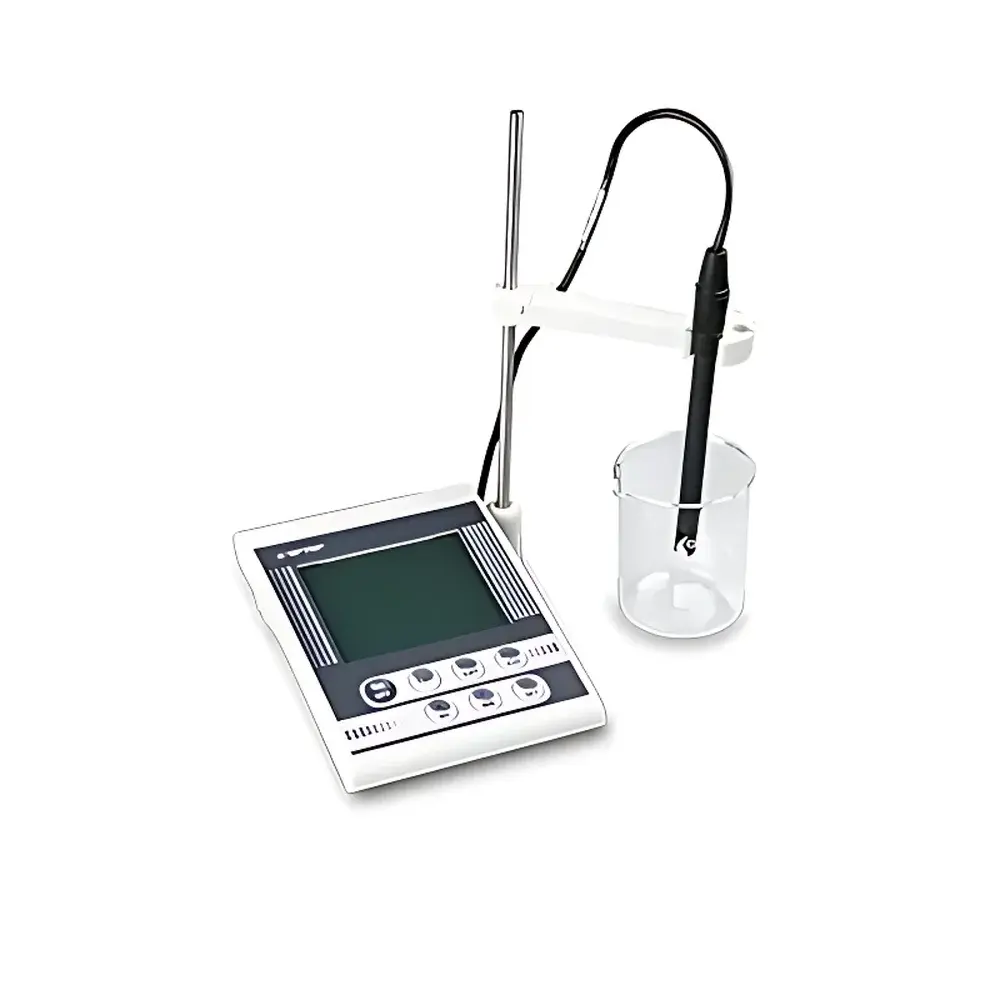
SOPTOP pH6220 Benchtop Standard pH Meter
| Brand | SOPTOP |
|---|---|
| Origin | Shanghai, China |
| Model | pH6220 |
| Instrument Type | Benchtop |
| Parameter Type | Single-Parameter (pH/mV/Temperature) |
| pH Range | -2.00 to 16.00 pH |
| mV Range | -2000 to +2000 mV |
| Temperature Range | -5.0 to 120.0 °C |
| Temperature Compensation | Automatic or Manual |
| pH Resolution | 0.01 pH |
| mV Resolution | 0.1 mV |
| Temperature Resolution | 0.1 °C / 0.1 °F |
| pH Accuracy | ±0.01 pH |
| mV Accuracy | ±0.2 mV |
| Temperature Accuracy | ±0.3 °C / ±0.5 °F |
| Calibration Points | Up to 5-point NIST-traceable calibration (China-specific NIST-type buffers) |
| Data Storage | 100 measurement records |
| Auto-Power-Off | Configurable (default: 10 min inactivity) |
| Display | 5-inch LED, 120° viewing angle |
| Power | USB-powered base with integrated rechargeable 3.7 V Li-ion battery compartment (battery not included) |
| Interface | USB communication port |
| Software | Included data acquisition software (CD-based) |
Overview
The SOPTOP pH6220 Benchtop Standard pH Meter is a precision electrochemical instrument engineered for routine pH, mV, and temperature measurements in quality control laboratories, educational institutions, and industrial process support environments. It operates on the fundamental principle of potentiometric measurement: detecting the potential difference between a pH-sensitive glass electrode and a stable reference electrode immersed in an aqueous sample. This voltage—generated in accordance with the Nernst equation—is converted into a pH value using calibrated slope and offset parameters. Designed for stability and repeatability under standard laboratory conditions, the pH6220 complies with core metrological requirements for single-parameter benchtop meters as defined in ISO 7027-1 (for photometric comparators, contextually referenced for validation frameworks) and aligns with general practices outlined in ASTM E70 (Standard Test Method for pH of Aqueous Solutions with the Glass Electrode). Its architecture supports traceable calibration against NIST-traceable buffer standards compliant with Chinese national metrological specifications (JJG 119–2018), ensuring consistency across regional regulatory expectations.
Key Features
- High-resolution 5-inch LED display with 120° wide-angle viewing, enabling clear readability from multiple operator positions in shared lab spaces.
- True dual-mode temperature compensation—both automatic (via integrated Pt1000 sensor) and manual entry—ensuring accurate pH readings across non-ambient sample conditions (-5.0 to 120.0 °C).
- Five-point calibration capability using NIST-type buffer solutions certified to China’s JJG 119–2018 standard, with real-time display of electrode slope (%), offset (mV), and diagnostic status.
- Dual power architecture: USB-powered operation with optional integration of a user-supplied 3.7 V rechargeable Li-ion battery housed in the base unit—enabling uninterrupted measurements during brief power interruptions or mobile deployment within lab zones.
- Configurable operational settings including adjustable auto-off delay (default 10 minutes), audible keypress feedback (Beep), backlight intensity toggle, and readout lock function for stable endpoint recording.
- Built-in electrode health diagnostics provide immediate visual indication of membrane integrity and junction functionality—reducing downtime caused by undetected electrode degradation.
Sample Compatibility & Compliance
The pH6220 is validated for use with standard combination pH electrodes (BNC connector, Ag/AgCl reference system) suitable for aqueous, mildly buffered, and low-conductivity samples. It is not designed for non-aqueous solvents, highly viscous suspensions, or aggressive HF-containing media. All calibration and measurement procedures adhere to GLP-aligned documentation practices. While the instrument itself does not carry FDA 21 CFR Part 11 certification, its data export functionality (via USB and bundled software) supports audit-ready recordkeeping when deployed within internally validated workflows meeting ISO/IEC 17025 or GMP Annex 11 requirements. The use of NIST-traceable buffers—specifically those conforming to China’s national standard JJG 119–2018—ensures metrological continuity across domestic and multinational laboratory networks operating under harmonized calibration hierarchies.
Software & Data Management
The included Windows-compatible data acquisition software enables direct real-time logging of pH, mV, and temperature values via USB interface. Each recorded entry captures timestamp, electrode ID (manually entered), calibration history snapshot, and environmental metadata. Export formats include CSV and XLSX for downstream statistical analysis in tools such as Minitab or JMP. The software supports configurable sampling intervals (1 s to 600 s), alarm thresholds for out-of-specification results, and batch-level annotation—facilitating compliance with internal QA protocols. No cloud synchronization or remote access capabilities are embedded; all data remains resident on the local host PC, preserving data sovereignty and simplifying IT security governance.
Applications
- Routine QC testing of purified water, buffer solutions, and pharmaceutical excipients per USP and EP 2.2.3 guidelines.
- Educational demonstrations of acid-base equilibria, titration endpoints, and electrode response kinetics in undergraduate chemistry labs.
- Monitoring of fermentation broth pH stability in bioprocessing pilot-scale reactors.
- Environmental water analysis—including surface water, wastewater effluent, and soil leachates—per EPA Method 150.1 and GB/T 6920–1986 equivalents.
- Food & beverage production line verification of rinse water, marinade brines, and dairy product acidity profiles.
FAQ
What calibration standards are supported?
The pH6220 accepts NIST-type buffer solutions compliant with China’s JJG 119–2018 metrological verification regulation—typically pH 4.01, 6.86, 7.00, 9.18, and 10.01 at 25 °C.
Can the instrument store calibration data across power cycles?
Yes—calibration coefficients (slope, offset, temperature) are retained in non-volatile memory and persist after shutdown or battery removal.
Is the USB interface compatible with modern Windows OS versions?
The included software supports Windows 10 and Windows 11 (64-bit); driver installation is plug-and-play via Windows Update infrastructure.
Does the meter support GLP-compliant audit trails?
While the device does not generate electronic signatures or time-stamped operator logs internally, the companion software exports fully timestamped datasets that may be incorporated into externally managed GLP audit trails.
What electrode types are recommended for optimal performance?
SOPTOP-certified combination pH electrodes with double-junction reference systems and gel-filled electrolytes are recommended for long-term stability in routine lab applications.




