
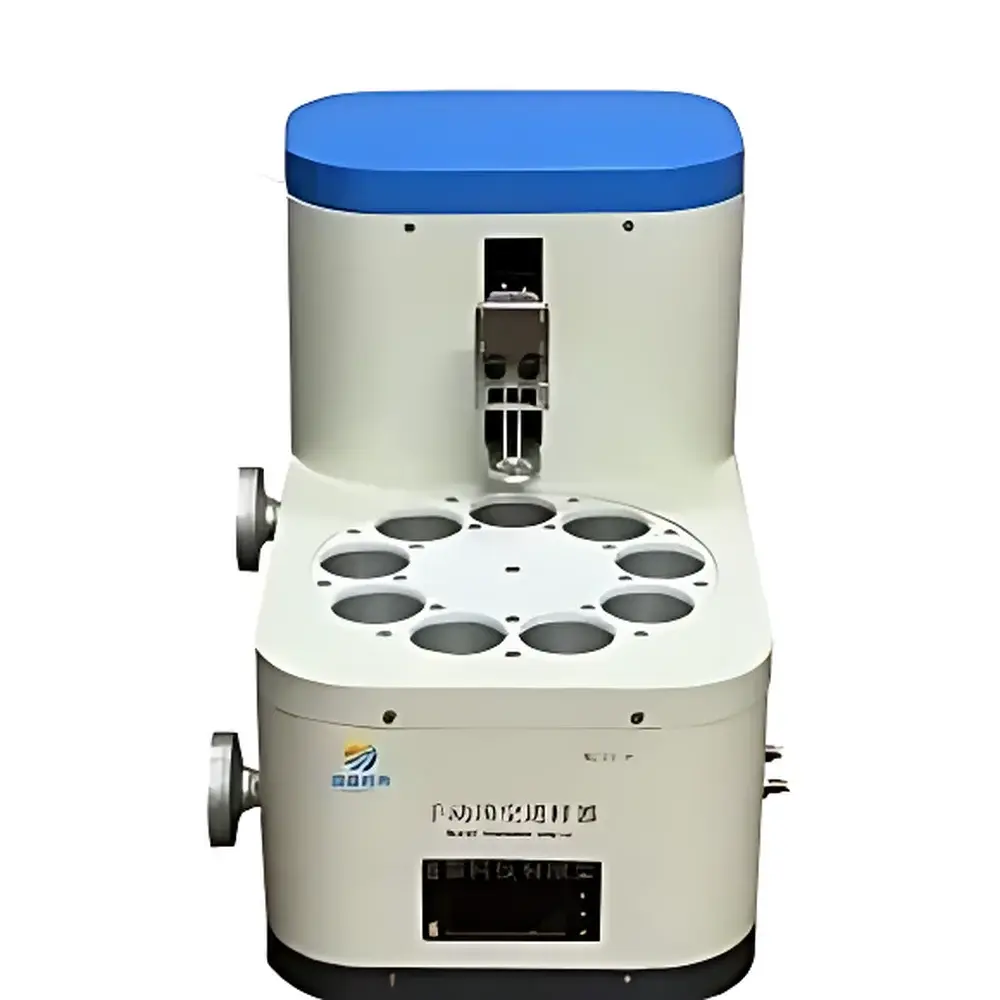
ENSOUL MHSS-9 Manual Headspace Sampler for PEN-Series Electronic Nose Systems
| Brand | ENSOUL |
|---|---|
| Model | MHSS-9 |
| Sample Positions | 9 |
| Heating Temperature Range | Ambient to 100 °C |
| Temperature Accuracy | ±0.1 °C |
| Power Supply | AC 220 V |
| Power Consumption | 650 W |
| Compatibility | PEN-series electronic nose instruments |
| Origin | Beijing, China |
Overview
The ENSOUL MHSS-9 Manual Headspace Sampler is a precision-engineered thermal desorption interface designed specifically for integration with PEN-series electronic nose systems. It operates on the principle of static headspace sampling: solid or liquid samples are sealed in standardized vials, heated under controlled conditions to promote volatilization of odor-active compounds, and the equilibrium vapor phase above the sample (the “headspace”) is manually introduced into the electronic nose sensor array via syringe-driven gas transfer. This methodology enables reproducible, matrix-minimized analysis of volatile organic compound (VOC) profiles without direct contact between the sample matrix and the sensor chamber—critical for preserving sensor longevity and measurement stability. The MHSS-9 is not a standalone analytical instrument but a regulated sample introduction module, fulfilling a defined role within sensory intelligent analysis workflows where headspace composition reflects intrinsic odor quality, freshness, spoilage, or authenticity.
Key Features
- 9-position sample carousel enabling sequential manual analysis of multiple specimens without reconfiguration
- Precise digital temperature control from ambient to 100 °C with ±0.1 °C accuracy, ensuring consistent thermal equilibration across replicates
- Stainless-steel heating block and insulated chamber design for uniform thermal distribution and minimal gradient-induced variability
- Dedicated gas outlet port with standard 1/8″ compression fitting, compatible with PEN-series inlet tubing and pneumatic interfaces
- Low-power, energy-efficient operation (650 W nominal) optimized for laboratory benchtop deployment and long-duration thermal conditioning
- Compact footprint (approx. 280 × 220 × 300 mm) and lightweight construction (≤8 kg), facilitating integration into multi-instrument sensory labs
Sample Compatibility & Compliance
The MHSS-9 accommodates standard 10–20 mL crimp-top or screw-cap headspace vials (e.g., 20 mL amber glass vials with PTFE/silicone septa), supporting both solid (e.g., food matrices, herbs, polymers) and liquid (e.g., beverages, oils, solvents) samples. Its operation aligns with widely adopted headspace sampling protocols referenced in ISO 17299-3:2015 (sensory analysis — methodology for measuring odor intensity) and ASTM E2454-21 (standard guide for electronic nose evaluation). While the MHSS-9 itself does not carry CE, UL, or FDA certification, its mechanical and thermal architecture conforms to IEC 61010-1 safety requirements for laboratory electrical equipment. When deployed in GLP-compliant environments, users are advised to document thermal calibration records, vial sealing integrity checks, and sampling sequence logs to support audit readiness.
Software & Data Management
As a hardware interface—not a data-acquisition device—the MHSS-9 requires no embedded firmware or driver software. All operational parameters (temperature setpoint, equilibration time, vial position selection) are configured manually via front-panel controls. Data acquisition, pattern recognition, and multivariate statistical analysis (PCA, LDA, SIMCA) are performed exclusively by the connected PEN-series electronic nose system and its native software suite (e.g., PEN Software v4.x). The MHSS-9 supports full traceability when used with PEN instruments compliant with FDA 21 CFR Part 11: user-defined sampling sequences, timestamps, and temperature logs can be exported as CSV or XML and cross-referenced with sensor response datasets for complete analytical provenance.
Applications
- Food & beverage quality control: detection of off-odors in dairy, meat, coffee, and fermented products
- Pharmaceutical excipient screening: monitoring VOC emissions from tablet coatings or packaging materials
- Environmental odor source identification: characterization of landfill leachate, wastewater treatment emissions, or compost volatiles
- Material science: assessment of outgassing profiles from adhesives, plastics, and printed circuit board substrates
- Academic research in chemosensory biology: correlation of headspace VOC patterns with microbial activity or enzymatic degradation kinetics
FAQ
Is the MHSS-9 compatible with non-PEN electronic nose platforms?
The MHSS-9 is mechanically and pneumatically engineered for direct coupling with PEN-series instruments. Interfacing with third-party e-noses requires verification of inlet pressure tolerance, flow rate compatibility, and connector specifications; ENSOUL does not guarantee interoperability beyond PEN systems.
What is the recommended equilibration time for optimal VOC recovery?
Equilibration time depends on sample matrix, vial volume, and target analyte volatility. Typical ranges are 10–30 minutes at 60–80 °C; method development should follow ISO 17299-3 guidance and include blank vial controls.
Does the MHSS-9 include temperature calibration documentation?
No factory calibration certificate is supplied. Users must perform initial and periodic verification using a NIST-traceable PT100 probe inserted into a representative vial well.
Can the MHSS-9 be used for quantitative analysis?
It supports semi-quantitative profiling when paired with internal standards and calibrated PEN sensor responses. Absolute quantification requires GC-MS validation and external calibration curves.
Is there an automated version of this sampler available?
ENSOUL offers the MHSA-12 automated headspace sampler for high-throughput labs; the MHSS-9 remains purpose-built for method development, teaching labs, and low-volume routine analysis where manual control enhances experimental flexibility.




