
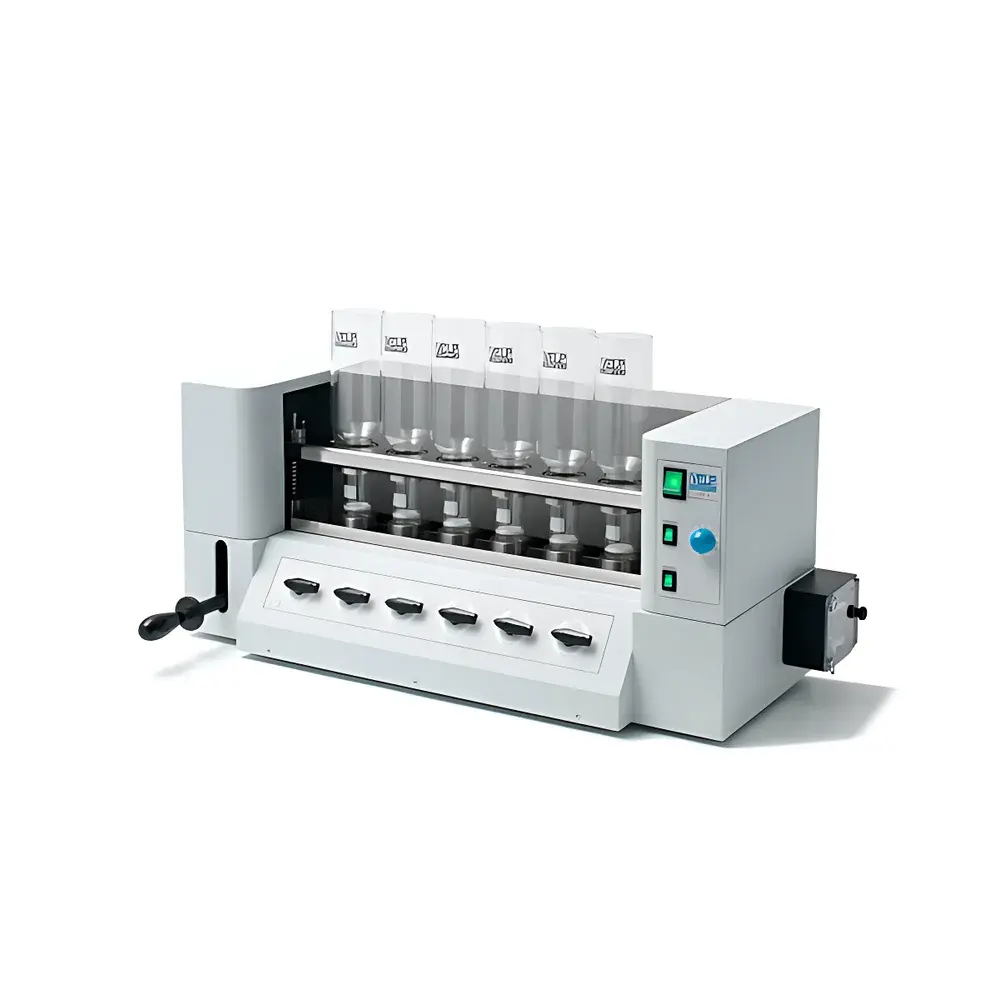
VELP GDE-CFS6 Dietary Fiber Analyzer
| Brand | VELP |
|---|---|
| Origin | Italy |
| Model | GDE-CFS6 |
| Temperature Range | Ambient to 100 °C |
| Temperature Control Accuracy | ±0.1 °C |
| Sample Mass Range | 0.5–3 g |
| Relative Error | ≤1% |
| Fiber Quantification Range | 0.1–99% |
| Batch Capacity | 6 samples |
| Housing | Epoxy-coated steel for chemical and mechanical resistance |
Overview
The VELP GDE-CFS6 Dietary Fiber Analyzer is a fully integrated, AOAC- and AACC-compliant instrument engineered for precise, reproducible determination of total, soluble, and insoluble dietary fiber in food and feed matrices. It implements the enzymatic-gravimetric method (AOAC 991.43, AOAC 2009.01, AACC 32–40) — a physiologically relevant approach that simulates human gastrointestinal digestion using standardized enzyme cocktails (pancreatin, amyloglucosidase, protease), followed by ethanol precipitation and gravimetric quantification. Unlike rapid spectrophotometric or chromatographic alternatives, the GDE-CFS6 delivers reference-grade results traceable to official regulatory methods required for nutritional labeling (EU Regulation No. 1169/2011, FDA 21 CFR §101.9), clinical nutrition studies, and product development in functional food R&D.
Key Features
- Simultaneous 6-position sample processing with independent reaction vessel control — enables parallel digestion, filtration, and washing without cross-contamination.
- Integrated high-efficiency peristaltic pump and adjustable vacuum filtration system — ensures consistent filtrate removal across all vessels; vacuum level digitally tunable from 0.2 to 0.8 bar for optimized particulate retention.
- Gas-assisted backflush capability — nitrogen or compressed air pulses accelerate residue washing and minimize filter clogging during insoluble fiber recovery.
- Dual-function enzymatic digestion module: precision water bath (ambient to 100 °C, ±0.1 °C stability) coupled with six-position magnetic stirrer — each position supports standard 600 mL borosilicate beakers; stirring speed adjustable from 0 to 500 rpm for uniform enzyme-substrate interaction.
- Programmable timer with audible and visual end-of-cycle alerts — supports multi-step protocols including incubation (30–180 min), pH adjustment, enzymatic hydrolysis, and ethanol precipitation phases.
- Chemically inert epoxy-coated steel chassis — resistant to repeated exposure to acidic, alkaline, and organic solvents (e.g., ethanol, acetone, 0.05 M HCl) used in fiber isolation workflows.
Sample Compatibility & Compliance
The GDE-CFS6 accommodates heterogeneous solid, semi-solid, and powdered food matrices — including cereals, legumes, fruits, bakery products, infant formulas, and dietary supplements. Its design conforms to Good Laboratory Practice (GLP) requirements for analytical traceability: all temperature setpoints, incubation durations, and vacuum levels are manually logged or externally recorded via analog outputs. The methodology meets ISO 13905:2014 (determination of dietary fiber in foods), AOAC Official Methods of Analysis™ (OMA) 991.43 (total dietary fiber) and 2009.01 (soluble/insoluble fractionation), as well as USP <2040> guidelines for fiber assay validation. Instrument performance is verifiable using NIST-traceable reference materials (e.g., wheat bran, soy flour CRM).
Software & Data Management
While the GDE-CFS6 operates as a stand-alone hardware platform without embedded software, it is fully compatible with laboratory information management systems (LIMS) and electronic lab notebooks (ELN) through its analog voltage outputs (0–10 V) for temperature and timer status. All operational parameters are manually configured and documented per GLP/GMP audit requirements. Users maintain full control over protocol documentation, calibration records, and raw gravimetric data entry — supporting compliance with FDA 21 CFR Part 11 when paired with validated electronic recordkeeping practices. Optional external data loggers (e.g., Omega OM-DAQPRO-5300) may be interfaced for continuous temperature and time stamping.
Applications
- Nutritional labeling compliance testing for packaged foods sold in EU, US, Canada, and ASEAN markets.
- Quality control of high-fiber ingredients (e.g., inulin, resistant starch, psyllium husk) during manufacturing.
- Stability studies assessing fiber degradation under thermal processing, extrusion, or storage conditions.
- Method validation and inter-laboratory comparison exercises in accredited food testing laboratories (ISO/IEC 17025).
- Research on fiber bioaccessibility and fermentability using sequential in vitro digestion models (INFOGEST protocol extensions).
FAQ
Does the GDE-CFS6 include built-in data logging or touchscreen interface?
No — it is a dedicated benchtop instrument designed for manual operation and procedural transparency. Data recording follows traditional GLP-compliant lab notebook practices.
Can the system be used for resistant starch analysis?
Yes — when adapted with the AOAC 2002.02 or AACC 32–40 protocols, the digestion and filtration modules support resistant starch quantification alongside total dietary fiber.
What maintenance is required for long-term reliability?
Routine cleaning of digestion beakers, filtration funnels, and tubing; periodic verification of temperature sensor calibration using a certified RTD probe; annual inspection of peristaltic pump rollers and vacuum seals.
Is the instrument suitable for routine QC in high-throughput food testing labs?
Yes — its 6-sample batch capacity, repeatable vacuum filtration, and stable thermal control enable consistent throughput of 12–18 samples per 8-hour shift with minimal operator intervention.
Are consumables such as filters and enzymes supplied by VELP?
VELP provides optional accessory kits including glass microfiber filters (Whatman GF/A equivalent), calibrated thermometers, and validated enzyme reagent sets — all traceable to certificate of analysis (CoA).





