
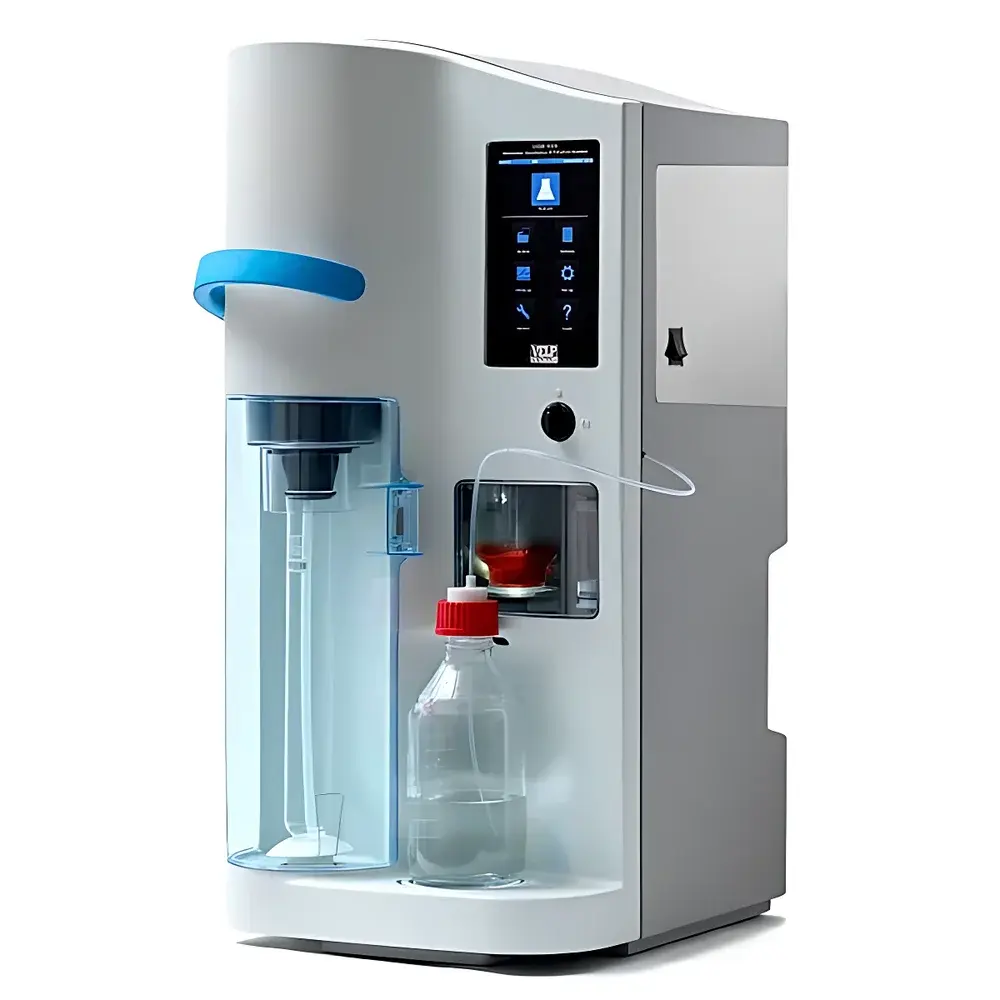
VELP UDK159 Automated Kjeldahl Nitrogen Determinator
| Brand | VELP |
|---|---|
| Origin | Italy |
| Model | UDK159 |
| Instrument Type | Automated Kjeldahl Nitrogen Determinator |
| Nitrogen Determination Range | 0.1–200 mg N |
| Distillation Time | 1–99 min (typical 3.5 min per sample) |
| Repeatability | ≤1% RSD |
| Sample Nitrogen Mass Capacity | 0.1–200 mg N |
| Nitrogen Recovery Rate | ≥99.5% |
| Power Consumption | 2200 W |
| Dimensions (W×D×H) | 385 × 780 × 416 mm |
| Weight | 31 kg |
| Display | 6-inch full-color capacitive touchscreen |
| Operating System | Embedded Windows-based UI |
| Language Options | English, Chinese, Italian, French, Russian |
| Data Storage Capacity | >100,000 test records |
| Connectivity | Ethernet, 2× USB, RS232 |
| Steam Generator | Atmospheric-pressure stainless-steel steam generator with optimized thermal conductivity |
| Condenser | High-efficiency titanium condenser |
| Safety Sensors | Digestion tube position, safety door interlock, drip tray level, cooling water overflow, reagent tank level, waste tank level |
| Protective Features | Splash guard (polymer-based, replacing glass), corrosion-resistant housing, color-coded digestion tubes |
Overview
The VELP UDK159 Automated Kjeldahl Nitrogen Determinator is a fully integrated, CE-compliant instrument engineered for precise, high-throughput total nitrogen quantification in accordance with ISO 8968, AOAC 984.13, and ASTM D1122 standards. Based on the classical Kjeldahl method—comprising digestion, distillation, and titration—the UDK159 automates all critical steps following sample mineralization in concentrated sulfuric acid with catalysts. Its core architecture employs VELP’s proprietary TEMS (Thermal Efficiency Management System), which optimizes steam generation, condensation efficiency, and thermal recovery to reduce energy consumption and laboratory footprint without compromising analytical rigor. Unlike conventional systems relying on pressurized steam or external cooling units, the UDK159 integrates an atmospheric-pressure stainless-steel steam generator with uniform heat distribution and a passive titanium condenser that maintains distillate temperature below 35 °C—ensuring quantitative ammonia transfer while minimizing cooling water demand by up to 40% compared to legacy models.
Key Features
- 6-inch full-color capacitive touchscreen interface with embedded Windows-based OS, supporting real-time parameter adjustment and multi-language operation (English, Chinese, Italian, French, Russian)
- Atmospheric-pressure steam generator fabricated from corrosion-resistant stainless steel, designed for maintenance-free continuous operation and stable steam output across variable load conditions
- Titanium condenser with enhanced thermal conductivity and low thermal mass, enabling rapid equilibration and consistent distillate temperature control (±0.5 °C)
- Comprehensive sensor network monitoring digestion tube positioning, safety door status, drip tray fill level, cooling water overflow, reagent volume, and waste tank capacity—each visualized in real time with configurable alerts
- Polymer-based splash guard replacing fragile glass components, improving operator safety and reducing consumable replacement frequency
- Color-coded digestion tube recognition system to prevent misloading and support GLP-compliant sample traceability
- Modular reagent delivery system with independent pumps for acid, base, and diluent—programmable for sequential or simultaneous addition with volumetric precision ±0.5%
Sample Compatibility & Compliance
The UDK159 accommodates standard 100–400 mL digestion tubes (including Kjeldahl, macro, and micro formats) and supports solid, liquid, and semi-solid matrices such as cereals, dairy products, meat, feedstuffs, soil extracts, and wastewater digests. All fluid-handling pathways are constructed from PTFE, borosilicate glass, and 316 stainless steel to resist aggressive reagents (e.g., H₂SO₄, NaOH, H₃BO₃). The system meets IEC 61010-1 safety requirements and complies with EU Directive 2014/30/EU (EMC) and 2014/35/EU (LVD). Data integrity protocols align with FDA 21 CFR Part 11 expectations—including electronic signature capability, audit trail logging (user actions, method changes, result modifications), and password-protected access levels (operator, supervisor, administrator).
Software & Data Management
Internal storage retains over 100,000 complete analysis records—including raw titration curves, steam pressure logs, condenser temperature profiles, and reagent consumption metrics—with automatic timestamping and user ID tagging. Export options include CSV, PDF, and XML via Ethernet or USB; seamless integration with LIMS is supported through TCP/IP-based API and HL7-compliant messaging. Method templates can be created, duplicated, and version-controlled, with built-in validation checks for parameter boundaries (e.g., minimum acid volume, maximum distillation time). Software updates are delivered via secure HTTPS download with SHA-256 checksum verification.
Applications
The UDK159 serves quality control laboratories in food & beverage (protein content per AOAC 992.15), agricultural research (soil N availability, fertilizer efficacy), environmental testing (wastewater TN, sludge digestibility), and pharmaceutical excipient characterization (nitrogen impurity profiling). Its ≤1% repeatability and ≥99.5% recovery rate enable compliance with ISO/IEC 17025 method validation requirements. Routine use includes dairy protein certification (casein, whey), cereal gluten quantification, animal feed formulation, and regulatory submissions under EFSA, USDA, and Codex Alimentarius frameworks.
FAQ
What digestion systems are compatible with the UDK159?
The UDK159 interfaces with VELP’s DUO 6, DUO 12, and SmartDigest series digesters via RS232 handshake, enabling automated start-of-distillation triggers upon digestion completion.
Does the UDK159 support back-titration protocols?
Yes—pre-programmed methods include direct titration with standardized HCl and back-titration using standardized NaOH after boric acid trapping, with endpoint detection via pH electrode or colorimetric sensor.
Is remote monitoring possible?
Via optional VELP Connect software and Ethernet connection, users can view live status, receive email/SMS alerts for errors or completion, and initiate diagnostic routines from any authorized workstation.
How is calibration verified?
Built-in calibration verification uses certified ammonium sulfate standards (e.g., 10 mg N, 50 mg N) traceable to NIST SRM 2381b; results are auto-compared against stored reference values and flagged if deviation exceeds ±0.8%.
What maintenance intervals are recommended?
Daily: Visual inspection of tubing, waste level, and reagent volumes. Quarterly: Steam generator descaling with citric acid solution; condenser cleaning with 10% nitric acid. Annually: Full sensor calibration and pump actuator verification by certified service engineer.




