
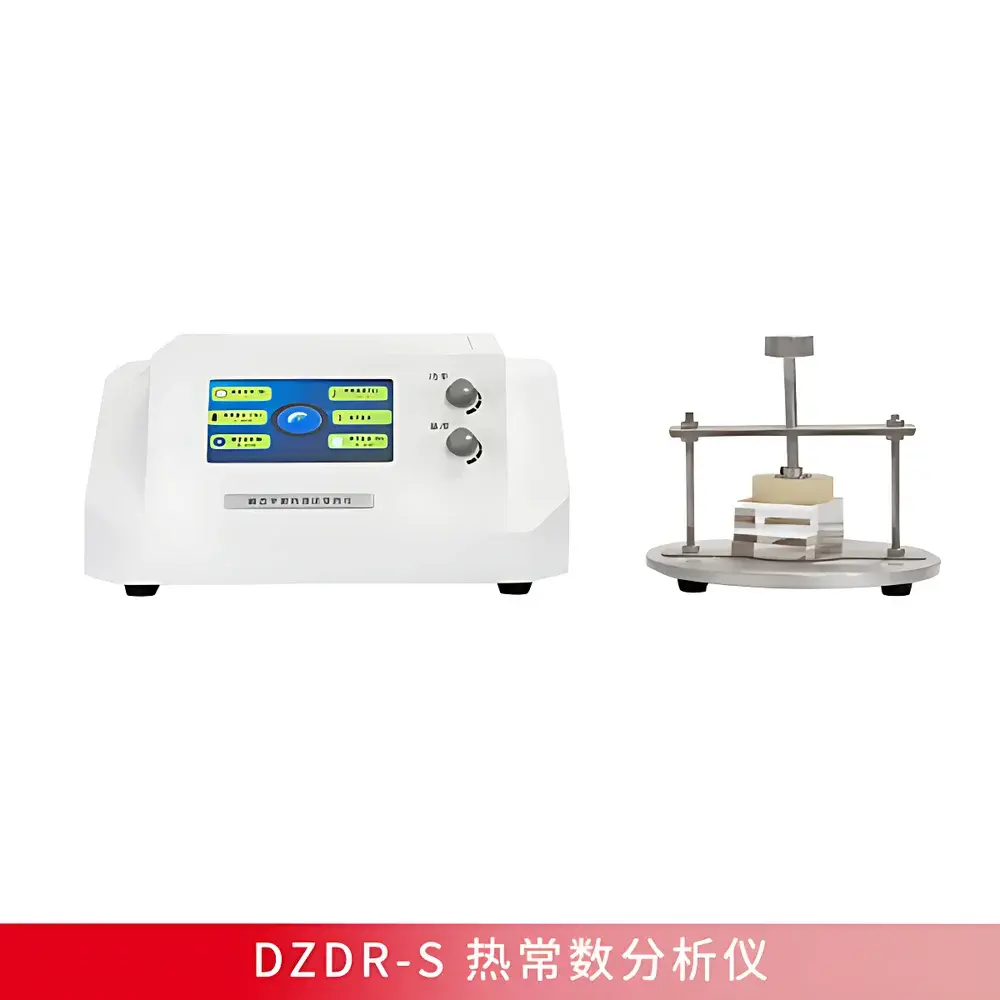
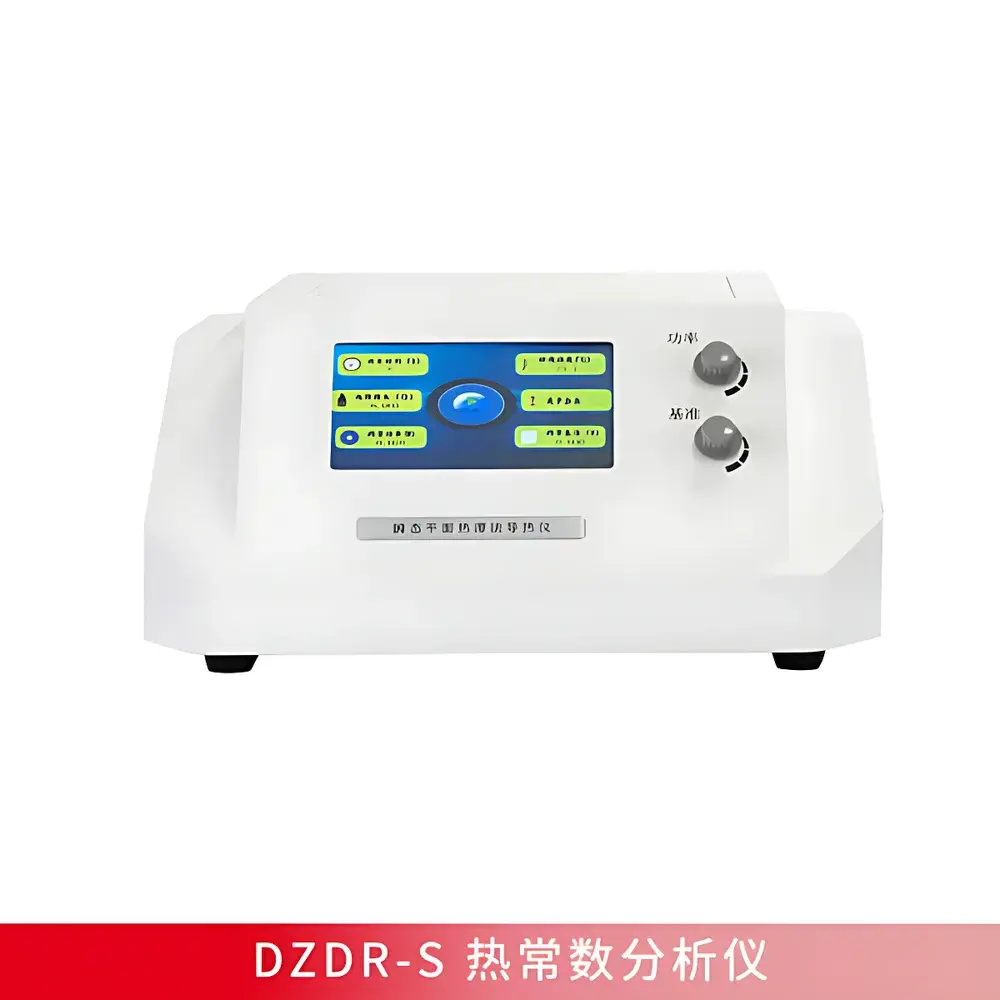
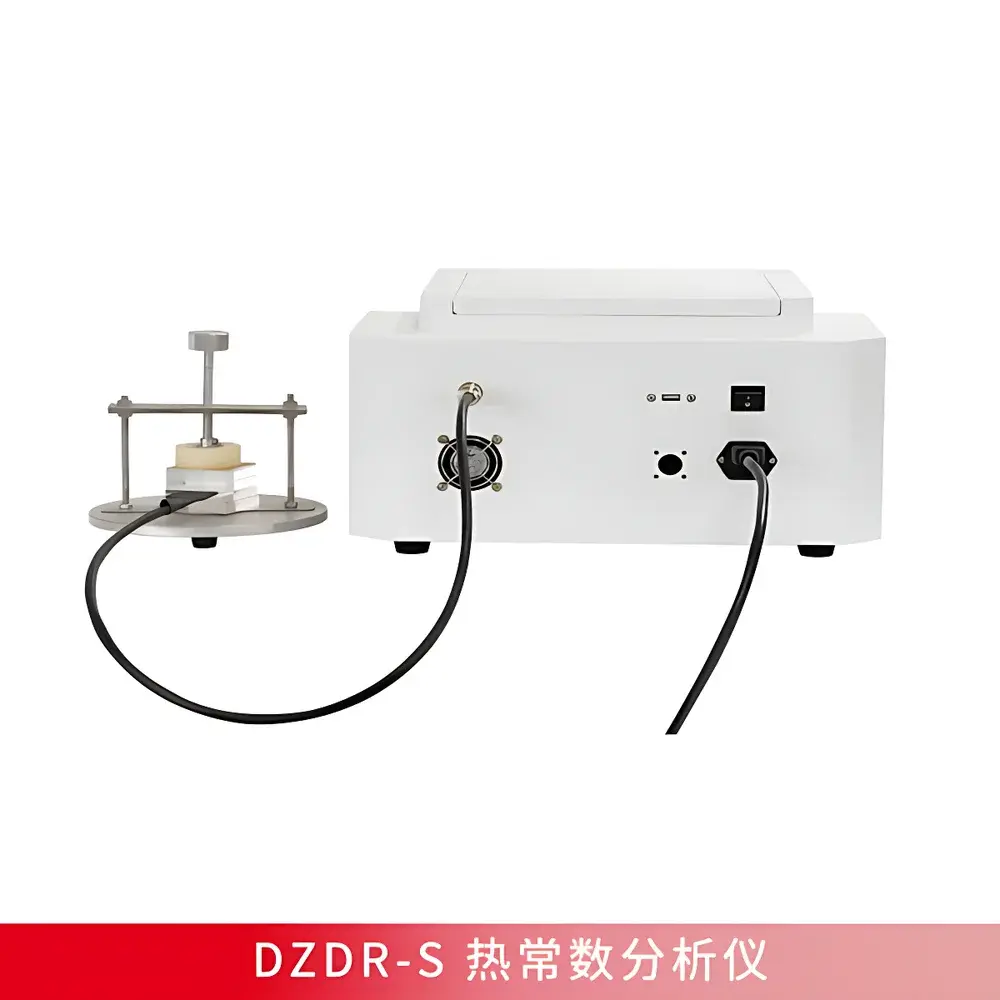
Nanjing Dazhan DZDR-S Transient Plane Source (TPS) Thermal Conductivity Analyzer
| Brand | Nanjing Dazhan |
|---|---|
| Model | DZDR-S |
| Measurement Principle | Transient Plane Source (TPS) Method |
| Thermal Conductivity Range | 0.0001–300 W/(m·K) |
| Accuracy | ±3% |
| Repeatability | ≤3% |
| Sample Types | Solids, Powders, Liquids, Gels, Metals, Coatings, Films, Insulation Materials |
| Test Duration | 5–160 s (user-configurable) |
| Operating Temperature | Ambient to 130 °C |
| Probe Options | 7.5 mm, 15 mm, 50 mm diameter |
| Sample Dimensions (min.) | 15×15×3.75 mm (for 7.5 mm probe), 30×30×7.5 mm (for 15 mm probe), 50×50×7.5 mm (for 50 mm probe) |
| Power Supply | AC 220 V, <500 W |
| Data Acquisition | High-resolution imported ADC chip |
| Control System | ARM-based embedded microprocessor |
| Interface | Color LCD touchscreen |
| Compliance | Designed for ASTM D7984, ISO 22007-2, and GLP-compliant thermal property characterization workflows |
Overview
The Nanjing Dazhan DZDR-S Transient Plane Source (TPS) Thermal Conductivity Analyzer is a precision instrument engineered for the direct, non-destructive measurement of thermal conductivity, thermal diffusivity, and volumetric heat capacity across a broad spectrum of materials. It implements the internationally standardized transient plane source method—defined in ISO 22007-2 and ASTM D7984—as a contact-based, time-domain technique wherein a thin, double-spiral sensor acts simultaneously as both heater and temperature sensor. Upon application of a constant current pulse, the sensor generates a controlled thermal transient; the resulting temperature rise over time is recorded with high temporal resolution and analyzed using analytical solutions to Fourier’s heat conduction equation under the TPS boundary condition. This approach eliminates reliance on steady-state assumptions or interfacial contact resistance correction models, enabling reliable quantification of thermal transport properties without calibration against reference standards for most homogeneous or isotropic samples.
Key Features
- Triple-probe modular configuration (7.5 mm, 15 mm, and 50 mm diameters) enables optimized testing across diverse sample geometries—from small laboratory coupons to bulk insulation panels.
- ARM-based embedded control architecture ensures deterministic real-time data acquisition, low-latency signal processing, and stable thermal pulse generation with sub-millisecond timing resolution.
- High-fidelity analog-to-digital conversion using industrial-grade imported ADC chips delivers ≥18-bit effective resolution, minimizing quantization error in low-signal regimes typical of low-conductivity materials (e.g., aerogels, foams).
- Non-invasive, single-sided measurement protocol preserves sample integrity—ideal for reusable specimens, precious research materials, or quality control in production environments.
- Minimal sample preparation: flatness tolerance relaxed to ±0.1 mm over probe-contact area; no polishing, coating, or vacuum sealing required for routine measurements.
- Integrated thermal guard design minimizes lateral heat loss during short-duration tests (5–160 s), improving accuracy for low-diffusivity materials.
- Touchscreen-driven user interface supports multilingual operation, test parameter scripting, and on-device result visualization—including real-time ΔT vs. √t plots and automatic curve-fitting diagnostics.
Sample Compatibility & Compliance
The DZDR-S accommodates solids (metals, ceramics, polymers), powders (with optional custom containment vessel), liquids, gels, pastes, thin films (<100 µm), and heterogeneous composites—provided thermal homogeneity exists at the scale of the active probe area. Each probe size corresponds to defined minimum sample dimensions to ensure one-dimensional heat flow assumptions hold within ±1% error margin. The system is designed to support regulatory-compliant workflows: audit-trail-enabled data logging meets FDA 21 CFR Part 11 requirements when paired with validated PC software; measurement uncertainty budgets align with ISO/IEC 17025 guidelines; and traceable calibration procedures follow NIST-traceable reference material protocols (e.g., SRM 1470a). All firmware and analysis algorithms are version-controlled and documented per GLP documentation standards.
Software & Data Management
The analyzer interfaces via USB or Ethernet with proprietary Windows-based ThermalLab Suite v4.x, which provides full I/O control, automated report generation (PDF/CSV/XLSX), statistical process monitoring (SPC), and batch-mode analysis for multi-sample studies. Raw voltage-time datasets are stored with full metadata (timestamp, ambient RH/T, probe ID, operator ID, sample ID). Software includes built-in validation tools: residual analysis of linearized √t fits, confidence interval estimation for k-values, and outlier detection based on Cook’s distance metrics. Exported reports include uncertainty propagation per GUM (JCGM 100:2008), supporting technical audits and peer-reviewed publication requirements.
Applications
- QC/QA of thermal interface materials (TIMs) in electronics packaging, including phase-change pads and conductive greases.
- R&D of battery electrode coatings, solid-state electrolytes, and thermal barrier coatings for aerospace components.
- Characterization of building insulation materials (rock wool, phenolic foam, vacuum insulated panels) per EN 12667.
- Pharmaceutical excipient screening—thermal stability assessment of lyophilized formulations and amorphous dispersions.
- Geotechnical analysis of soil thermal resistivity for underground cable rating calculations (IEC 60287-3-2).
- Academic research in soft matter physics, nanocomposite thermoelectrics, and biomaterial thermal response modeling.
FAQ
What standards does the DZDR-S comply with?
It adheres to ISO 22007-2 (thermal conductivity by TPS), ASTM D7984 (standard guide for TPS instrumentation), and supports implementation of ASTM C177, ISO 8302, and EN 12667 for comparative validation.
Can the system measure anisotropic materials?
Yes—when combined with rotational sample mounting fixtures (optional accessory), directional thermal conductivity can be assessed along principal axes; however, standard configuration assumes isotropy.
Is calibration required before each test?
No routine recalibration is needed; the system uses self-consistent physical modeling. However, annual verification using certified reference materials (e.g., NIST SRM 1470a) is recommended for ISO/IEC 17025 accreditation.
How is contact resistance mitigated in the TPS method?
By embedding the sensor within the sample volume (sandwich configuration) or applying controlled normal force in single-sided mode, interfacial resistance is mathematically decoupled from bulk conduction via the two-parameter fitting algorithm.
Does the instrument support automated temperature ramping?
Not natively—the base model operates at ambient to 130 °C. For dynamic temperature-dependent measurements, integration with external environmental chambers (e.g., Linkam TS1500) is supported via analog I/O and TTL trigger synchronization.



